

84
VIII – Cauchy Theory
on the integration contour, the contribution from the large arcs to the integral
is O(R
1−Re(s) ), hence tends to 0 since Re(s) > 1. For the same reason, the
contribution from the small circular arc is O(r
1−Re(s) ), but it does not follow
that it approaches 0 as r tends to 0; as always, we have to choose between
convergence at infinity and convergence at 0. . .
As R increases indefinitely, the integral along AB approaches the integral
(10) we started with and the integrals over the large circular arcs tend to 0.
In view of the directions of integration,
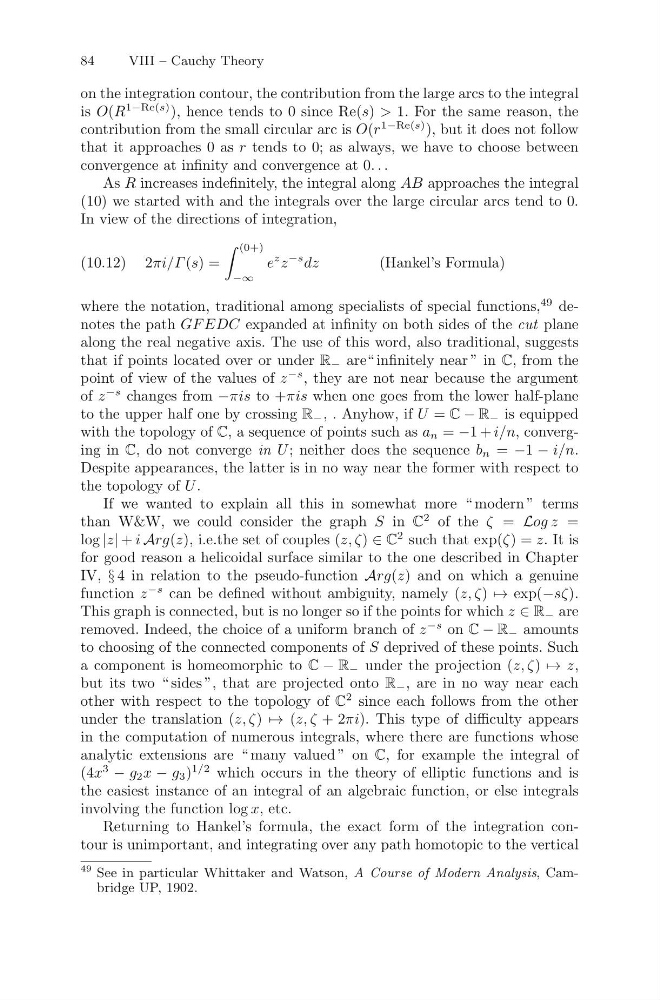
2πi/Γ (s) =
(0+)
−∞
e
z z
−s dz
(Hankel’s Formula)
(10.12)
where the notation, traditional among specialists of special functions,
49 denotes the path GF EDC expanded at infinity on both sides of the cut plane
along the real negative axis. The use of this word, also traditional, suggests
that if points located over or under R − are“ infinitely near ” in C, from the
point of view of the values of z
−s , they are not near because the argument
of z
−s changes from −πis to +πis when one goes from the lower half-plane
to the upper half one by crossing R − , . Anyhow, if U = C − R − is equipped
with the topology of C, a sequence of points such as a n = −1 + i/n, converging in C, do not converge in U ; neither does the sequence b n = −1 − i/n.
Despite appearances, the latter is in no way near the former with respect to
the topology of U .
If we wanted to explain all this in somewhat more “ modern ” terms
than W&W, we could consider the graph S in C
2 of the ζ = Log z =
log |z| + i Arg(z), i.e.the set of couples (z, ζ) ∈ C
2 such that exp(ζ) = z. It is
for good reason a helicoidal surface similar to the one described in Chapter
IV, § 4 in relation to the pseudo-function Arg(z) and on which a genuine
function z
−s can be defined without ambiguity, namely (z, ζ) → exp(−sζ).
This graph is connected, but is no longer so if the points for which z ∈ R − are
removed. Indeed, the choice of a uniform branch of z
−s on C − R − amounts
to choosing of the connected components of S deprived of these points. Such
a component is homeomorphic to C − R − under the projection (z, ζ) → z,
but its two “ sides ”, that are projected onto R − , are in no way near each
other with respect to the topology of C
2 since each follows from the other
under the translation (z, ζ) → (z, ζ + 2πi). This type of difficulty appears
in the computation of numerous integrals, where there are functions whose
analytic extensions are “ many valued ” on C, for example the integral of
(4x
3
− g 2 x − g 3 )
1/2 which occurs in the theory of elliptic functions and is
the easiest instance of an integral of an algebraic function, or else integrals
involving the function log x, etc.
Returning to Hankel’s formula, the exact form of the integration contour is unimportant, and integrating over any path homotopic to the vertical
49 See in particular Whittaker and Watson, A Course of Modern Analysis, Cambridge UP, 1902.
VIII – Cauchy Theory
on the integration contour, the contribution from the large arcs to the integral
is O(R
1−Re(s) ), hence tends to 0 since Re(s) > 1. For the same reason, the
contribution from the small circular arc is O(r
1−Re(s) ), but it does not follow
that it approaches 0 as r tends to 0; as always, we have to choose between
convergence at infinity and convergence at 0. . .
As R increases indefinitely, the integral along AB approaches the integral
(10) we started with and the integrals over the large circular arcs tend to 0.
In view of the directions of integration,
2πi/Γ (s) =
(0+)
−∞
e
z z
−s dz
(Hankel’s Formula)
(10.12)
where the notation, traditional among specialists of special functions,
49 denotes the path GF EDC expanded at infinity on both sides of the cut plane
along the real negative axis. The use of this word, also traditional, suggests
that if points located over or under R − are“ infinitely near ” in C, from the
point of view of the values of z
−s , they are not near because the argument
of z
−s changes from −πis to +πis when one goes from the lower half-plane
to the upper half one by crossing R − , . Anyhow, if U = C − R − is equipped
with the topology of C, a sequence of points such as a n = −1 + i/n, converging in C, do not converge in U ; neither does the sequence b n = −1 − i/n.
Despite appearances, the latter is in no way near the former with respect to
the topology of U .
If we wanted to explain all this in somewhat more “ modern ” terms
than W&W, we could consider the graph S in C
2 of the ζ = Log z =
log |z| + i Arg(z), i.e.the set of couples (z, ζ) ∈ C
2 such that exp(ζ) = z. It is
for good reason a helicoidal surface similar to the one described in Chapter
IV, § 4 in relation to the pseudo-function Arg(z) and on which a genuine
function z
−s can be defined without ambiguity, namely (z, ζ) → exp(−sζ).
This graph is connected, but is no longer so if the points for which z ∈ R − are
removed. Indeed, the choice of a uniform branch of z
−s on C − R − amounts
to choosing of the connected components of S deprived of these points. Such
a component is homeomorphic to C − R − under the projection (z, ζ) → z,
but its two “ sides ”, that are projected onto R − , are in no way near each
other with respect to the topology of C
2 since each follows from the other
under the translation (z, ζ) → (z, ζ + 2πi). This type of difficulty appears
in the computation of numerous integrals, where there are functions whose
analytic extensions are “ many valued ” on C, for example the integral of
(4x
3
− g 2 x − g 3 )
1/2 which occurs in the theory of elliptic functions and is
the easiest instance of an integral of an algebraic function, or else integrals
involving the function log x, etc.
Returning to Hankel’s formula, the exact form of the integration contour is unimportant, and integrating over any path homotopic to the vertical
49 See in particular Whittaker and Watson, A Course of Modern Analysis, Cambridge UP, 1902.