

§ 3. Some Applications of Cauchy’s Method
65
the relevance of introducing such a measure lies in its invariance under
“ multiplicative translations ” x → ax(a = 0) and under x → 1/x :
f (ax)d
∗ x =
f (x)d
∗ x,
f (1/x)d
∗ x =
f (x)d
∗ x .
In other words, d
∗ x plays the same role for the multiplicative group R
∗ as
the Lebesgue measure dx does for the additive group R.
8 – Fourier Transform of a Rational Fraction
(i) Absolutely convergent integrals of rational functions. A seemingly trivial
example, but which illustrates one of the most used techniques in practice,
is the computation of the integral of f (x) = 1/(1 + x
2 ) over R; the given
function having arctg x as primitive, the result obviously equals π.
−R
R
i
Fig. 8.9.
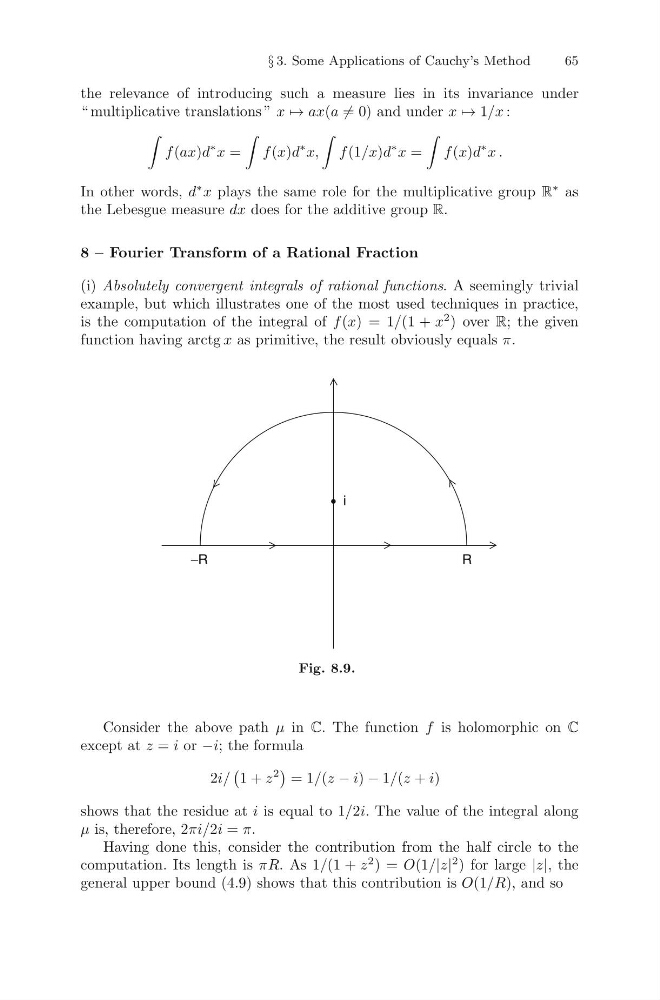
Consider the above path μ in C. The function f is holomorphic on C
except at z = i or −i; the formula
2i/
1 + z
2
= 1/(z − i) − 1/(z + i)
shows that the residue at i is equal to 1/2i. The value of the integral along
μ is, therefore, 2πi/2i = π.
Having done this, consider the contribution from the half circle to the
computation. Its length is πR. As 1/(1 + z
2 ) = O(1/|z|
2 ) for large |z|, the
general upper bound (4.9) shows that this contribution is O(1/R), and so
65
the relevance of introducing such a measure lies in its invariance under
“ multiplicative translations ” x → ax(a = 0) and under x → 1/x :
f (ax)d
∗ x =
f (x)d
∗ x,
f (1/x)d
∗ x =
f (x)d
∗ x .
In other words, d
∗ x plays the same role for the multiplicative group R
∗ as
the Lebesgue measure dx does for the additive group R.
8 – Fourier Transform of a Rational Fraction
(i) Absolutely convergent integrals of rational functions. A seemingly trivial
example, but which illustrates one of the most used techniques in practice,
is the computation of the integral of f (x) = 1/(1 + x
2 ) over R; the given
function having arctg x as primitive, the result obviously equals π.
−R
R
i
Fig. 8.9.
Consider the above path μ in C. The function f is holomorphic on C
except at z = i or −i; the formula
2i/
1 + z
2
= 1/(z − i) − 1/(z + i)
shows that the residue at i is equal to 1/2i. The value of the integral along
μ is, therefore, 2πi/2i = π.
Having done this, consider the contribution from the half circle to the
computation. Its length is πR. As 1/(1 + z
2 ) = O(1/|z|
2 ) for large |z|, the
general upper bound (4.9) shows that this contribution is O(1/R), and so