

64
VIII – Cauchy Theory
and not only large z or near to a given point. The next result often serves as
an example if U = C − R − :
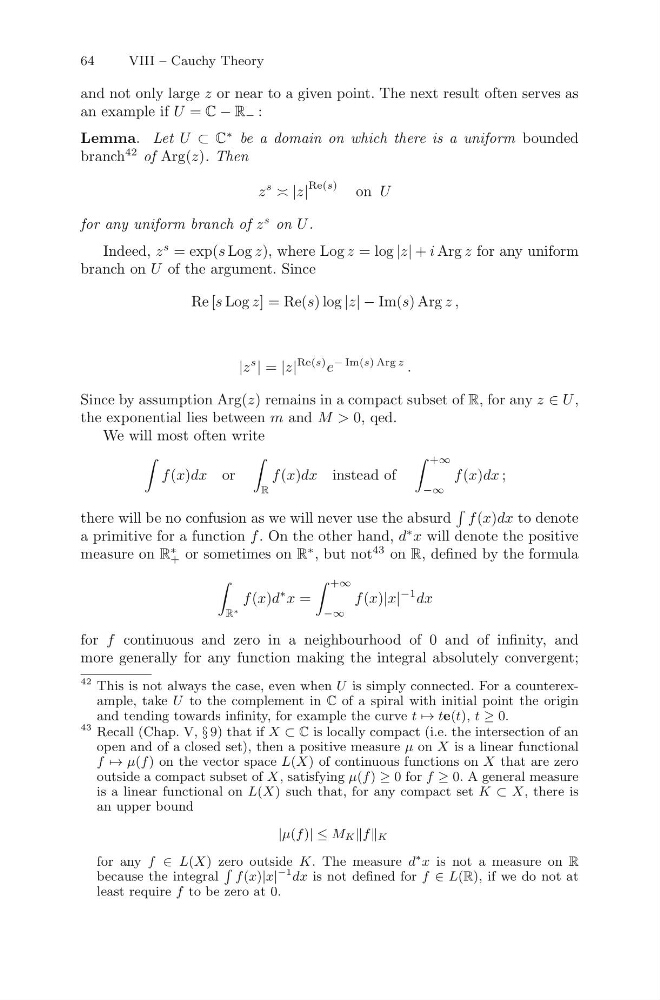
Lemma. Let U ⊂ C
∗ be a domain on which there is a uniform bounded
branch
42 of Arg(z). Then
z
s
|z|
Re(s)
on U
for any uniform branch of z
s on U .
Indeed, z
s = exp(s Log z), where Log z = log |z| + i Arg z for any uniform
branch on U of the argument. Since
Re [s Log z] = Re(s) log |z| − Im(s) Arg z ,
|z
s
| = |z|
Re(s) e
− Im(s) Arg z .
Since by assumption Arg(z) remains in a compact subset of R, for any z ∈ U ,
the exponential lies between m and M > 0, qed.
We will most often write
f (x)dx or
R
f (x)dx instead of
+∞
−∞
f (x)dx ;
there will be no confusion as we will never use the absurd
f (x)dx to denote
a primitive for a function f . On the other hand, d
∗ x will denote the positive
measure on R
∗
+ or sometimes on R
∗ , but not
43 on R, defined by the formula
R ∗
f (x)d
∗ x =
+∞
−∞
f (x)|x|
−1 dx
for f continuous and zero in a neighbourhood of 0 and of infinity, and
more generally for any function making the integral absolutely convergent;
42 This is not always the case, even when U is simply connected. For a counterexample, take U to the complement in C of a spiral with initial point the origin
and tending towards infinity, for example the curve t → te(t), t ≥ 0.
43 Recall (Chap. V, § 9) that if X ⊂ C is locally compact (i.e. the intersection of an
open and of a closed set), then a positive measure μ on X is a linear functional
f → μ(f ) on the vector space L(X) of continuous functions on X that are zero
outside a compact subset of X, satisfying μ(f ) ≥ 0 for f ≥ 0. A general measure
is a linear functional on L(X) such that, for any compact set K ⊂ X, there is
an upper bound
|μ(f )| ≤ MK f K
for any f ∈ L(X) zero outside K. The measure d
∗ x is not a measure on R
because the integral
f (x)|x|
−1 dx is not defined for f ∈ L(R), if we do not at
least require f to be zero at 0.
VIII – Cauchy Theory
and not only large z or near to a given point. The next result often serves as
an example if U = C − R − :
Lemma. Let U ⊂ C
∗ be a domain on which there is a uniform bounded
branch
42 of Arg(z). Then
z
s
|z|
Re(s)
on U
for any uniform branch of z
s on U .
Indeed, z
s = exp(s Log z), where Log z = log |z| + i Arg z for any uniform
branch on U of the argument. Since
Re [s Log z] = Re(s) log |z| − Im(s) Arg z ,
|z
s
| = |z|
Re(s) e
− Im(s) Arg z .
Since by assumption Arg(z) remains in a compact subset of R, for any z ∈ U ,
the exponential lies between m and M > 0, qed.
We will most often write
f (x)dx or
R
f (x)dx instead of
+∞
−∞
f (x)dx ;
there will be no confusion as we will never use the absurd
f (x)dx to denote
a primitive for a function f . On the other hand, d
∗ x will denote the positive
measure on R
∗
+ or sometimes on R
∗ , but not
43 on R, defined by the formula
R ∗
f (x)d
∗ x =
+∞
−∞
f (x)|x|
−1 dx
for f continuous and zero in a neighbourhood of 0 and of infinity, and
more generally for any function making the integral absolutely convergent;
42 This is not always the case, even when U is simply connected. For a counterexample, take U to the complement in C of a spiral with initial point the origin
and tending towards infinity, for example the curve t → te(t), t ≥ 0.
43 Recall (Chap. V, § 9) that if X ⊂ C is locally compact (i.e. the intersection of an
open and of a closed set), then a positive measure μ on X is a linear functional
f → μ(f ) on the vector space L(X) of continuous functions on X that are zero
outside a compact subset of X, satisfying μ(f ) ≥ 0 for f ≥ 0. A general measure
is a linear functional on L(X) such that, for any compact set K ⊂ X, there is
an upper bound
|μ(f )| ≤ MK f K
for any f ∈ L(X) zero outside K. The measure d
∗ x is not a measure on R
because the integral
f (x)|x|
−1 dx is not defined for f ∈ L(R), if we do not at
least require f to be zero at 0.