

§ 1. Integrals of Holomorphic Functions
29
1
1
2
2
μ
μ
G
K
K
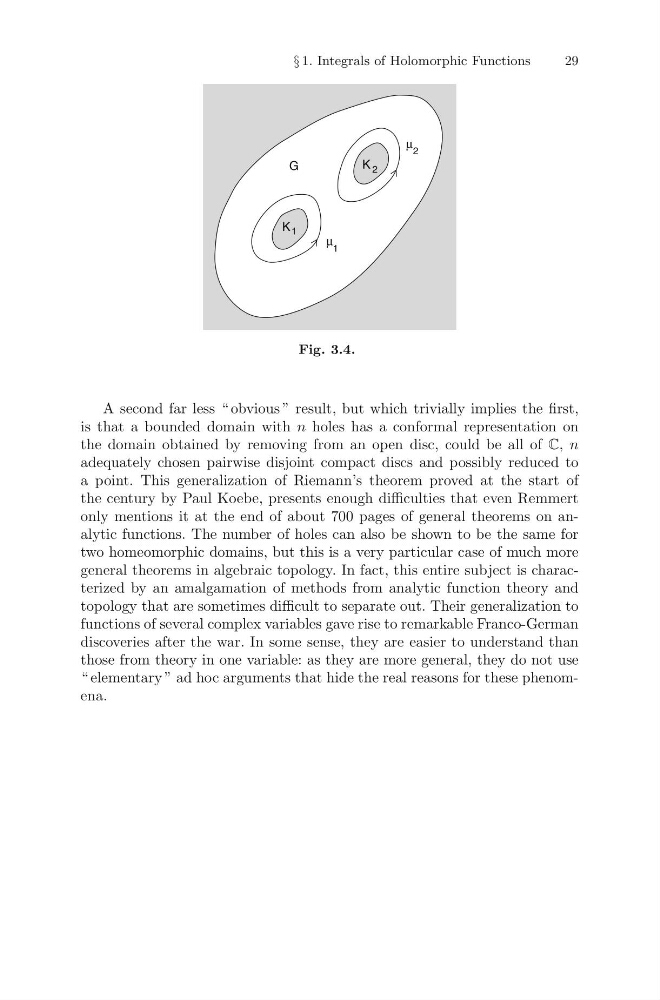
Fig. 3.4.
A second far less “ obvious ” result, but which trivially implies the first,
is that a bounded domain with n holes has a conformal representation on
the domain obtained by removing from an open disc, could be all of C, n
adequately chosen pairwise disjoint compact discs and possibly reduced to
a point. This generalization of Riemann’s theorem proved at the start of
the century by Paul Koebe, presents enough difficulties that even Remmert
only mentions it at the end of about 700 pages of general theorems on analytic functions. The number of holes can also be shown to be the same for
two homeomorphic domains, but this is a very particular case of much more
general theorems in algebraic topology. In fact, this entire subject is characterized by an amalgamation of methods from analytic function theory and
topology that are sometimes difficult to separate out. Their generalization to
functions of several complex variables gave rise to remarkable Franco-German
discoveries after the war. In some sense, they are easier to understand than
those from theory in one variable: as they are more general, they do not use
“ elementary ” ad hoc arguments that hide the real reasons for these phenomena.
29
1
1
2
2
μ
μ
G
K
K
Fig. 3.4.
A second far less “ obvious ” result, but which trivially implies the first,
is that a bounded domain with n holes has a conformal representation on
the domain obtained by removing from an open disc, could be all of C, n
adequately chosen pairwise disjoint compact discs and possibly reduced to
a point. This generalization of Riemann’s theorem proved at the start of
the century by Paul Koebe, presents enough difficulties that even Remmert
only mentions it at the end of about 700 pages of general theorems on analytic functions. The number of holes can also be shown to be the same for
two homeomorphic domains, but this is a very particular case of much more
general theorems in algebraic topology. In fact, this entire subject is characterized by an amalgamation of methods from analytic function theory and
topology that are sometimes difficult to separate out. Their generalization to
functions of several complex variables gave rise to remarkable Franco-German
discoveries after the war. In some sense, they are easier to understand than
those from theory in one variable: as they are more general, they do not use
“ elementary ” ad hoc arguments that hide the real reasons for these phenomena.