

28
VIII – Cauchy Theory
if its boundary consists of a finite number of simple arcs of curve, or if G is
bounded and convex, then f can be extended to a homeomorphism from the
closure ¯
G of G onto the closed disc |z| ≤ 1.
If f is a conformal representation of G on the unit disc D, then any
conformal representation of G on D is obviously of the form h ◦ f , where
h = g ◦ f
−1 is a conformal representation of D on itself, and conversely. This
leads us to determine the conformal representations of D on D, which is
much easier than proving Riemann’s theorem : these are precisely the maps
given by
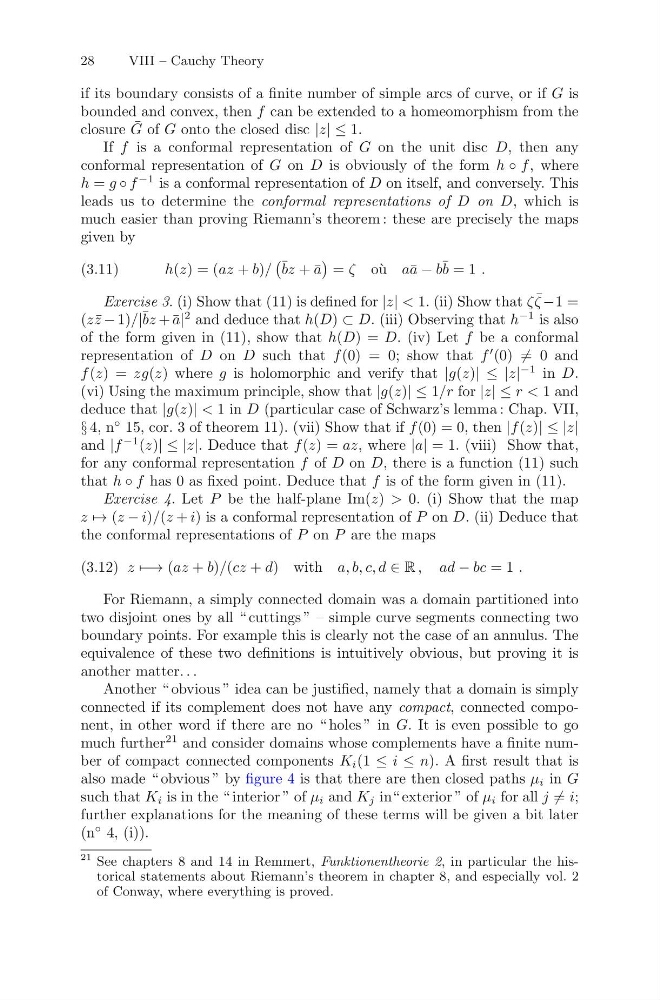
h(z) = (az + b)/
¯ bz + ¯
a
= ζ o` u a¯ a − b ¯ b = 1 .
(3.11)
Exercise 3. (i) Show that (11) is defined for |z| < 1. (ii) Show that ζ ¯
ζ −1 =
(z ¯
z − 1)/| ¯ bz + ¯
a|
2 and deduce that h(D) ⊂ D. (iii) Observing that h
−1 is also
of the form given in (11), show that h(D) = D. (iv) Let f be a conformal
representation of D on D such that f (0) = 0; show that f
(0) = 0 and
f (z) = zg(z) where g is holomorphic and verify that |g(z)| ≤ |z|
−1 in D.
(vi) Using the maximum principle, show that |g(z)| ≤ 1/r for |z| ≤ r < 1 and
deduce that |g(z)| < 1 in D (particular case of Schwarz’s lemma : Chap. VII,
§ 4, n
◦ 15, cor. 3 of theorem 11). (vii) Show that if f (0) = 0, then |f (z)| ≤ |z|
and |f
−1 (z)| ≤ |z|. Deduce that f (z) = az, where |a| = 1. (viii) Show that,
for any conformal representation f of D on D, there is a function (11) such
that h ◦ f has 0 as fixed point. Deduce that f is of the form given in (11).
Exercise 4. Let P be the half-plane Im(z) > 0. (i) Show that the map
z → (z − i)/(z + i) is a conformal representation of P on D. (ii) Deduce that
the conformal representations of P on P are the maps
z −→ (az + b)/(cz + d) with a, b, c, d ∈ R , ad − bc = 1 .
(3.12)
For Riemann, a simply connected domain was a domain partitioned into
two disjoint ones by all “ cuttings ” – simple curve segments connecting two
boundary points. For example this is clearly not the case of an annulus. The
equivalence of these two definitions is intuitively obvious, but proving it is
another matter. . .
Another “ obvious ” idea can be justified, namely that a domain is simply
connected if its complement does not have any compact, connected component, in other word if there are no “ holes ” in G. It is even possible to go
much further
21 and consider domains whose complements have a finite number of compact connected components K i (1 ≤ i ≤ n). A first result that is
also made “ obvious ” by figure 4 is that there are then closed paths μ i in G
such that K i is in the “ interior ” of μ i and K j in“ exterior ” of μ i for all j = i;
further explanations for the meaning of these terms will be given a bit later
(n
◦ 4, (i)).
21 See chapters 8 and 14 in Remmert, Funktionentheorie 2, in particular the historical statements about Riemann’s theorem in chapter 8, and especially vol. 2
of Conway, where everything is proved.
VIII – Cauchy Theory
if its boundary consists of a finite number of simple arcs of curve, or if G is
bounded and convex, then f can be extended to a homeomorphism from the
closure ¯
G of G onto the closed disc |z| ≤ 1.
If f is a conformal representation of G on the unit disc D, then any
conformal representation of G on D is obviously of the form h ◦ f , where
h = g ◦ f
−1 is a conformal representation of D on itself, and conversely. This
leads us to determine the conformal representations of D on D, which is
much easier than proving Riemann’s theorem : these are precisely the maps
given by
h(z) = (az + b)/
¯ bz + ¯
a
= ζ o` u a¯ a − b ¯ b = 1 .
(3.11)
Exercise 3. (i) Show that (11) is defined for |z| < 1. (ii) Show that ζ ¯
ζ −1 =
(z ¯
z − 1)/| ¯ bz + ¯
a|
2 and deduce that h(D) ⊂ D. (iii) Observing that h
−1 is also
of the form given in (11), show that h(D) = D. (iv) Let f be a conformal
representation of D on D such that f (0) = 0; show that f
(0) = 0 and
f (z) = zg(z) where g is holomorphic and verify that |g(z)| ≤ |z|
−1 in D.
(vi) Using the maximum principle, show that |g(z)| ≤ 1/r for |z| ≤ r < 1 and
deduce that |g(z)| < 1 in D (particular case of Schwarz’s lemma : Chap. VII,
§ 4, n
◦ 15, cor. 3 of theorem 11). (vii) Show that if f (0) = 0, then |f (z)| ≤ |z|
and |f
−1 (z)| ≤ |z|. Deduce that f (z) = az, where |a| = 1. (viii) Show that,
for any conformal representation f of D on D, there is a function (11) such
that h ◦ f has 0 as fixed point. Deduce that f is of the form given in (11).
Exercise 4. Let P be the half-plane Im(z) > 0. (i) Show that the map
z → (z − i)/(z + i) is a conformal representation of P on D. (ii) Deduce that
the conformal representations of P on P are the maps
z −→ (az + b)/(cz + d) with a, b, c, d ∈ R , ad − bc = 1 .
(3.12)
For Riemann, a simply connected domain was a domain partitioned into
two disjoint ones by all “ cuttings ” – simple curve segments connecting two
boundary points. For example this is clearly not the case of an annulus. The
equivalence of these two definitions is intuitively obvious, but proving it is
another matter. . .
Another “ obvious ” idea can be justified, namely that a domain is simply
connected if its complement does not have any compact, connected component, in other word if there are no “ holes ” in G. It is even possible to go
much further
21 and consider domains whose complements have a finite number of compact connected components K i (1 ≤ i ≤ n). A first result that is
also made “ obvious ” by figure 4 is that there are then closed paths μ i in G
such that K i is in the “ interior ” of μ i and K j in“ exterior ” of μ i for all j = i;
further explanations for the meaning of these terms will be given a bit later
(n
◦ 4, (i)).
21 See chapters 8 and 14 in Remmert, Funktionentheorie 2, in particular the historical statements about Riemann’s theorem in chapter 8, and especially vol. 2
of Conway, where everything is proved.