

262
IX – Multivariate Differential and Integral Calculus
This is the only formula likely to still be well-defined here.
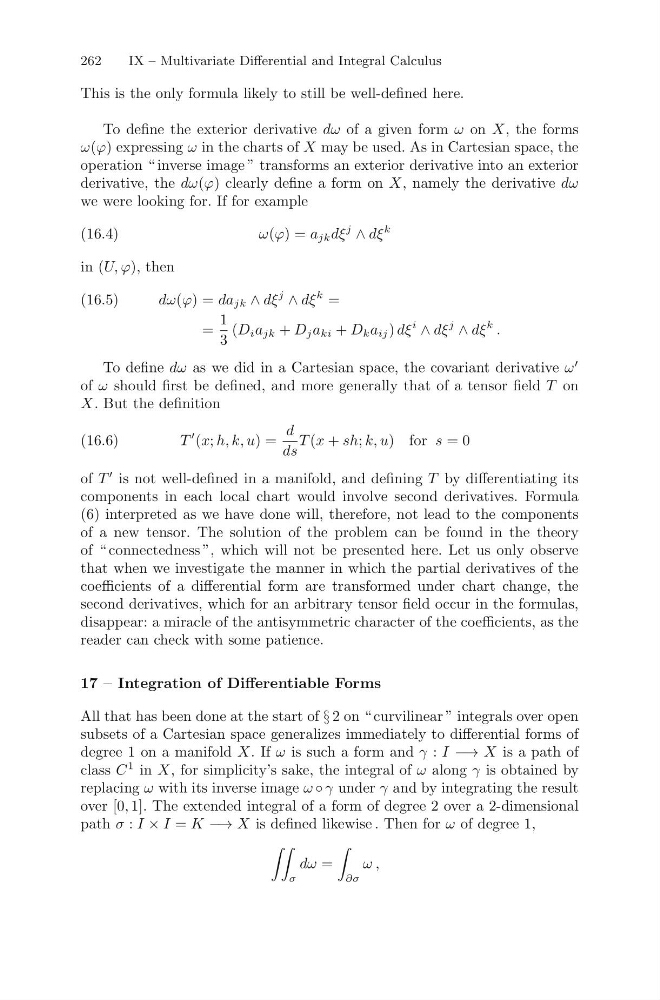
To define the exterior derivative dω of a given form ω on X, the forms
ω(ϕ) expressing ω in the charts of X may be used. As in Cartesian space, the
operation “ inverse image ” transforms an exterior derivative into an exterior
derivative, the dω(ϕ) clearly define a form on X, namely the derivative dω
we were looking for. If for example
ω(ϕ) = a jk dξ
j
∧ dξ
k
(16.4)
in (U, ϕ), then
dω(ϕ) = da jk ∧ dξ
j
∧ dξ
k =
(16.5)
=
1
3
(D i a jk + D j a ki + D k a ij ) dξ
i
∧ dξ
j
∧ dξ
k .
To define dω as we did in a Cartesian space, the covariant derivative ω
of ω should first be defined, and more generally that of a tensor field T on
X. But the definition
T
(x; h, k, u) =
d
ds
T (x + sh; k, u) for s = 0
(16.6)
of T
is not well-defined in a manifold, and defining T by differentiating its
components in each local chart would involve second derivatives. Formula
(6) interpreted as we have done will, therefore, not lead to the components
of a new tensor. The solution of the problem can be found in the theory
of “ connectedness ”, which will not be presented here. Let us only observe
that when we investigate the manner in which the partial derivatives of the
coefficients of a differential form are transformed under chart change, the
second derivatives, which for an arbitrary tensor field occur in the formulas,
disappear: a miracle of the antisymmetric character of the coefficients, as the
reader can check with some patience.
17 – Integration of Differentiable Forms
All that has been done at the start of § 2 on “ curvilinear ” integrals over open
subsets of a Cartesian space generalizes immediately to differential forms of
degree 1 on a manifold X. If ω is such a form and γ : I −→ X is a path of
class C
1 in X, for simplicity’s sake, the integral of ω along γ is obtained by
replacing ω with its inverse image ω ◦ γ under γ and by integrating the result
over [0, 1]. The extended integral of a form of degree 2 over a 2-dimensional
path σ : I × I = K −→ X is defined likewise . Then for ω of degree 1,
σ
dω =
∂σ
ω ,
IX – Multivariate Differential and Integral Calculus
This is the only formula likely to still be well-defined here.
To define the exterior derivative dω of a given form ω on X, the forms
ω(ϕ) expressing ω in the charts of X may be used. As in Cartesian space, the
operation “ inverse image ” transforms an exterior derivative into an exterior
derivative, the dω(ϕ) clearly define a form on X, namely the derivative dω
we were looking for. If for example
ω(ϕ) = a jk dξ
j
∧ dξ
k
(16.4)
in (U, ϕ), then
dω(ϕ) = da jk ∧ dξ
j
∧ dξ
k =
(16.5)
=
1
3
(D i a jk + D j a ki + D k a ij ) dξ
i
∧ dξ
j
∧ dξ
k .
To define dω as we did in a Cartesian space, the covariant derivative ω
of ω should first be defined, and more generally that of a tensor field T on
X. But the definition
T
(x; h, k, u) =
d
ds
T (x + sh; k, u) for s = 0
(16.6)
of T
is not well-defined in a manifold, and defining T by differentiating its
components in each local chart would involve second derivatives. Formula
(6) interpreted as we have done will, therefore, not lead to the components
of a new tensor. The solution of the problem can be found in the theory
of “ connectedness ”, which will not be presented here. Let us only observe
that when we investigate the manner in which the partial derivatives of the
coefficients of a differential form are transformed under chart change, the
second derivatives, which for an arbitrary tensor field occur in the formulas,
disappear: a miracle of the antisymmetric character of the coefficients, as the
reader can check with some patience.
17 – Integration of Differentiable Forms
All that has been done at the start of § 2 on “ curvilinear ” integrals over open
subsets of a Cartesian space generalizes immediately to differential forms of
degree 1 on a manifold X. If ω is such a form and γ : I −→ X is a path of
class C
1 in X, for simplicity’s sake, the integral of ω along γ is obtained by
replacing ω with its inverse image ω ◦ γ under γ and by integrating the result
over [0, 1]. The extended integral of a form of degree 2 over a 2-dimensional
path σ : I × I = K −→ X is defined likewise . Then for ω of degree 1,
σ
dω =
∂σ
ω ,