

§ 4. Differential Manifolds
261
det(u) = f [u(a 1 ) . . . , u(a n )] = f (u 1 , . . . , u n ) ,
where u i = u(a i ). Show that the derivative
det
(u) : h −→
d
dt
det(u + th) for t = 0 ,
which takes M (E) linearly onto R, is given by
h −→ f (u 1 + h 1 , u 2 , . . . , u n ) + . . . + f (u 1 , . . . , u n−1 , u n + h n ) ,
where h i = h(a i ). Deduce that
det
(u)h = det(u)Tr(h) .
(15.27)
Exercise 3. Show that the group SL n (R) of X ∈ M n (R) such that
det(X) = 1 is a closed submanifold of M n (R).
The § where we will discuss Lie groups in vol. IV will provide an opportunity to apply the results of this n
◦ in a particularly important case.
16 – Differential Forms on a Manifold
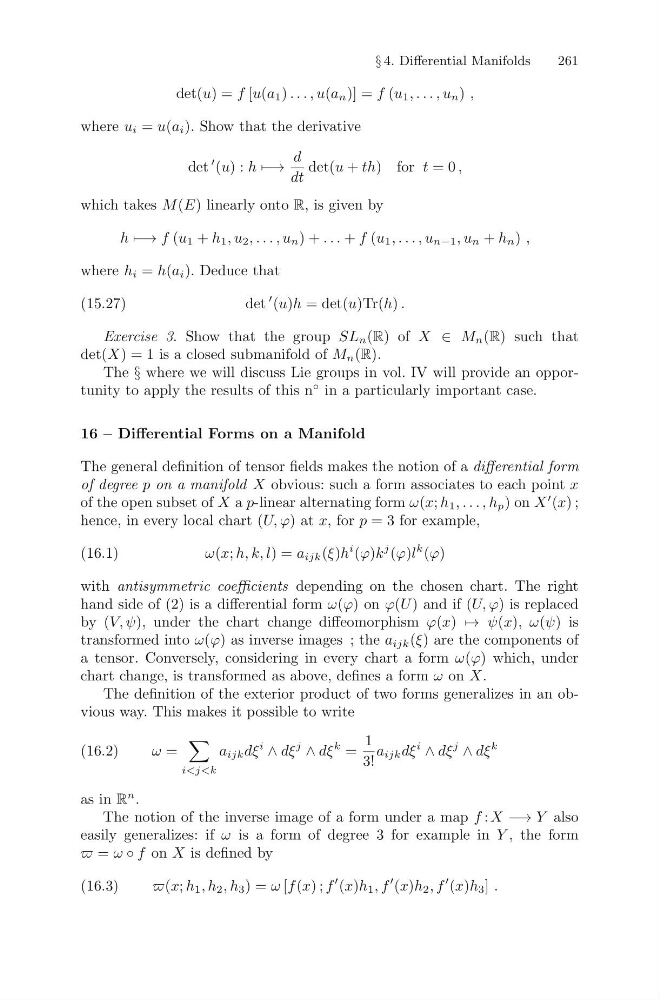
The general definition of tensor fields makes the notion of a differential form
of degree p on a manifold X obvious: such a form associates to each point x
of the open subset of X a p-linear alternating form ω(x; h 1 , . . . , h p ) on X
(x) ;
hence, in every local chart (U, ϕ) at x, for p = 3 for example,
ω(x; h, k, l) = a ijk (ξ)h
i (ϕ)k
j (ϕ)l
k (ϕ)
(16.1)
with antisymmetric coefficients depending on the chosen chart. The right
hand side of (2) is a differential form ω(ϕ) on ϕ(U ) and if (U, ϕ) is replaced
by (V, ψ), under the chart change diffeomorphism ϕ(x) → ψ(x), ω(ψ) is
transformed into ω(ϕ) as inverse images ; the a ijk (ξ) are the components of
a tensor. Conversely, considering in every chart a form ω(ϕ) which, under
chart change, is transformed as above, defines a form ω on X.
The definition of the exterior product of two forms generalizes in an obvious way. This makes it possible to write
ω =
i
i
∧ dξ
j
∧ dξ
k =
1
3!
a ijk dξ
i
∧ dξ
j
∧ dξ
k
(16.2)
as in R
n .
The notion of the inverse image of a form under a map f : X −→ Y also
easily generalizes: if ω is a form of degree 3 for example in Y , the form
= ω ◦ f on X is defined by
(x; h 1 , h 2 , h 3 ) = ω [f (x) ; f
(x)h 1 , f
(x)h 2 , f
(x)h 3 ] .
(16.3)
261
det(u) = f [u(a 1 ) . . . , u(a n )] = f (u 1 , . . . , u n ) ,
where u i = u(a i ). Show that the derivative
det
(u) : h −→
d
dt
det(u + th) for t = 0 ,
which takes M (E) linearly onto R, is given by
h −→ f (u 1 + h 1 , u 2 , . . . , u n ) + . . . + f (u 1 , . . . , u n−1 , u n + h n ) ,
where h i = h(a i ). Deduce that
det
(u)h = det(u)Tr(h) .
(15.27)
Exercise 3. Show that the group SL n (R) of X ∈ M n (R) such that
det(X) = 1 is a closed submanifold of M n (R).
The § where we will discuss Lie groups in vol. IV will provide an opportunity to apply the results of this n
◦ in a particularly important case.
16 – Differential Forms on a Manifold
The general definition of tensor fields makes the notion of a differential form
of degree p on a manifold X obvious: such a form associates to each point x
of the open subset of X a p-linear alternating form ω(x; h 1 , . . . , h p ) on X
(x) ;
hence, in every local chart (U, ϕ) at x, for p = 3 for example,
ω(x; h, k, l) = a ijk (ξ)h
i (ϕ)k
j (ϕ)l
k (ϕ)
(16.1)
with antisymmetric coefficients depending on the chosen chart. The right
hand side of (2) is a differential form ω(ϕ) on ϕ(U ) and if (U, ϕ) is replaced
by (V, ψ), under the chart change diffeomorphism ϕ(x) → ψ(x), ω(ψ) is
transformed into ω(ϕ) as inverse images ; the a ijk (ξ) are the components of
a tensor. Conversely, considering in every chart a form ω(ϕ) which, under
chart change, is transformed as above, defines a form ω on X.
The definition of the exterior product of two forms generalizes in an obvious way. This makes it possible to write
ω =
i
i
∧ dξ
j
∧ dξ
k =
1
3!
a ijk dξ
i
∧ dξ
j
∧ dξ
k
(16.2)
as in R
n .
The notion of the inverse image of a form under a map f : X −→ Y also
easily generalizes: if ω is a form of degree 3 for example in Y , the form
= ω ◦ f on X is defined by
(x; h 1 , h 2 , h 3 ) = ω [f (x) ; f
(x)h 1 , f
(x)h 2 , f
(x)h 3 ] .
(16.3)