

§ 1. Integrals of Holomorphic Functions
13
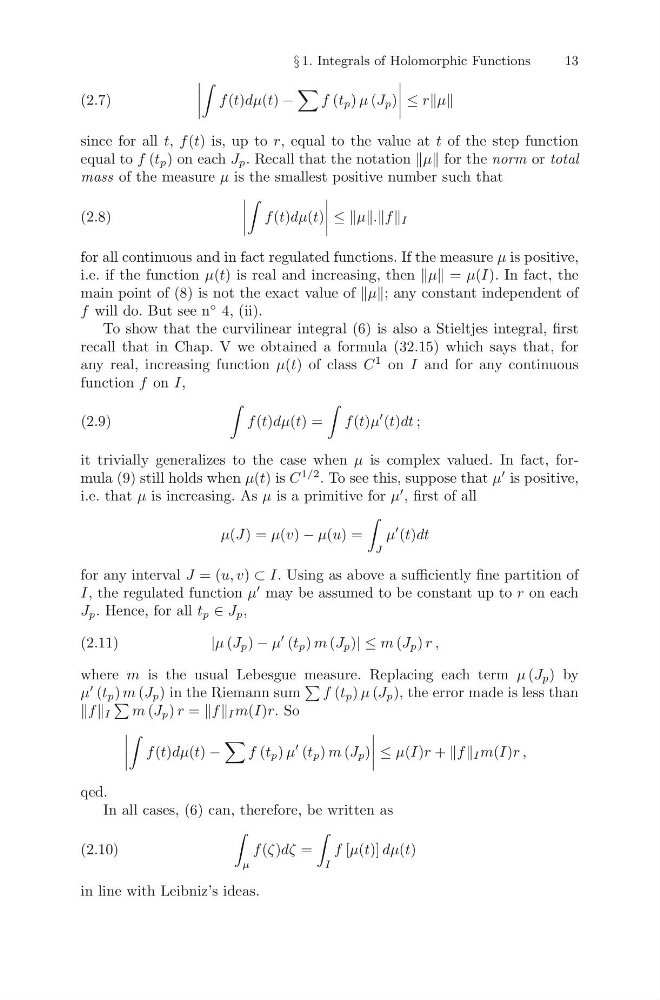
f (t)dμ(t) −
f (t p ) μ (J p )
≤ rμ
(2.7)
since for all t, f (t) is, up to r, equal to the value at t of the step function
equal to f (t p ) on each J p . Recall that the notation μ for the norm or total
mass of the measure μ is the smallest positive number such that
f (t)dμ(t)
≤ ≤μ.f I
(2.8)
for all continuous and in fact regulated functions. If the measure μ is positive,
i.e. if the function μ(t) is real and increasing, then μ = μ(I). In fact, the
main point of (8) is not the exact value of μ; any constant independent of
f will do. But see n
◦ 4, (ii).
To show that the curvilinear integral (6) is also a Stieltjes integral, first
recall that in Chap. V we obtained a formula (32.15) which says that, for
any real, increasing function μ(t) of class C
1 on I and for any continuous
function f on I,
f (t)dμ(t) =
f (t)μ
(t)dt ;
(2.9)
it trivially generalizes to the case when μ is complex valued. In fact, formula (9) still holds when μ(t) is C
1/2 . To see this, suppose that μ
is positive,
i.e. that μ is increasing. As μ is a primitive for μ
, first of all
μ(J) = μ(v) − μ(u) =
J
μ
(t)dt
for any interval J = (u, v) ⊂ I. Using as above a sufficiently fine partition of
I, the regulated function μ
may be assumed to be constant up to r on each
J p . Hence, for all t p ∈ J p ,
|μ (J p ) − μ
(t p ) m (J p )| ≤ m (J p ) r ,
(2.11)
where m is the usual Lebesgue measure. Replacing each term μ (J p ) by
μ
(t p ) m (J p ) in the Riemann sum
f (t p ) μ (J p ), the error made is less than
f I
m (J p ) r = f I m(I)r. So
f (t)dμ(t) −
f (t p ) μ
(t p ) m (J p )
≤ μ(I)r + f I m(I)r ,
qed.
In all cases, (6) can, therefore, be written as
μ
f (ζ)dζ =
I
f [μ(t)] dμ(t)
(2.10)
in line with Leibniz’s ideas.
13
f (t)dμ(t) −
f (t p ) μ (J p )
≤ rμ
(2.7)
since for all t, f (t) is, up to r, equal to the value at t of the step function
equal to f (t p ) on each J p . Recall that the notation μ for the norm or total
mass of the measure μ is the smallest positive number such that
f (t)dμ(t)
≤ ≤μ.f I
(2.8)
for all continuous and in fact regulated functions. If the measure μ is positive,
i.e. if the function μ(t) is real and increasing, then μ = μ(I). In fact, the
main point of (8) is not the exact value of μ; any constant independent of
f will do. But see n
◦ 4, (ii).
To show that the curvilinear integral (6) is also a Stieltjes integral, first
recall that in Chap. V we obtained a formula (32.15) which says that, for
any real, increasing function μ(t) of class C
1 on I and for any continuous
function f on I,
f (t)dμ(t) =
f (t)μ
(t)dt ;
(2.9)
it trivially generalizes to the case when μ is complex valued. In fact, formula (9) still holds when μ(t) is C
1/2 . To see this, suppose that μ
is positive,
i.e. that μ is increasing. As μ is a primitive for μ
, first of all
μ(J) = μ(v) − μ(u) =
J
μ
(t)dt
for any interval J = (u, v) ⊂ I. Using as above a sufficiently fine partition of
I, the regulated function μ
may be assumed to be constant up to r on each
J p . Hence, for all t p ∈ J p ,
|μ (J p ) − μ
(t p ) m (J p )| ≤ m (J p ) r ,
(2.11)
where m is the usual Lebesgue measure. Replacing each term μ (J p ) by
μ
(t p ) m (J p ) in the Riemann sum
f (t p ) μ (J p ), the error made is less than
f I
m (J p ) r = f I m(I)r. So
f (t)dμ(t) −
f (t p ) μ
(t p ) m (J p )
≤ μ(I)r + f I m(I)r ,
qed.
In all cases, (6) can, therefore, be written as
μ
f (ζ)dζ =
I
f [μ(t)] dμ(t)
(2.10)
in line with Leibniz’s ideas.