

12
VIII – Cauchy Theory
a
b
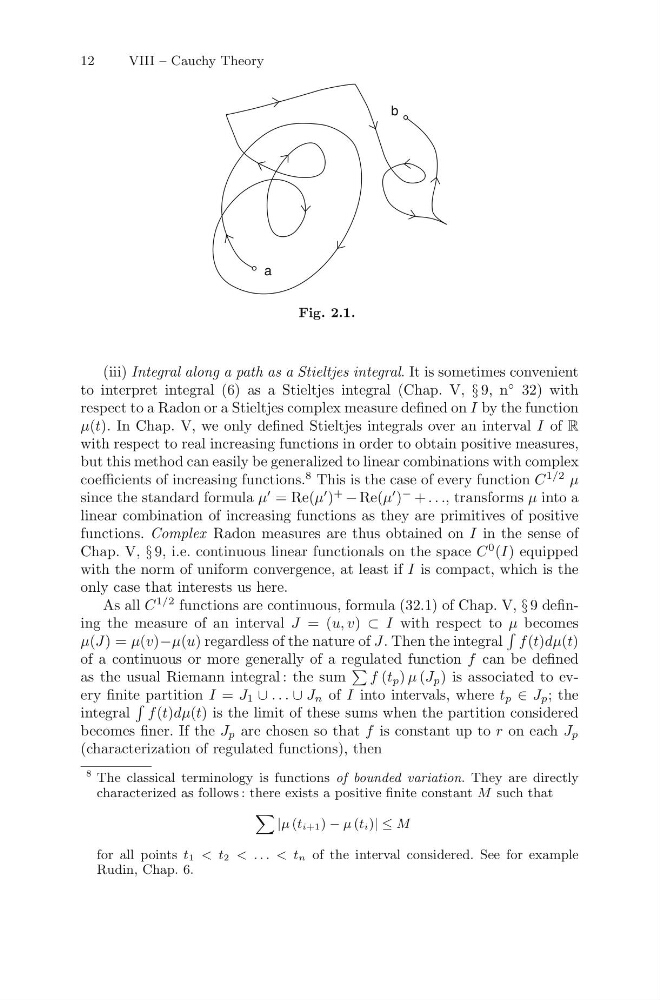
Fig. 2.1.
(iii) Integral along a path as a Stieltjes integral. It is sometimes convenient
to interpret integral (6) as a Stieltjes integral (Chap. V, § 9, n
◦ 32) with
respect to a Radon or a Stieltjes complex measure defined on I by the function
μ(t). In Chap. V, we only defined Stieltjes integrals over an interval I of R
with respect to real increasing functions in order to obtain positive measures,
but this method can easily be generalized to linear combinations with complex
coefficients of increasing functions.
8 This is the case of every function C
1/2 μ
since the standard formula μ
= Re(μ
)
+
− Re(μ
)
− + . . ., transforms μ into a
linear combination of increasing functions as they are primitives of positive
functions. Complex Radon measures are thus obtained on I in the sense of
Chap. V, § 9, i.e. continuous linear functionals on the space C
0 (I) equipped
with the norm of uniform convergence, at least if I is compact, which is the
only case that interests us here.
As all C
1/2 functions are continuous, formula (32.1) of Chap. V, § 9 defining the measure of an interval J = (u, v) ⊂ I with respect to μ becomes
μ(J) = μ(v)−μ(u) regardless of the nature of J. Then the integral
f (t)dμ(t)
of a continuous or more generally of a regulated function f can be defined
as the usual Riemann integral : the sum
f (t p ) μ (J p ) is associated to every finite partition I = J 1 ∪ . . . ∪ J n of I into intervals, where t p ∈ J p ; the
integral
f (t)dμ(t) is the limit of these sums when the partition considered
becomes finer. If the J p are chosen so that f is constant up to r on each J p
(characterization of regulated functions), then
8 The classical terminology is functions of bounded variation. They are directly
characterized as follows : there exists a positive finite constant M such that
|μ (ti+1) − μ (ti)| ≤ M
for all points t1 < t2 < . . . < tn of the interval considered. See for example
Rudin, Chap. 6.
VIII – Cauchy Theory
a
b
Fig. 2.1.
(iii) Integral along a path as a Stieltjes integral. It is sometimes convenient
to interpret integral (6) as a Stieltjes integral (Chap. V, § 9, n
◦ 32) with
respect to a Radon or a Stieltjes complex measure defined on I by the function
μ(t). In Chap. V, we only defined Stieltjes integrals over an interval I of R
with respect to real increasing functions in order to obtain positive measures,
but this method can easily be generalized to linear combinations with complex
coefficients of increasing functions.
8 This is the case of every function C
1/2 μ
since the standard formula μ
= Re(μ
)
+
− Re(μ
)
− + . . ., transforms μ into a
linear combination of increasing functions as they are primitives of positive
functions. Complex Radon measures are thus obtained on I in the sense of
Chap. V, § 9, i.e. continuous linear functionals on the space C
0 (I) equipped
with the norm of uniform convergence, at least if I is compact, which is the
only case that interests us here.
As all C
1/2 functions are continuous, formula (32.1) of Chap. V, § 9 defining the measure of an interval J = (u, v) ⊂ I with respect to μ becomes
μ(J) = μ(v)−μ(u) regardless of the nature of J. Then the integral
f (t)dμ(t)
of a continuous or more generally of a regulated function f can be defined
as the usual Riemann integral : the sum
f (t p ) μ (J p ) is associated to every finite partition I = J 1 ∪ . . . ∪ J n of I into intervals, where t p ∈ J p ; the
integral
f (t)dμ(t) is the limit of these sums when the partition considered
becomes finer. If the J p are chosen so that f is constant up to r on each J p
(characterization of regulated functions), then
8 The classical terminology is functions of bounded variation. They are directly
characterized as follows : there exists a positive finite constant M such that
|μ (ti+1) − μ (ti)| ≤ M
for all points t1 < t2 < . . . < tn of the interval considered. See for example
Rudin, Chap. 6.