

§ 3. Integration of Differential Forms
191
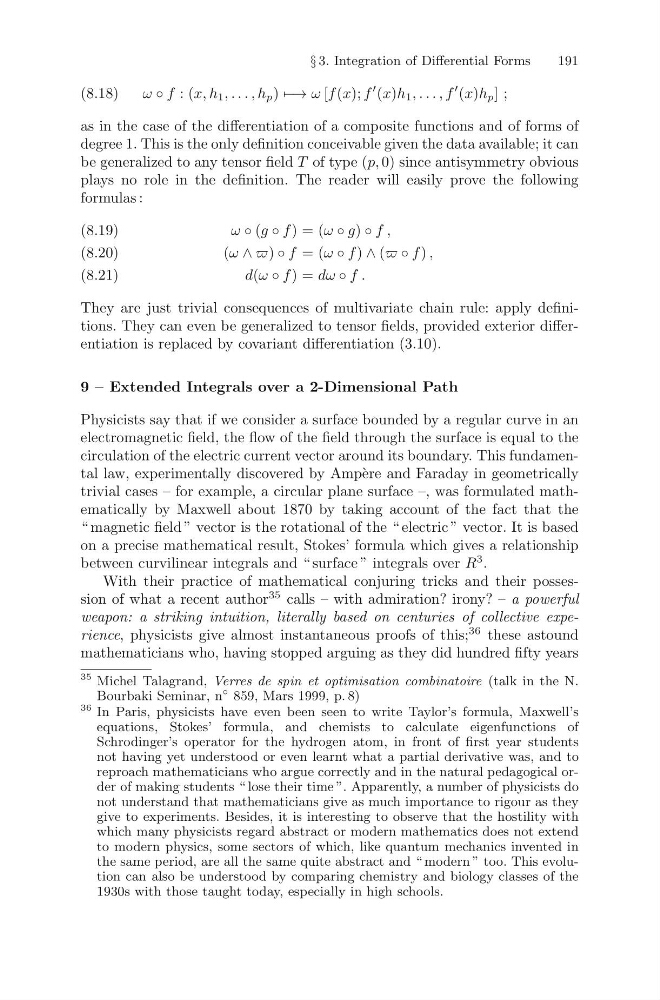
ω ◦ f : (x, h 1 , . . . , h p ) −→ ω [f (x); f
(x)h 1 , . . . , f
(x)h p ] ;
(8.18)
as in the case of the differentiation of a composite functions and of forms of
degree 1. This is the only definition conceivable given the data available; it can
be generalized to any tensor field T of type (p, 0) since antisymmetry obvious
plays no role in the definition. The reader will easily prove the following
formulas :
ω ◦ (g ◦ f ) = (ω ◦ g) ◦ f ,
(8.19)
(ω ∧ ) ◦ f = (ω ◦ f ) ∧ ( ◦ f ) ,
(8.20)
d(ω ◦ f ) = dω ◦ f .
(8.21)
They are just trivial consequences of multivariate chain rule: apply definitions. They can even be generalized to tensor fields, provided exterior differentiation is replaced by covariant differentiation (3.10).
9 – Extended Integrals over a 2-Dimensional Path
Physicists say that if we consider a surface bounded by a regular curve in an
electromagnetic field, the flow of the field through the surface is equal to the
circulation of the electric current vector around its boundary. This fundamental law, experimentally discovered by Amp` ere and Faraday in geometrically
trivial cases – for example, a circular plane surface –, was formulated mathematically by Maxwell about 1870 by taking account of the fact that the
“ magnetic field ” vector is the rotational of the “ electric ” vector. It is based
on a precise mathematical result, Stokes’ formula which gives a relationship
between curvilinear integrals and “ surface ” integrals over R
3 .
With their practice of mathematical conjuring tricks and their possession of what a recent author
35 calls – with admiration? irony? – a powerful
weapon: a striking intuition, literally based on centuries of collective experience, physicists give almost instantaneous proofs of this;
36 these astound
mathematicians who, having stopped arguing as they did hundred fifty years
35 Michel Talagrand, Verres de spin et optimisation combinatoire (talk in the N.
Bourbaki Seminar, n
◦ 859, Mars 1999, p. 8)
36 In Paris, physicists have even been seen to write Taylor’s formula, Maxwell’s
equations, Stokes’ formula, and chemists to calculate eigenfunctions of
Schrodinger’s operator for the hydrogen atom, in front of first year students
not having yet understood or even learnt what a partial derivative was, and to
reproach mathematicians who argue correctly and in the natural pedagogical order of making students “ lose their time ”. Apparently, a number of physicists do
not understand that mathematicians give as much importance to rigour as they
give to experiments. Besides, it is interesting to observe that the hostility with
which many physicists regard abstract or modern mathematics does not extend
to modern physics, some sectors of which, like quantum mechanics invented in
the same period, are all the same quite abstract and “ modern ” too. This evolution can also be understood by comparing chemistry and biology classes of the
1930s with those taught today, especially in high schools.
191
ω ◦ f : (x, h 1 , . . . , h p ) −→ ω [f (x); f
(x)h 1 , . . . , f
(x)h p ] ;
(8.18)
as in the case of the differentiation of a composite functions and of forms of
degree 1. This is the only definition conceivable given the data available; it can
be generalized to any tensor field T of type (p, 0) since antisymmetry obvious
plays no role in the definition. The reader will easily prove the following
formulas :
ω ◦ (g ◦ f ) = (ω ◦ g) ◦ f ,
(8.19)
(ω ∧ ) ◦ f = (ω ◦ f ) ∧ ( ◦ f ) ,
(8.20)
d(ω ◦ f ) = dω ◦ f .
(8.21)
They are just trivial consequences of multivariate chain rule: apply definitions. They can even be generalized to tensor fields, provided exterior differentiation is replaced by covariant differentiation (3.10).
9 – Extended Integrals over a 2-Dimensional Path
Physicists say that if we consider a surface bounded by a regular curve in an
electromagnetic field, the flow of the field through the surface is equal to the
circulation of the electric current vector around its boundary. This fundamental law, experimentally discovered by Amp` ere and Faraday in geometrically
trivial cases – for example, a circular plane surface –, was formulated mathematically by Maxwell about 1870 by taking account of the fact that the
“ magnetic field ” vector is the rotational of the “ electric ” vector. It is based
on a precise mathematical result, Stokes’ formula which gives a relationship
between curvilinear integrals and “ surface ” integrals over R
3 .
With their practice of mathematical conjuring tricks and their possession of what a recent author
35 calls – with admiration? irony? – a powerful
weapon: a striking intuition, literally based on centuries of collective experience, physicists give almost instantaneous proofs of this;
36 these astound
mathematicians who, having stopped arguing as they did hundred fifty years
35 Michel Talagrand, Verres de spin et optimisation combinatoire (talk in the N.
Bourbaki Seminar, n
◦ 859, Mars 1999, p. 8)
36 In Paris, physicists have even been seen to write Taylor’s formula, Maxwell’s
equations, Stokes’ formula, and chemists to calculate eigenfunctions of
Schrodinger’s operator for the hydrogen atom, in front of first year students
not having yet understood or even learnt what a partial derivative was, and to
reproach mathematicians who argue correctly and in the natural pedagogical order of making students “ lose their time ”. Apparently, a number of physicists do
not understand that mathematicians give as much importance to rigour as they
give to experiments. Besides, it is interesting to observe that the hostility with
which many physicists regard abstract or modern mathematics does not extend
to modern physics, some sectors of which, like quantum mechanics invented in
the same period, are all the same quite abstract and “ modern ” too. This evolution can also be understood by comparing chemistry and biology classes of the
1930s with those taught today, especially in high schools.