

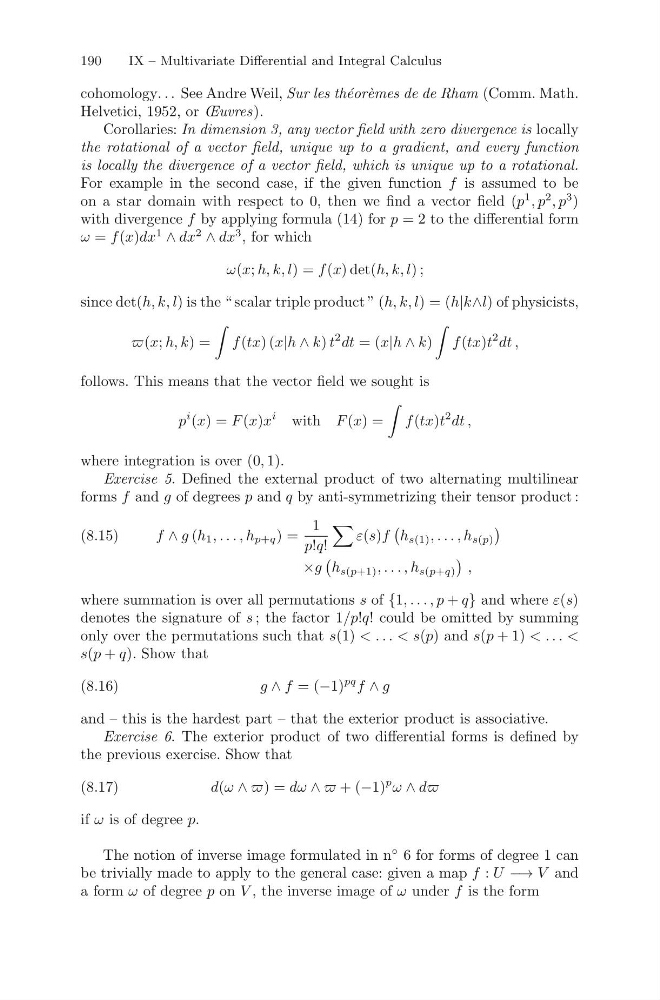
190
IX – Multivariate Differential and Integral Calculus
cohomology. . . See Andre Weil, Sur les th´ eor` emes de de Rham (Comm. Math.
Helvetici, 1952, or Œuvres).
Corollaries: In dimension 3, any vector field with zero divergence is locally
the rotational of a vector field, unique up to a gradient, and every function
is locally the divergence of a vector field, which is unique up to a rotational.
For example in the second case, if the given function f is assumed to be
on a star domain with respect to 0, then we find a vector field (p
1 , p
2 , p
3 )
with divergence f by applying formula (14) for p = 2 to the differential form
ω = f (x)dx
1
∧ dx
2
∧ dx
3 , for which
ω(x; h, k, l) = f (x) det(h, k, l) ;
since det(h, k, l) is the “ scalar triple product ” (h, k, l) = (h|k∧l) of physicists,
(x; h, k) =
f (tx) (x|h ∧ k) t
2 dt = (x|h ∧ k)
f (tx)t
2 dt ,
follows. This means that the vector field we sought is
p
i (x) = F (x)x
i
with F (x) =
f (tx)t
2 dt ,
where integration is over (0, 1).
Exercise 5. Defined the external product of two alternating multilinear
forms f and g of degrees p and q by anti-symmetrizing their tensor product :
f ∧ g (h 1 , . . . , h p+q ) =
1
p!q!
ε(s)f
h s(1) , . . . , h s(p)
(8.15)
×g
h s(p+1) , . . . , h s(p+q)
,
where summation is over all permutations s of {1, . . . , p + q} and where ε(s)
denotes the signature of s ; the factor 1/p!q! could be omitted by summing
only over the permutations such that s(1) < . . . < s(p) and s(p + 1) < . . . <
s(p + q). Show that
g ∧ f = (−1)
pq f ∧ g
(8.16)
and – this is the hardest part – that the exterior product is associative.
Exercise 6. The exterior product of two differential forms is defined by
the previous exercise. Show that
d(ω ∧ ) = dω ∧ + (−1)
p ω ∧ dd
(8.17)
if ω is of degree p.
The notion of inverse image formulated in n
◦ 6 for forms of degree 1 can
be trivially made to apply to the general case: given a map f : U −→ V and
a form ω of degree p on V , the inverse image of ω under f is the form
IX – Multivariate Differential and Integral Calculus
cohomology. . . See Andre Weil, Sur les th´ eor` emes de de Rham (Comm. Math.
Helvetici, 1952, or Œuvres).
Corollaries: In dimension 3, any vector field with zero divergence is locally
the rotational of a vector field, unique up to a gradient, and every function
is locally the divergence of a vector field, which is unique up to a rotational.
For example in the second case, if the given function f is assumed to be
on a star domain with respect to 0, then we find a vector field (p
1 , p
2 , p
3 )
with divergence f by applying formula (14) for p = 2 to the differential form
ω = f (x)dx
1
∧ dx
2
∧ dx
3 , for which
ω(x; h, k, l) = f (x) det(h, k, l) ;
since det(h, k, l) is the “ scalar triple product ” (h, k, l) = (h|k∧l) of physicists,
(x; h, k) =
f (tx) (x|h ∧ k) t
2 dt = (x|h ∧ k)
f (tx)t
2 dt ,
follows. This means that the vector field we sought is
p
i (x) = F (x)x
i
with F (x) =
f (tx)t
2 dt ,
where integration is over (0, 1).
Exercise 5. Defined the external product of two alternating multilinear
forms f and g of degrees p and q by anti-symmetrizing their tensor product :
f ∧ g (h 1 , . . . , h p+q ) =
1
p!q!
ε(s)f
h s(1) , . . . , h s(p)
(8.15)
×g
h s(p+1) , . . . , h s(p+q)
,
where summation is over all permutations s of {1, . . . , p + q} and where ε(s)
denotes the signature of s ; the factor 1/p!q! could be omitted by summing
only over the permutations such that s(1) < . . . < s(p) and s(p + 1) < . . . <
s(p + q). Show that
g ∧ f = (−1)
pq f ∧ g
(8.16)
and – this is the hardest part – that the exterior product is associative.
Exercise 6. The exterior product of two differential forms is defined by
the previous exercise. Show that
d(ω ∧ ) = dω ∧ + (−1)
p ω ∧ dd
(8.17)
if ω is of degree p.
The notion of inverse image formulated in n
◦ 6 for forms of degree 1 can
be trivially made to apply to the general case: given a map f : U −→ V and
a form ω of degree p on V , the inverse image of ω under f is the form