

160
IX – Multivariate Differential and Integral Calculus
The relations
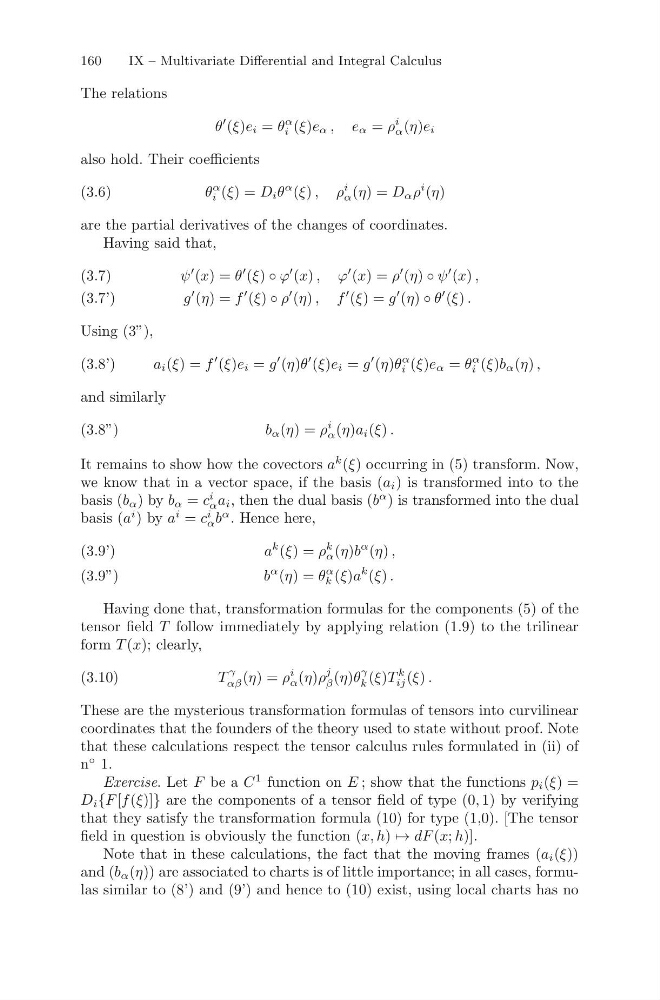
θ
(ξ)e i = θ
α
i (ξ)e α , e α = ρ
i
α (η)e i
also hold. Their coefficients
θ
α
i (ξ) = D i θ
α (ξ) , ρ
i
α (η) = D α ρ
i (η)
(3.6)
are the partial derivatives of the changes of coordinates.
Having said that,
ψ
(x) = θ
(ξ) ◦ ϕ
(x) , ϕ
(x) = ρ
(η) ◦ ψ
(x) ,
(3.7)
g
(η) = f
(ξ) ◦ ρ
(η) , f
(ξ) = g
(η) ◦ θ
(ξ) .
(3.7’)
Using (3”),
a i (ξ) = f
(ξ)e i = g
(η)θ
(ξ)e i = g
(η)θ
α
i (ξ)e α = θ
α
i (ξ)b α (η) ,
(3.8’)
and similarly
b α (η) = ρ
i
α (η)a i (ξ) .
(3.8”)
It remains to show how the covectors a
k (ξ) occurring in (5) transform. Now,
we know that in a vector space, if the basis (a i ) is transformed into to the
basis (b α ) by b α = c
i
α a i , then the dual basis (b
α ) is transformed into the dual
basis (a
i ) by a
i = c
i
α b
α . Hence here,
a
k (ξ) = ρ
k
α (η)b
α (η) ,
(3.9’)
b
α (η) = θ
α
k (ξ)a
k (ξ) .
(3.9”)
Having done that, transformation formulas for the components (5) of the
tensor field T follow immediately by applying relation (1.9) to the trilinear
form T (x); clearly,
T
γ
αβ (η) = ρ
i
α (η)ρ
j
β (η)θ
γ
k (ξ)T
k
ij (ξ) .
(3.10)
These are the mysterious transformation formulas of tensors into curvilinear
coordinates that the founders of the theory used to state without proof. Note
that these calculations respect the tensor calculus rules formulated in (ii) of
n
◦ 1.
Exercise. Let F be a C
1 function on E ; show that the functions p i (ξ) =
D i {F [f (ξ)]} are the components of a tensor field of type (0, 1) by verifying
that they satisfy the transformation formula (10) for type (1,0). [The tensor
field in question is obviously the function (x, h) → dF (x; h)].
Note that in these calculations, the fact that the moving frames (a i (ξ))
and (b α (η)) are associated to charts is of little importance; in all cases, formulas similar to (8’) and (9’) and hence to (10) exist, using local charts has no
IX – Multivariate Differential and Integral Calculus
The relations
θ
(ξ)e i = θ
α
i (ξ)e α , e α = ρ
i
α (η)e i
also hold. Their coefficients
θ
α
i (ξ) = D i θ
α (ξ) , ρ
i
α (η) = D α ρ
i (η)
(3.6)
are the partial derivatives of the changes of coordinates.
Having said that,
ψ
(x) = θ
(ξ) ◦ ϕ
(x) , ϕ
(x) = ρ
(η) ◦ ψ
(x) ,
(3.7)
g
(η) = f
(ξ) ◦ ρ
(η) , f
(ξ) = g
(η) ◦ θ
(ξ) .
(3.7’)
Using (3”),
a i (ξ) = f
(ξ)e i = g
(η)θ
(ξ)e i = g
(η)θ
α
i (ξ)e α = θ
α
i (ξ)b α (η) ,
(3.8’)
and similarly
b α (η) = ρ
i
α (η)a i (ξ) .
(3.8”)
It remains to show how the covectors a
k (ξ) occurring in (5) transform. Now,
we know that in a vector space, if the basis (a i ) is transformed into to the
basis (b α ) by b α = c
i
α a i , then the dual basis (b
α ) is transformed into the dual
basis (a
i ) by a
i = c
i
α b
α . Hence here,
a
k (ξ) = ρ
k
α (η)b
α (η) ,
(3.9’)
b
α (η) = θ
α
k (ξ)a
k (ξ) .
(3.9”)
Having done that, transformation formulas for the components (5) of the
tensor field T follow immediately by applying relation (1.9) to the trilinear
form T (x); clearly,
T
γ
αβ (η) = ρ
i
α (η)ρ
j
β (η)θ
γ
k (ξ)T
k
ij (ξ) .
(3.10)
These are the mysterious transformation formulas of tensors into curvilinear
coordinates that the founders of the theory used to state without proof. Note
that these calculations respect the tensor calculus rules formulated in (ii) of
n
◦ 1.
Exercise. Let F be a C
1 function on E ; show that the functions p i (ξ) =
D i {F [f (ξ)]} are the components of a tensor field of type (0, 1) by verifying
that they satisfy the transformation formula (10) for type (1,0). [The tensor
field in question is obviously the function (x, h) → dF (x; h)].
Note that in these calculations, the fact that the moving frames (a i (ξ))
and (b α (η)) are associated to charts is of little importance; in all cases, formulas similar to (8’) and (9’) and hence to (10) exist, using local charts has no