

§ 1. Classical Differential Calculus
159
In fact, ´
Elie Cartan used more general moving frames than those defined
above from local charts; for him, it was merely a basis (a i (x)) of E depending
on a point x ∈ E and whose vectors were functions of x as much differentiable
as necessary. We will return to this a bit later in our discussion of differential
forms, where it is essential to understand their calculations.
The notion of a local chart allows us to understand Rene Lagrange’s (i.e.
Ricci’s and Levi-Civita’s) “ tensors ”, mentioned in n
◦ 1, (ii), and foremost in
the case of a Cartesian space E since that is all we know until further notice.
Suppose that there is a tensor field on an open subset X or E, for example
a function T (x; h, k, u) that is multilinear in h, k ∈ E and u ∈ E
∗ , for all
x ∈ X. Consider a chart (U, ϕ) with U ⊂ X. Write f for the inverse map of ϕ
and for x = f (ξ), let (a i (ξ)) be, as above, the image basis under f
(ξ) of the
canonical basis of R
n ; write (a
i (ξ)) for the dual basis of E
∗ . For x = f (ξ) ∈ U ,
let
T
k
ij (ξ) = T
x; a i (ξ), a j (ξ), a
k (ξ)
(3.5)
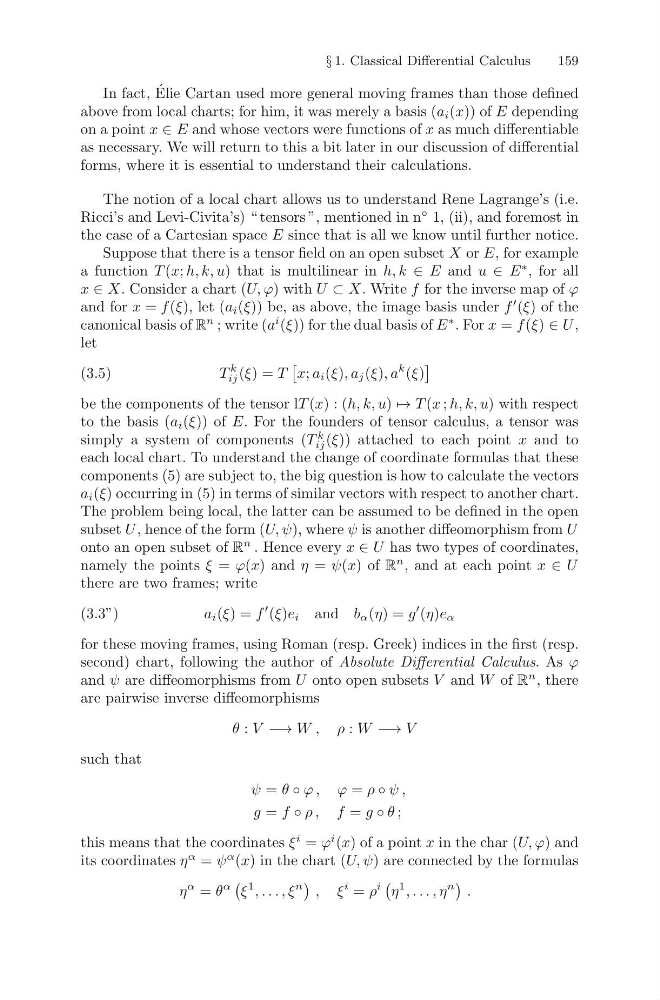
be the components of the tensor lT (x) : (h, k, u) → T (x ; h, k, u) with respect
to the basis (a i (ξ)) of E. For the founders of tensor calculus, a tensor was
simply a system of components (T
k
ij (ξ)) attached to each point x and to
each local chart. To understand the change of coordinate formulas that these
components (5) are subject to, the big question is how to calculate the vectors
a i (ξ) occurring in (5) in terms of similar vectors with respect to another chart.
The problem being local, the latter can be assumed to be defined in the open
subset U , hence of the form (U, ψ), where ψ is another diffeomorphism from U
onto an open subset of R
n . Hence every x ∈ U has two types of coordinates,
namely the points ξ = ϕ(x) and η = ψ(x) of R
n , and at each point x ∈ U
there are two frames; write
a i (ξ) = f
(ξ)e i and b α (η) = g
(η)e α
(3.3”)
for these moving frames, using Roman (resp. Greek) indices in the first (resp.
second) chart, following the author of Absolute Differential Calculus. As ϕ
and ψ are diffeomorphisms from U onto open subsets V and W of R
n , there
are pairwise inverse diffeomorphisms
θ : V −→ W , ρ : W −→ V
such that
ψ = θ ◦ ϕ , ϕ = ρ ◦ ψ ,
g = f ◦ ρ , f = g ◦ θ ;
this means that the coordinates ξ
i = ϕ
i (x) of a point x in the char (U, ϕ) and
its coordinates η
α = ψ
α (x) in the chart (U, ψ) are connected by the formulas
η
α = θ
α
ξ
1 , . . . , ξ
n
, ξ
i = ρ
i
η
1 , . . . , η
n
.
159
In fact, ´
Elie Cartan used more general moving frames than those defined
above from local charts; for him, it was merely a basis (a i (x)) of E depending
on a point x ∈ E and whose vectors were functions of x as much differentiable
as necessary. We will return to this a bit later in our discussion of differential
forms, where it is essential to understand their calculations.
The notion of a local chart allows us to understand Rene Lagrange’s (i.e.
Ricci’s and Levi-Civita’s) “ tensors ”, mentioned in n
◦ 1, (ii), and foremost in
the case of a Cartesian space E since that is all we know until further notice.
Suppose that there is a tensor field on an open subset X or E, for example
a function T (x; h, k, u) that is multilinear in h, k ∈ E and u ∈ E
∗ , for all
x ∈ X. Consider a chart (U, ϕ) with U ⊂ X. Write f for the inverse map of ϕ
and for x = f (ξ), let (a i (ξ)) be, as above, the image basis under f
(ξ) of the
canonical basis of R
n ; write (a
i (ξ)) for the dual basis of E
∗ . For x = f (ξ) ∈ U ,
let
T
k
ij (ξ) = T
x; a i (ξ), a j (ξ), a
k (ξ)
(3.5)
be the components of the tensor lT (x) : (h, k, u) → T (x ; h, k, u) with respect
to the basis (a i (ξ)) of E. For the founders of tensor calculus, a tensor was
simply a system of components (T
k
ij (ξ)) attached to each point x and to
each local chart. To understand the change of coordinate formulas that these
components (5) are subject to, the big question is how to calculate the vectors
a i (ξ) occurring in (5) in terms of similar vectors with respect to another chart.
The problem being local, the latter can be assumed to be defined in the open
subset U , hence of the form (U, ψ), where ψ is another diffeomorphism from U
onto an open subset of R
n . Hence every x ∈ U has two types of coordinates,
namely the points ξ = ϕ(x) and η = ψ(x) of R
n , and at each point x ∈ U
there are two frames; write
a i (ξ) = f
(ξ)e i and b α (η) = g
(η)e α
(3.3”)
for these moving frames, using Roman (resp. Greek) indices in the first (resp.
second) chart, following the author of Absolute Differential Calculus. As ϕ
and ψ are diffeomorphisms from U onto open subsets V and W of R
n , there
are pairwise inverse diffeomorphisms
θ : V −→ W , ρ : W −→ V
such that
ψ = θ ◦ ϕ , ϕ = ρ ◦ ψ ,
g = f ◦ ρ , f = g ◦ θ ;
this means that the coordinates ξ
i = ϕ
i (x) of a point x in the char (U, ϕ) and
its coordinates η
α = ψ
α (x) in the chart (U, ψ) are connected by the formulas
η
α = θ
α
ξ
1 , . . . , ξ
n
, ξ
i = ρ
i
η
1 , . . . , η
n
.