

§ 1. Classical Differential Calculus
149
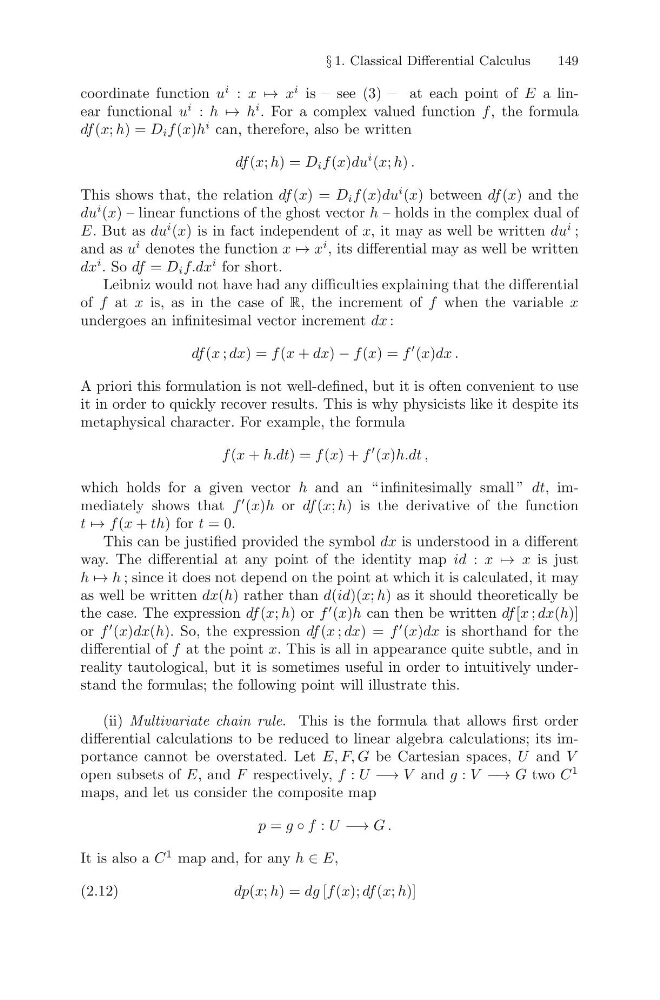
coordinate function u
i : x → x
i is – see (3) – at each point of E a linear functional u
i : h → h
i . For a complex valued function f , the formula
df (x; h) = D i f (x)h
i can, therefore, also be written
df (x; h) = D i f (x)du
i (x; h) .
This shows that, the relation df (x) = D i f (x)du
i (x) between df (x) and the
du
i (x) – linear functions of the ghost vector h – holds in the complex dual of
E. But as du
i (x) is in fact independent of x, it may as well be written du
i ;
and as u
i denotes the function x → x
i , its differential may as well be written
dx
i . So df = D i f.dx
i for short.
Leibniz would not have had any difficulties explaining that the differential
of f at x is, as in the case of R, the increment of f when the variable x
undergoes an infinitesimal vector increment dx :
df (x ; dx) = f (x + dx) − f (x) = f
(x)dx .
A priori this formulation is not well-defined, but it is often convenient to use
it in order to quickly recover results. This is why physicists like it despite its
metaphysical character. For example, the formula
f (x + h.dt) = f (x) + f
(x)h.dt ,
which holds for a given vector h and an “ infinitesimally small ” dt, immediately shows that f
(x)h or df (x; h) is the derivative of the function
t → f (x + th) for t = 0.
This can be justified provided the symbol dx is understood in a different
way. The differential at any point of the identity map id : x → x is just
h → h ; since it does not depend on the point at which it is calculated, it may
as well be written dx(h) rather than d(id)(x; h) as it should theoretically be
the case. The expression df (x; h) or f
(x)h can then be written df [x ; dx(h)]
or f
(x)dx(h). So, the expression df (x ; dx) = f
(x)dx is shorthand for the
differential of f at the point x. This is all in appearance quite subtle, and in
reality tautological, but it is sometimes useful in order to intuitively understand the formulas; the following point will illustrate this.
(ii) Multivariate chain rule. This is the formula that allows first order
differential calculations to be reduced to linear algebra calculations; its importance cannot be overstated. Let E, F, G be Cartesian spaces, U and V
open subsets of E, and F respectively, f : U −→ V and g : V −→ G two C
1
maps, and let us consider the composite map
p = g ◦ f : U −→ G .
It is also a C
1 map and, for any h ∈ E,
dp(x; h) = dg [f (x); df (x; h)]
(2.12)
149
coordinate function u
i : x → x
i is – see (3) – at each point of E a linear functional u
i : h → h
i . For a complex valued function f , the formula
df (x; h) = D i f (x)h
i can, therefore, also be written
df (x; h) = D i f (x)du
i (x; h) .
This shows that, the relation df (x) = D i f (x)du
i (x) between df (x) and the
du
i (x) – linear functions of the ghost vector h – holds in the complex dual of
E. But as du
i (x) is in fact independent of x, it may as well be written du
i ;
and as u
i denotes the function x → x
i , its differential may as well be written
dx
i . So df = D i f.dx
i for short.
Leibniz would not have had any difficulties explaining that the differential
of f at x is, as in the case of R, the increment of f when the variable x
undergoes an infinitesimal vector increment dx :
df (x ; dx) = f (x + dx) − f (x) = f
(x)dx .
A priori this formulation is not well-defined, but it is often convenient to use
it in order to quickly recover results. This is why physicists like it despite its
metaphysical character. For example, the formula
f (x + h.dt) = f (x) + f
(x)h.dt ,
which holds for a given vector h and an “ infinitesimally small ” dt, immediately shows that f
(x)h or df (x; h) is the derivative of the function
t → f (x + th) for t = 0.
This can be justified provided the symbol dx is understood in a different
way. The differential at any point of the identity map id : x → x is just
h → h ; since it does not depend on the point at which it is calculated, it may
as well be written dx(h) rather than d(id)(x; h) as it should theoretically be
the case. The expression df (x; h) or f
(x)h can then be written df [x ; dx(h)]
or f
(x)dx(h). So, the expression df (x ; dx) = f
(x)dx is shorthand for the
differential of f at the point x. This is all in appearance quite subtle, and in
reality tautological, but it is sometimes useful in order to intuitively understand the formulas; the following point will illustrate this.
(ii) Multivariate chain rule. This is the formula that allows first order
differential calculations to be reduced to linear algebra calculations; its importance cannot be overstated. Let E, F, G be Cartesian spaces, U and V
open subsets of E, and F respectively, f : U −→ V and g : V −→ G two C
1
maps, and let us consider the composite map
p = g ◦ f : U −→ G .
It is also a C
1 map and, for any h ∈ E,
dp(x; h) = dg [f (x); df (x; h)]
(2.12)