

§ 1. Integrals of Holomorphic Functions
7
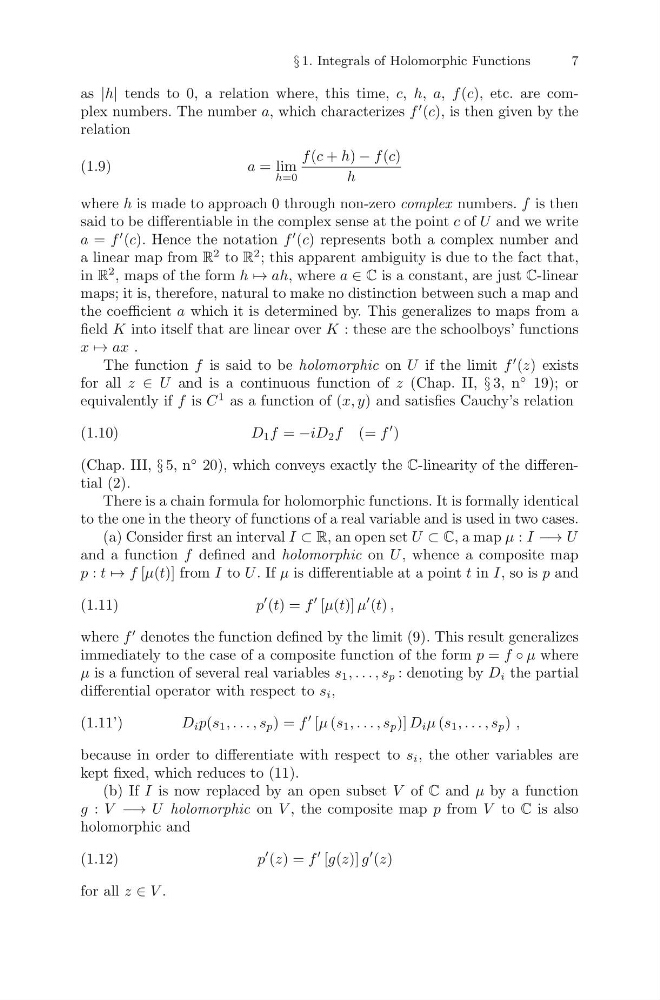
as |h| tends to 0, a relation where, this time, c, h, a, f (c), etc. are complex numbers. The number a, which characterizes f
(c), is then given by the
relation
a = lim
h=0
f (c + h) − f (c)
h
(1.9)
where h is made to approach 0 through non-zero complex numbers. f is then
said to be differentiable in the complex sense at the point c of U and we write
a = f
(c). Hence the notation f
(c) represents both a complex number and
a linear map from R
2 to R
2 ; this apparent ambiguity is due to the fact that,
in R
2 , maps of the form h → ah, where a ∈ C is a constant, are just C-linear
maps; it is, therefore, natural to make no distinction between such a map and
the coefficient a which it is determined by. This generalizes to maps from a
field K into itself that are linear over K : these are the schoolboys’ functions
x → ax .
The function f is said to be holomorphic on U if the limit f
(z) exists
for all z ∈ U and is a continuous function of z (Chap. II, § 3, n
◦ 19); or
equivalently if f is C
1 as a function of (x, y) and satisfies Cauchy’s relation
D 1 f = −iD 2 f (= f
)
(1.10)
(Chap. III, § 5, n
◦ 20), which conveys exactly the C-linearity of the differential (2).
There is a chain formula for holomorphic functions. It is formally identical
to the one in the theory of functions of a real variable and is used in two cases.
(a) Consider first an interval I ⊂ R, an open set U ⊂ C, a map μ : I −→ U
and a function f defined and holomorphic on U , whence a composite map
p : t → f [μ(t)] from I to U . If μ is differentiable at a point t in I, so is p and
p
(t) = f
[μ(t)] μ
(t) ,
(1.11)
where f
denotes the function defined by the limit (9). This result generalizes
immediately to the case of a composite function of the form p = f ◦ μ where
μ is a function of several real variables s 1 , . . . , s p : denoting by D i the partial
differential operator with respect to s i ,
D i p(s 1 , . . . , s p ) = f
[μ (s 1 , . . . , s p )] D i μ (s 1 , . . . , s p ) ,
(1.11’)
because in order to differentiate with respect to s i , the other variables are
kept fixed, which reduces to (11).
(b) If I is now replaced by an open subset V of C and μ by a function
g : V −→ U holomorphic on V , the composite map p from V to C is also
holomorphic and
p
(z) = f
[g(z)] g
(z)
(1.12)
for all z ∈ V .
7
as |h| tends to 0, a relation where, this time, c, h, a, f (c), etc. are complex numbers. The number a, which characterizes f
(c), is then given by the
relation
a = lim
h=0
f (c + h) − f (c)
h
(1.9)
where h is made to approach 0 through non-zero complex numbers. f is then
said to be differentiable in the complex sense at the point c of U and we write
a = f
(c). Hence the notation f
(c) represents both a complex number and
a linear map from R
2 to R
2 ; this apparent ambiguity is due to the fact that,
in R
2 , maps of the form h → ah, where a ∈ C is a constant, are just C-linear
maps; it is, therefore, natural to make no distinction between such a map and
the coefficient a which it is determined by. This generalizes to maps from a
field K into itself that are linear over K : these are the schoolboys’ functions
x → ax .
The function f is said to be holomorphic on U if the limit f
(z) exists
for all z ∈ U and is a continuous function of z (Chap. II, § 3, n
◦ 19); or
equivalently if f is C
1 as a function of (x, y) and satisfies Cauchy’s relation
D 1 f = −iD 2 f (= f
)
(1.10)
(Chap. III, § 5, n
◦ 20), which conveys exactly the C-linearity of the differential (2).
There is a chain formula for holomorphic functions. It is formally identical
to the one in the theory of functions of a real variable and is used in two cases.
(a) Consider first an interval I ⊂ R, an open set U ⊂ C, a map μ : I −→ U
and a function f defined and holomorphic on U , whence a composite map
p : t → f [μ(t)] from I to U . If μ is differentiable at a point t in I, so is p and
p
(t) = f
[μ(t)] μ
(t) ,
(1.11)
where f
denotes the function defined by the limit (9). This result generalizes
immediately to the case of a composite function of the form p = f ◦ μ where
μ is a function of several real variables s 1 , . . . , s p : denoting by D i the partial
differential operator with respect to s i ,
D i p(s 1 , . . . , s p ) = f
[μ (s 1 , . . . , s p )] D i μ (s 1 , . . . , s p ) ,
(1.11’)
because in order to differentiate with respect to s i , the other variables are
kept fixed, which reduces to (11).
(b) If I is now replaced by an open subset V of C and μ by a function
g : V −→ U holomorphic on V , the composite map p from V to C is also
holomorphic and
p
(z) = f
[g(z)] g
(z)
(1.12)
for all z ∈ V .