

6
VIII – Cauchy Theory
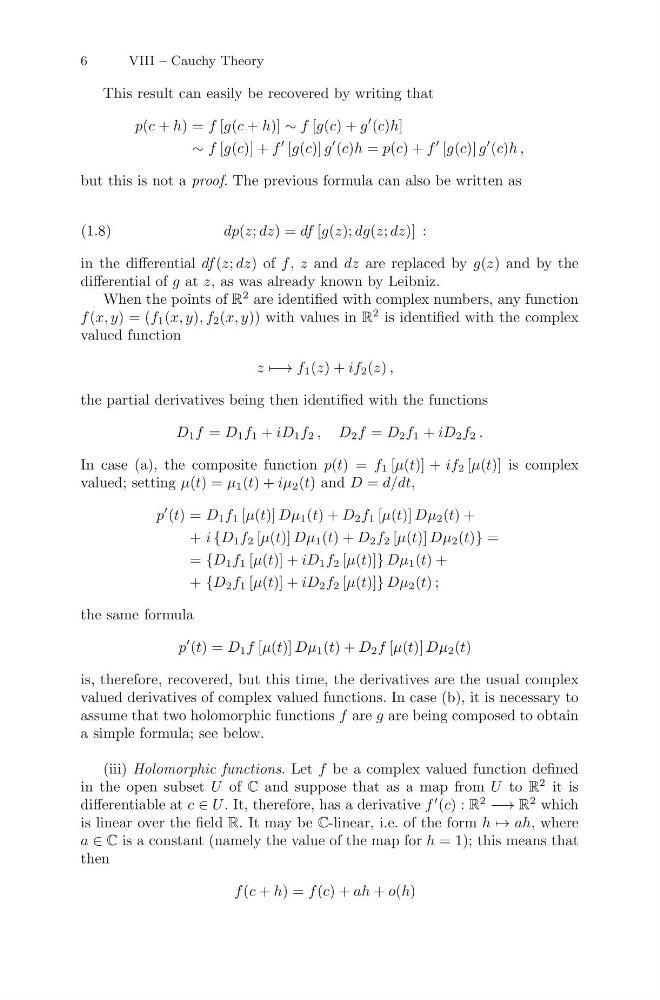
This result can easily be recovered by writing that
p(c + h) = f [g(c + h)] ∼ f [g(c) + g
(c)h]
∼ f [g(c)] + f
[g(c)] g
(c)h = p(c) + f
[g(c)] g
(c)h ,
but this is not a proof. The previous formula can also be written as
dp(z; dz) = df [g(z); dg(z; dz)] :
(1.8)
in the differential df (z; dz) of f , z and dz are replaced by g(z) and by the
differential of g at z, as was already known by Leibniz.
When the points of R
2 are identified with complex numbers, any function
f (x, y) = (f 1 (x, y), f 2 (x, y)) with values in R
2 is identified with the complex
valued function
z −→ f 1 (z) + if 2 (z) ,
the partial derivatives being then identified with the functions
D 1 f = D 1 f 1 + iD 1 f 2 , D 2 f = D 2 f 1 + iD 2 f 2 .
In case (a), the composite function p(t) = f 1 [μ(t)] + if 2 [μ(t)] is complex
valued; setting μ(t) = μ 1 (t) + iμ 2 (t) and D = d/dt,
p
(t) = D 1 f 1 [μ(t)] Dμ 1 (t) + D 2 f 1 [μ(t)] Dμ 2 (t) +
+ i {D 1 f 2 [μ(t)] Dμ 1 (t) + D 2 f 2 [μ(t)] Dμ 2 (t)} =
= {D 1 f 1 [μ(t)] + iD 1 f 2 [μ(t)]} Dμ 1 (t) +
+ {D 2 f 1 [μ(t)] + iD 2 f 2 [μ(t)]} Dμ 2 (t) ;
the same formula
p
(t) = D 1 f [μ(t)] Dμ 1 (t) + D 2 f [μ(t)] Dμ 2 (t)
is, therefore, recovered, but this time, the derivatives are the usual complex
valued derivatives of complex valued functions. In case (b), it is necessary to
assume that two holomorphic functions f are g are being composed to obtain
a simple formula; see below.
(iii) Holomorphic functions. Let f be a complex valued function defined
in the open subset U of C and suppose that as a map from U to R
2 it is
differentiable at c ∈ U . It, therefore, has a derivative f
(c) : R
2
−→ R
2 which
is linear over the field R. It may be C-linear, i.e. of the form h → ah, where
a ∈ C is a constant (namely the value of the map for h = 1); this means that
then
f (c + h) = f (c) + ah + o(h)
VIII – Cauchy Theory
This result can easily be recovered by writing that
p(c + h) = f [g(c + h)] ∼ f [g(c) + g
(c)h]
∼ f [g(c)] + f
[g(c)] g
(c)h = p(c) + f
[g(c)] g
(c)h ,
but this is not a proof. The previous formula can also be written as
dp(z; dz) = df [g(z); dg(z; dz)] :
(1.8)
in the differential df (z; dz) of f , z and dz are replaced by g(z) and by the
differential of g at z, as was already known by Leibniz.
When the points of R
2 are identified with complex numbers, any function
f (x, y) = (f 1 (x, y), f 2 (x, y)) with values in R
2 is identified with the complex
valued function
z −→ f 1 (z) + if 2 (z) ,
the partial derivatives being then identified with the functions
D 1 f = D 1 f 1 + iD 1 f 2 , D 2 f = D 2 f 1 + iD 2 f 2 .
In case (a), the composite function p(t) = f 1 [μ(t)] + if 2 [μ(t)] is complex
valued; setting μ(t) = μ 1 (t) + iμ 2 (t) and D = d/dt,
p
(t) = D 1 f 1 [μ(t)] Dμ 1 (t) + D 2 f 1 [μ(t)] Dμ 2 (t) +
+ i {D 1 f 2 [μ(t)] Dμ 1 (t) + D 2 f 2 [μ(t)] Dμ 2 (t)} =
= {D 1 f 1 [μ(t)] + iD 1 f 2 [μ(t)]} Dμ 1 (t) +
+ {D 2 f 1 [μ(t)] + iD 2 f 2 [μ(t)]} Dμ 2 (t) ;
the same formula
p
(t) = D 1 f [μ(t)] Dμ 1 (t) + D 2 f [μ(t)] Dμ 2 (t)
is, therefore, recovered, but this time, the derivatives are the usual complex
valued derivatives of complex valued functions. In case (b), it is necessary to
assume that two holomorphic functions f are g are being composed to obtain
a simple formula; see below.
(iii) Holomorphic functions. Let f be a complex valued function defined
in the open subset U of C and suppose that as a map from U to R
2 it is
differentiable at c ∈ U . It, therefore, has a derivative f
(c) : R
2
−→ R
2 which
is linear over the field R. It may be C-linear, i.e. of the form h → ah, where
a ∈ C is a constant (namely the value of the map for h = 1); this means that
then
f (c + h) = f (c) + ah + o(h)