

114
VIII – Cauchy Theory
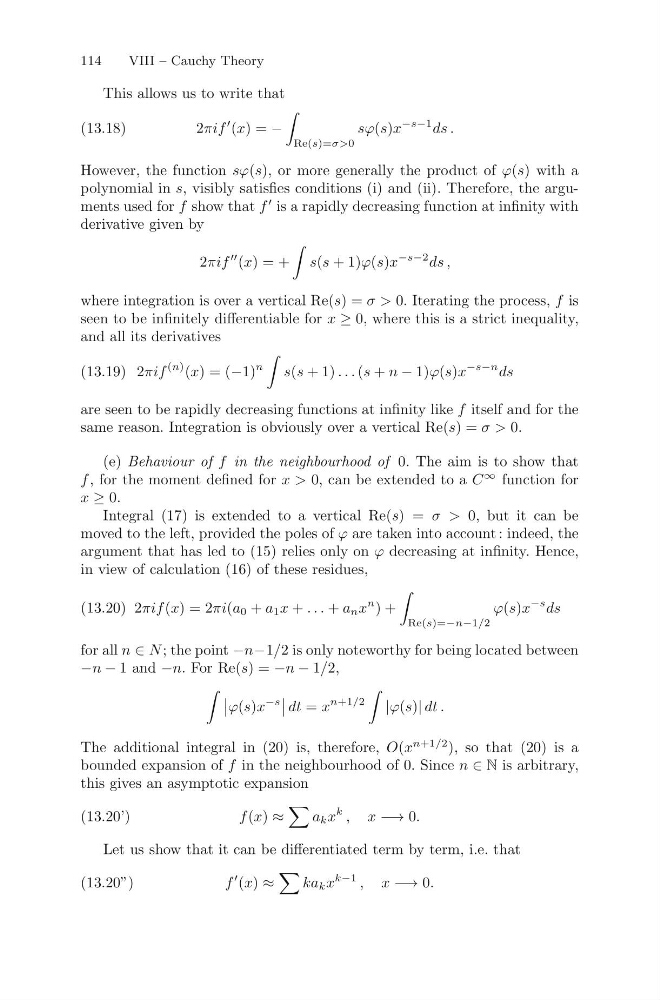
This allows us to write that
2πif
(x) = −
Re(s)=σ>0
sϕ(s)x
−s−1 ds .
(13.18)
However, the function sϕ(s), or more generally the product of ϕ(s) with a
polynomial in s, visibly satisfies conditions (i) and (ii). Therefore, the arguments used for f show that f
is a rapidly decreasing function at infinity with
derivative given by
2πif
(x) = +
s(s + 1)ϕ(s)x
−s−2 ds ,
where integration is over a vertical Re(s) = σ > 0. Iterating the process, f is
seen to be infinitely differentiable for x ≥ 0, where this is a strict inequality,
and all its derivatives
2πif
(n) (x) = (−1)
n
s(s + 1) . . . (s + n − 1)ϕ(s)x
−s−n ds
(13.19)
are seen to be rapidly decreasing functions at infinity like f itself and for the
same reason. Integration is obviously over a vertical Re(s) = σ > 0.
(e) Behaviour of f in the neighbourhood of 0. The aim is to show that
f , for the moment defined for x > 0, can be extended to a C
∞ function for
x ≥ 0.
Integral (17) is extended to a vertical Re(s) = σ > 0, but it can be
moved to the left, provided the poles of ϕ are taken into account : indeed, the
argument that has led to (15) relies only on ϕ decreasing at infinity. Hence,
in view of calculation (16) of these residues,
2πif (x) = 2πi(a 0 + a 1 x + . . . + a n x
n ) +
Re(s)=−n−1/2
ϕ(s)x
−s ds
(13.20)
for all n ∈ N ; the point −n−1/2 is only noteworthy for being located between
−n − 1 and −n. For Re(s) = −n − 1/2,
ϕ(s)x
−s
dt = x
n+1/2
|ϕ(s)| dt .
The additional integral in (20) is, therefore, O(x
n+1/2 ), so that (20) is a
bounded expansion of f in the neighbourhood of 0. Since n ∈ N is arbitrary,
this gives an asymptotic expansion
f (x) ≈
a k x
k , x −→ 0.
(13.20’)
Let us show that it can be differentiated term by term, i.e. that
f
(x) ≈
ka k x
k−1 , x −→ 0.
(13.20”)
VIII – Cauchy Theory
This allows us to write that
2πif
(x) = −
Re(s)=σ>0
sϕ(s)x
−s−1 ds .
(13.18)
However, the function sϕ(s), or more generally the product of ϕ(s) with a
polynomial in s, visibly satisfies conditions (i) and (ii). Therefore, the arguments used for f show that f
is a rapidly decreasing function at infinity with
derivative given by
2πif
(x) = +
s(s + 1)ϕ(s)x
−s−2 ds ,
where integration is over a vertical Re(s) = σ > 0. Iterating the process, f is
seen to be infinitely differentiable for x ≥ 0, where this is a strict inequality,
and all its derivatives
2πif
(n) (x) = (−1)
n
s(s + 1) . . . (s + n − 1)ϕ(s)x
−s−n ds
(13.19)
are seen to be rapidly decreasing functions at infinity like f itself and for the
same reason. Integration is obviously over a vertical Re(s) = σ > 0.
(e) Behaviour of f in the neighbourhood of 0. The aim is to show that
f , for the moment defined for x > 0, can be extended to a C
∞ function for
x ≥ 0.
Integral (17) is extended to a vertical Re(s) = σ > 0, but it can be
moved to the left, provided the poles of ϕ are taken into account : indeed, the
argument that has led to (15) relies only on ϕ decreasing at infinity. Hence,
in view of calculation (16) of these residues,
2πif (x) = 2πi(a 0 + a 1 x + . . . + a n x
n ) +
Re(s)=−n−1/2
ϕ(s)x
−s ds
(13.20)
for all n ∈ N ; the point −n−1/2 is only noteworthy for being located between
−n − 1 and −n. For Re(s) = −n − 1/2,
ϕ(s)x
−s
dt = x
n+1/2
|ϕ(s)| dt .
The additional integral in (20) is, therefore, O(x
n+1/2 ), so that (20) is a
bounded expansion of f in the neighbourhood of 0. Since n ∈ N is arbitrary,
this gives an asymptotic expansion
f (x) ≈
a k x
k , x −→ 0.
(13.20’)
Let us show that it can be differentiated term by term, i.e. that
f
(x) ≈
ka k x
k−1 , x −→ 0.
(13.20”)