

§ 3. Some Applications of Cauchy’s Method
113
Re(s)=b
ψ(s)ds −
Re(s)=a
ψ(s)ds = 2πi
a<−k
(13.15)
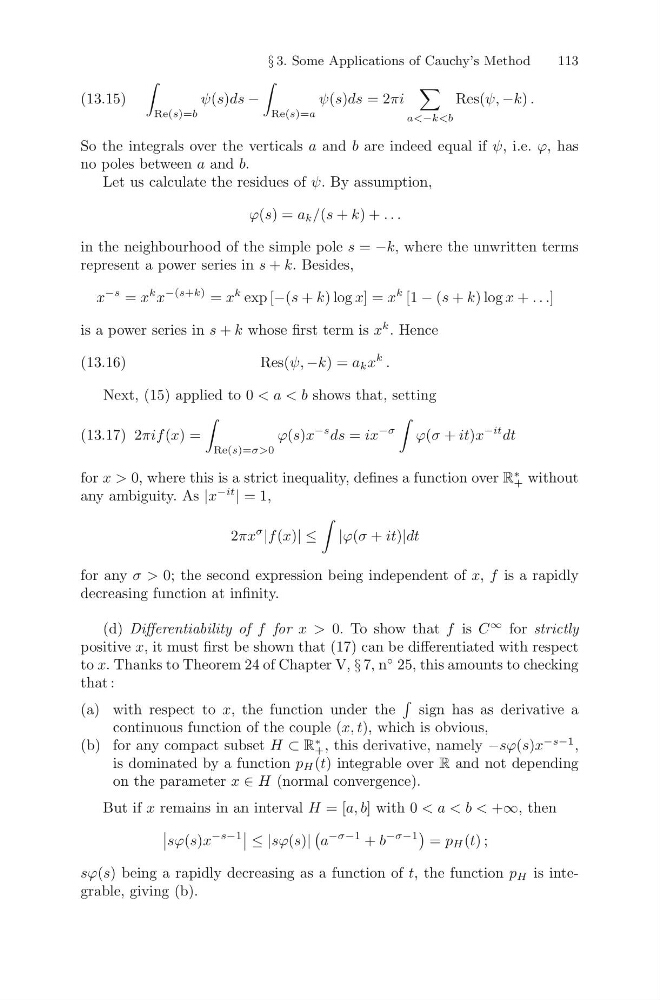
So the integrals over the verticals a and b are indeed equal if ψ, i.e. ϕ, has
no poles between a and b.
Let us calculate the residues of ψ. By assumption,
ϕ(s) = a k /(s + k) + . . .
in the neighbourhood of the simple pole s = −k, where the unwritten terms
represent a power series in s + k. Besides,
x
−s = x
k x
−(s+k) = x
k exp [−(s + k) log x] = x
k [1 − (s + k) log x + . . .]
is a power series in s + k whose first term is x
k . Hence
Res(ψ, −k) = a k x
k .
(13.16)
Next, (15) applied to 0 < a < b shows that, setting
2πif (x) =
Re(s)=σ>0
ϕ(s)x
−s ds = ix
−σ
ϕ(σ + it)x
−it dt
(13.17)
for x > 0, where this is a strict inequality, defines a function over R
∗
+ without
any ambiguity. As |x
−it
| = 1,
2πx
σ
|f (x)| ≤
|ϕ(σ + it)|dt
for any σ > 0; the second expression being independent of x, f is a rapidly
decreasing function at infinity.
(d) Differentiability of f for x > 0. To show that f is C
∞ for strictly
positive x, it must first be shown that (17) can be differentiated with respect
to x. Thanks to Theorem 24 of Chapter V, § 7, n
◦ 25, this amounts to checking
that :
(a) with respect to x, the function under the
sign has as derivative a
continuous function of the couple (x, t), which is obvious,
(b) for any compact subset H ⊂ R
∗
+ , this derivative, namely −sϕ(s)x
−s−1 ,
is dominated by a function p H (t) integrable over R and not depending
on the parameter x ∈ H (normal convergence).
But if x remains in an interval H = [a, b] with 0 < a < b < +∞, then
sϕ(s)x
−s−1
≤ |sϕ(s)|
a
−σ−1 + b
−σ−1
= p H (t) ;
sϕ(s) being a rapidly decreasing as a function of t, the function p H is integrable, giving (b).
113
Re(s)=b
ψ(s)ds −
Re(s)=a
ψ(s)ds = 2πi
a<−k
(13.15)
So the integrals over the verticals a and b are indeed equal if ψ, i.e. ϕ, has
no poles between a and b.
Let us calculate the residues of ψ. By assumption,
ϕ(s) = a k /(s + k) + . . .
in the neighbourhood of the simple pole s = −k, where the unwritten terms
represent a power series in s + k. Besides,
x
−s = x
k x
−(s+k) = x
k exp [−(s + k) log x] = x
k [1 − (s + k) log x + . . .]
is a power series in s + k whose first term is x
k . Hence
Res(ψ, −k) = a k x
k .
(13.16)
Next, (15) applied to 0 < a < b shows that, setting
2πif (x) =
Re(s)=σ>0
ϕ(s)x
−s ds = ix
−σ
ϕ(σ + it)x
−it dt
(13.17)
for x > 0, where this is a strict inequality, defines a function over R
∗
+ without
any ambiguity. As |x
−it
| = 1,
2πx
σ
|f (x)| ≤
|ϕ(σ + it)|dt
for any σ > 0; the second expression being independent of x, f is a rapidly
decreasing function at infinity.
(d) Differentiability of f for x > 0. To show that f is C
∞ for strictly
positive x, it must first be shown that (17) can be differentiated with respect
to x. Thanks to Theorem 24 of Chapter V, § 7, n
◦ 25, this amounts to checking
that :
(a) with respect to x, the function under the
sign has as derivative a
continuous function of the couple (x, t), which is obvious,
(b) for any compact subset H ⊂ R
∗
+ , this derivative, namely −sϕ(s)x
−s−1 ,
is dominated by a function p H (t) integrable over R and not depending
on the parameter x ∈ H (normal convergence).
But if x remains in an interval H = [a, b] with 0 < a < b < +∞, then
sϕ(s)x
−s−1
≤ |sϕ(s)|
a
−σ−1 + b
−σ−1
= p H (t) ;
sϕ(s) being a rapidly decreasing as a function of t, the function p H is integrable, giving (b).