

§4. The topology of the functions Arg(z) and £og z
423
components of the open set obtained by deleting the curve from C. It is no
less "obvious" that the interior is bounded and that the exterior is not: see
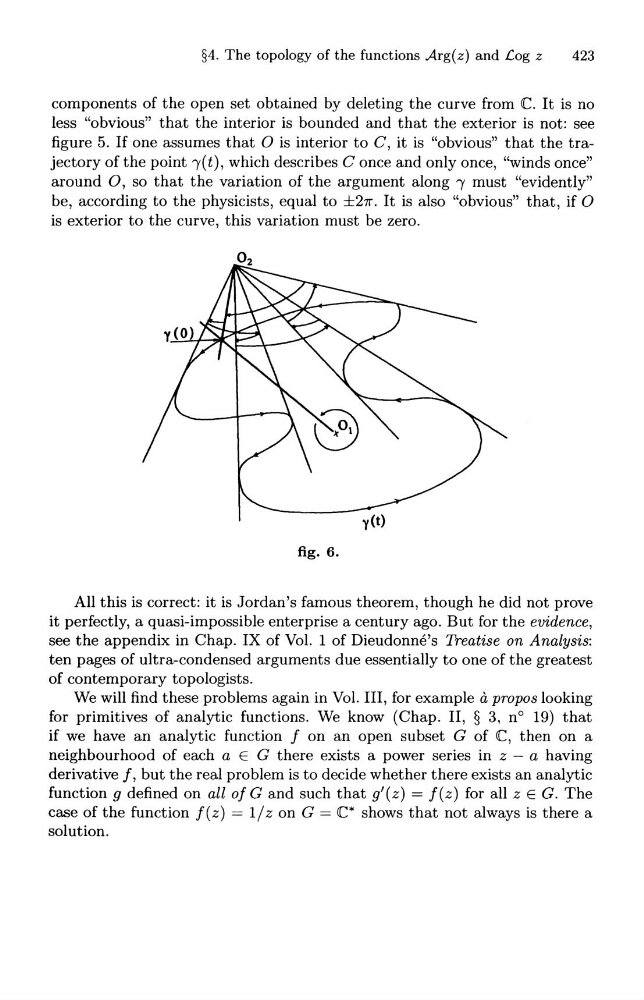
figure 5. If one assumes that 0 is interior to C, it is "obvious" that the trajectory of the point I'(t), which describes C once and only once, "winds once"
around 0, so that the variation of the argument along I' must "evidently"
be, according to the physicists, equal to ±27r. It is also "obvious" that, if 0
is exterior to the curve, this variation must be zero.
y(t)
fig. 6.
All this is correct: it is Jordan's famous theorem, though he did not prove
it perfectly, a quasi-impossible enterprise a century ago. But for the evidence,
see the appendix in Chap. IX of Vol. 1 of Dieudonne's Treatise on Analysis:
ten pages of ultra-condensed arguments due essentially to one of the greatest
of contemporary topologists.
We will find these problems again in Vol. III, for example a propos looking
for primitives of analytic functions. We know (Chap. II, § 3, nO 19) that
if we have an analytic function J on an open subset G of C, then on a
neighbourhood of each a E G there exists a power series in z - a having
derivative J, but the real problem is to decide whether there exists an analytic
function 9 defined on all oj G and such that g'(z) = J(z) for all z E G. The
case of the function J(z) = liz on G = C* shows that not always is there a
solution.
423
components of the open set obtained by deleting the curve from C. It is no
less "obvious" that the interior is bounded and that the exterior is not: see
figure 5. If one assumes that 0 is interior to C, it is "obvious" that the trajectory of the point I'(t), which describes C once and only once, "winds once"
around 0, so that the variation of the argument along I' must "evidently"
be, according to the physicists, equal to ±27r. It is also "obvious" that, if 0
is exterior to the curve, this variation must be zero.
y(t)
fig. 6.
All this is correct: it is Jordan's famous theorem, though he did not prove
it perfectly, a quasi-impossible enterprise a century ago. But for the evidence,
see the appendix in Chap. IX of Vol. 1 of Dieudonne's Treatise on Analysis:
ten pages of ultra-condensed arguments due essentially to one of the greatest
of contemporary topologists.
We will find these problems again in Vol. III, for example a propos looking
for primitives of analytic functions. We know (Chap. II, § 3, nO 19) that
if we have an analytic function J on an open subset G of C, then on a
neighbourhood of each a E G there exists a power series in z - a having
derivative J, but the real problem is to decide whether there exists an analytic
function 9 defined on all oj G and such that g'(z) = J(z) for all z E G. The
case of the function J(z) = liz on G = C* shows that not always is there a
solution.