

422
IV - Powers, Exponentials, Logarithms, Trigonometric Functions
ment equal to the value at departure increased by 2krr, where the integer k
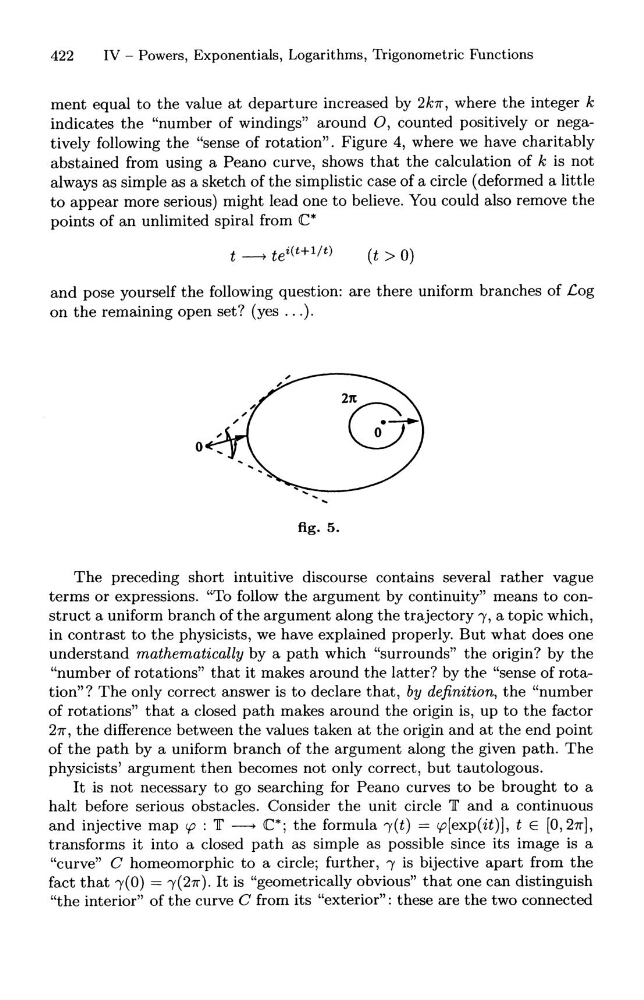
indicates the "number of windings" around 0, counted positively or negatively following the "sense of rotation". Figure 4, where we have charitably
abstained from using a Peano curve, shows that the calculation of k is not
always as simple as a sketch of the simplistic case of a circle (deformed a little
to appear more serious) might lead one to believe. You could also remove the
points of an unlimited spiral from C*
(t > 0)
and pose yourself the following question: are there uniform branches of Cog
on the remaining open set? (yes ... ).
o
fig. 5.
The preceding short intuitive discourse contains several rather vague
terms or expressions. "To follow the argument by continuity" means to construct a uniform branch ofthe argument along the trajectory ,,(, a topic which,
in contrast to the physicists, we have explained properly. But what does one
understand mathematically by a path which "surrounds" the origin? by the
"numbpr of rotations" that it makes around the latter? by the "sense of rotation"? The only correct answer is to declare that, by definition, the "number
of rotations" that a closed path makes around the origin is, up to the factor
2rr, the difference between the values taken at the origin and at the end point
of the path by a uniform branch of the argument along the given path. The
physicists' argument then becomes not only correct, but tautologous.
It is not necessary to go searching for Peano curves to be brought to a
halt before serious obstacles. Consider the unit circle 11' and a continuous
and injective map transforms it into a closed path as simple as possible since its image is a
"curve" C homeomorphic to a circle; further, "( is bijective apart from the
fact that "((0) = "((2rr). It is "geometrically obvious" that one can distinguish
"the interior" of the curve C from its "exterior": these are the two connected
IV - Powers, Exponentials, Logarithms, Trigonometric Functions
ment equal to the value at departure increased by 2krr, where the integer k
indicates the "number of windings" around 0, counted positively or negatively following the "sense of rotation". Figure 4, where we have charitably
abstained from using a Peano curve, shows that the calculation of k is not
always as simple as a sketch of the simplistic case of a circle (deformed a little
to appear more serious) might lead one to believe. You could also remove the
points of an unlimited spiral from C*
(t > 0)
and pose yourself the following question: are there uniform branches of Cog
on the remaining open set? (yes ... ).
o
fig. 5.
The preceding short intuitive discourse contains several rather vague
terms or expressions. "To follow the argument by continuity" means to construct a uniform branch ofthe argument along the trajectory ,,(, a topic which,
in contrast to the physicists, we have explained properly. But what does one
understand mathematically by a path which "surrounds" the origin? by the
"numbpr of rotations" that it makes around the latter? by the "sense of rotation"? The only correct answer is to declare that, by definition, the "number
of rotations" that a closed path makes around the origin is, up to the factor
2rr, the difference between the values taken at the origin and at the end point
of the path by a uniform branch of the argument along the given path. The
physicists' argument then becomes not only correct, but tautologous.
It is not necessary to go searching for Peano curves to be brought to a
halt before serious obstacles. Consider the unit circle 11' and a continuous
and injective map transforms it into a closed path as simple as possible since its image is a
"curve" C homeomorphic to a circle; further, "( is bijective apart from the
fact that "((0) = "((2rr). It is "geometrically obvious" that one can distinguish
"the interior" of the curve C from its "exterior": these are the two connected