

§ 1. Direct construction
333
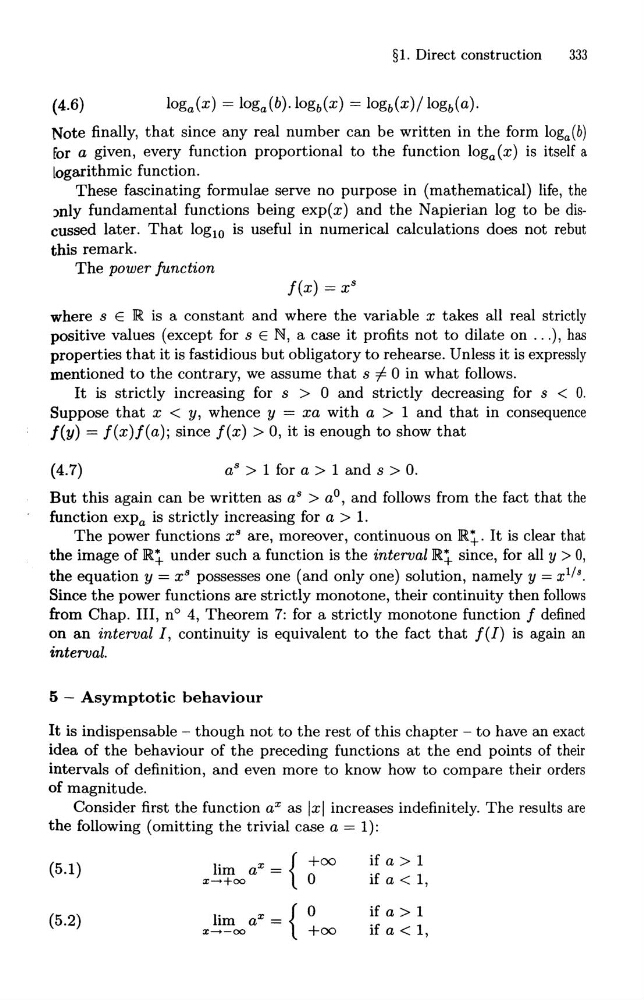
(4.6)
Note finally, that since any real number can be written in the form loga(b)
for a given, every function proportional to the function loga(x) is itself a
logarithmic function.
These fascinating formulae serve no purpose in (mathematical) life, the
)nly fundamental functions being exp(x) and the Napierian log to be discussed later. That IOglO is useful in numerical calculations does not rebut
this remark.
The power function
f(x) = X S
where s E IR is a constant and where the variable x takes all real strictly
positive values (except for sEN, a case it profits not to dilate on ... ), has
properties that it is fastidious but obligatory to rehearse. Unless it is expressly
mentioned to the contrary, we assume that S =f. 0 in what follows.
It is strictly increasing for s > 0 and strictly decreasing for s < o.
Suppose that x < y, whence y = xa with a > 1 and that in consequence
I(y) = f(x)f(a)j since f(x) > 0, it is enough to show that
(4.7)
as > 1 for a > 1 and s > o.
But this again can be written as as > a O , and follows from the fact that the
function eXPa is strictly increasing for a > 1.
The power functions x 8 are, moreover, continuous on 1R+. It is clear that
the image of 1R+ under such a function is the intervallR+ since, for all y > 0,
the equation y = x 8 possesses one (and only one) solution, namely y = Xl/s.
Since the power functions are strictly monotone, their continuity then follows
from Chap. III, nO 4, Theorem 7: for a strictly monotone function I defined
on an interval I, continuity is equivalent to the fact that f(l) is again an
interval.
5 - Asymptotic behaviour
It is indispensable - though not to the rest of this chapter - to have an exact
idea of the behaviour of the preceding functions at the end points of their
intervals of definition, and even more to know how to compare their orders
of magnitude.
Consider first the function aX as Ixl increases indefinitely. The results are
the following (omitting the trivial case a = 1):
(5.1)
lim aX = { +00
if a > 1
X-++OO
0
if a < 1,
(5.2)
lim aX = {
0
if a > 1
3:--+-00
+00
if a < 1,
333
(4.6)
Note finally, that since any real number can be written in the form loga(b)
for a given, every function proportional to the function loga(x) is itself a
logarithmic function.
These fascinating formulae serve no purpose in (mathematical) life, the
)nly fundamental functions being exp(x) and the Napierian log to be discussed later. That IOglO is useful in numerical calculations does not rebut
this remark.
The power function
f(x) = X S
where s E IR is a constant and where the variable x takes all real strictly
positive values (except for sEN, a case it profits not to dilate on ... ), has
properties that it is fastidious but obligatory to rehearse. Unless it is expressly
mentioned to the contrary, we assume that S =f. 0 in what follows.
It is strictly increasing for s > 0 and strictly decreasing for s < o.
Suppose that x < y, whence y = xa with a > 1 and that in consequence
I(y) = f(x)f(a)j since f(x) > 0, it is enough to show that
(4.7)
as > 1 for a > 1 and s > o.
But this again can be written as as > a O , and follows from the fact that the
function eXPa is strictly increasing for a > 1.
The power functions x 8 are, moreover, continuous on 1R+. It is clear that
the image of 1R+ under such a function is the intervallR+ since, for all y > 0,
the equation y = x 8 possesses one (and only one) solution, namely y = Xl/s.
Since the power functions are strictly monotone, their continuity then follows
from Chap. III, nO 4, Theorem 7: for a strictly monotone function I defined
on an interval I, continuity is equivalent to the fact that f(l) is again an
interval.
5 - Asymptotic behaviour
It is indispensable - though not to the rest of this chapter - to have an exact
idea of the behaviour of the preceding functions at the end points of their
intervals of definition, and even more to know how to compare their orders
of magnitude.
Consider first the function aX as Ixl increases indefinitely. The results are
the following (omitting the trivial case a = 1):
(5.1)
lim aX = { +00
if a > 1
X-++OO
0
if a < 1,
(5.2)
lim aX = {
0
if a > 1
3:--+-00
+00
if a < 1,