

332
IV - Powers, Exponentials, Logarithms, Trigonometric Functions
4 - Logarithms to base a. Power functions
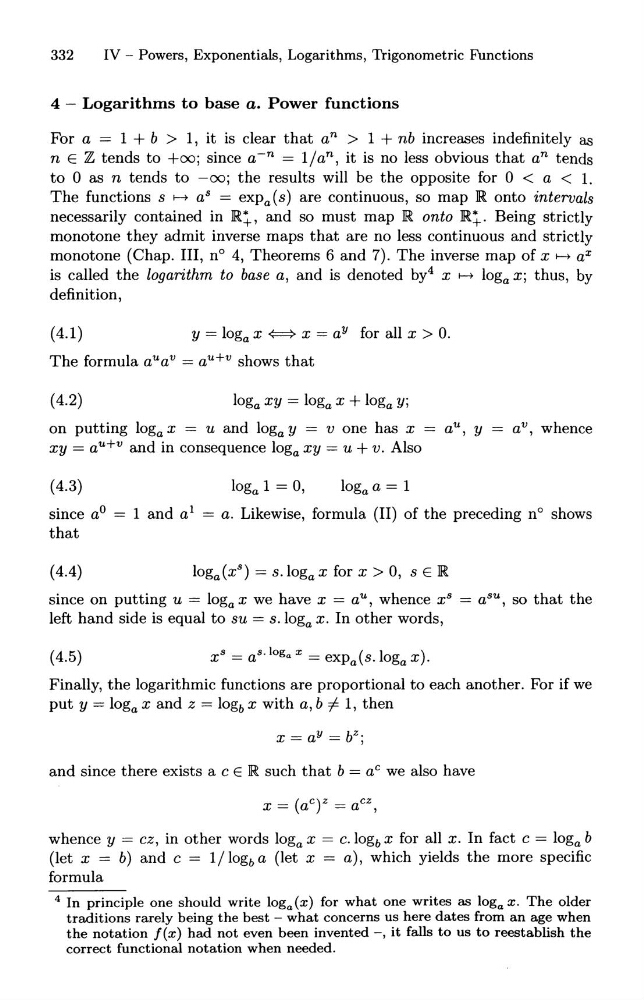
For a = 1 + b > 1, it is clear that an > 1 + nb increases indefinitely as
n E Z tends to +00; since a- n = 1/a n , it is no less obvious that an tends
to 0 as n tends to -00; the results will be the opposite for 0 < a < 1.
The functions S t--+ as = eXPa(s) are continuous, so map lR onto intervals
necessarily contained in 1R+, and so must map IR onto 1R+. Being strictly
monotone they admit inverse maps that are no less continuous and strictly
monotone (Chap. III, nO 4, Theorems 6 and 7). The inverse map of x t--+ aX
is called the logarithm to base a, and is denoted by4 x t--+ loga x; thus, by
definition,
(4.1)
y = loga x ~ x = a Y for all x > o.
The formula aUa V = a U + v shows that
(4.2)
loga xy = loga x + loga Y;
on putting loga x
U and loga Y = v one has x
aU, Y
aV, whence
xy = a U + v and in consequence loga xy = u + v. Also
(4.3)
loga 1 = 0,
loga a = 1
since aO = 1 and a l = a. Likewise, formula (II) of the preceding n° shows
that
(4.4)
since on putting u = loga x we have x = aU, whence X S = a Su , so that the
left hand side is equal to su = s.loga x. In other words,
(4.5)
Finally, the logarithmic functions are proportional to each another. For if we
put y = loga x and z = 10gb x with a, b =I- 1, then
and since there exists acE IR such that b = a C we also have
whence y = CZ, in other words loga x = c.logb x for all x. In fact c = loga b
(let x = b) and c = 1/ 10gb a (let x = a), which yields the more specific
formula
4 In principle one should write loga(x) for what one writes as loga x. The older
traditions rarely being the best - what concerns us here dates from an age when
the notation f(x) had not even been invented -, it falls to us to reestablish the
correct functional notation when needed.
IV - Powers, Exponentials, Logarithms, Trigonometric Functions
4 - Logarithms to base a. Power functions
For a = 1 + b > 1, it is clear that an > 1 + nb increases indefinitely as
n E Z tends to +00; since a- n = 1/a n , it is no less obvious that an tends
to 0 as n tends to -00; the results will be the opposite for 0 < a < 1.
The functions S t--+ as = eXPa(s) are continuous, so map lR onto intervals
necessarily contained in 1R+, and so must map IR onto 1R+. Being strictly
monotone they admit inverse maps that are no less continuous and strictly
monotone (Chap. III, nO 4, Theorems 6 and 7). The inverse map of x t--+ aX
is called the logarithm to base a, and is denoted by4 x t--+ loga x; thus, by
definition,
(4.1)
y = loga x ~ x = a Y for all x > o.
The formula aUa V = a U + v shows that
(4.2)
loga xy = loga x + loga Y;
on putting loga x
U and loga Y = v one has x
aU, Y
aV, whence
xy = a U + v and in consequence loga xy = u + v. Also
(4.3)
loga 1 = 0,
loga a = 1
since aO = 1 and a l = a. Likewise, formula (II) of the preceding n° shows
that
(4.4)
since on putting u = loga x we have x = aU, whence X S = a Su , so that the
left hand side is equal to su = s.loga x. In other words,
(4.5)
Finally, the logarithmic functions are proportional to each another. For if we
put y = loga x and z = 10gb x with a, b =I- 1, then
and since there exists acE IR such that b = a C we also have
whence y = CZ, in other words loga x = c.logb x for all x. In fact c = loga b
(let x = b) and c = 1/ 10gb a (let x = a), which yields the more specific
formula
4 In principle one should write loga(x) for what one writes as loga x. The older
traditions rarely being the best - what concerns us here dates from an age when
the notation f(x) had not even been invented -, it falls to us to reestablish the
correct functional notation when needed.