

§5. Differentiable functions of several variables
301
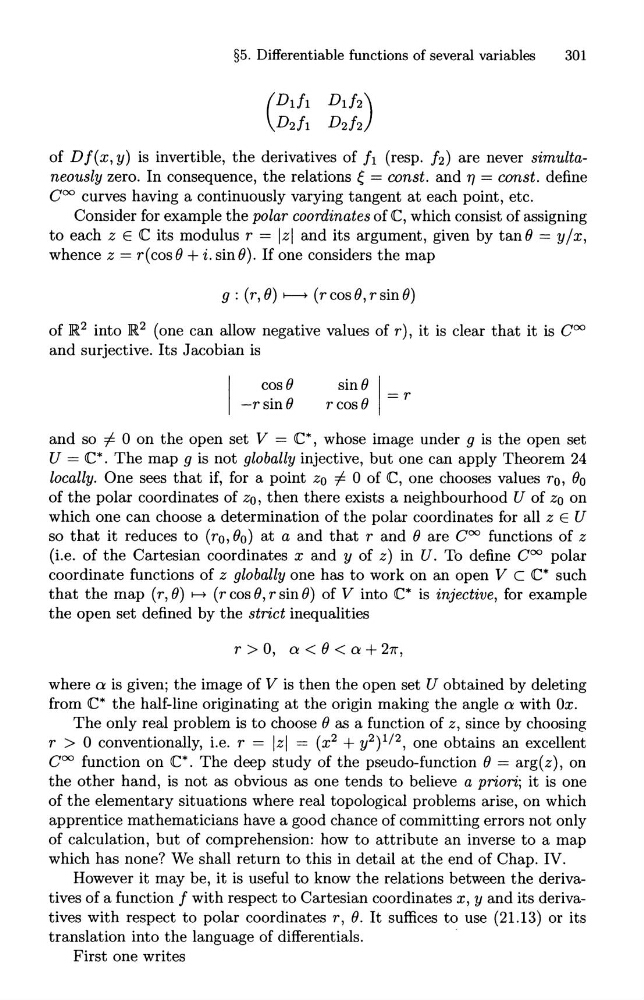
of D f (x, y) is invertible, the derivatives of h (resp. h) are never simultaneously zero. In consequence, the relations ~ = const. and 7J = const. define
Coo curves having a continuously varying tangent at each point, etc.
Consider for example the polar coordinates of C, which consist of assigning
to each z E C its modulus r = Izl and its argument, given by tanB = y/x,
whence z = r( cos B + i. sin B). If one considers the map
g: (r,B) t--+ (rcosB,rsinB)
of]R2 into ]R2 (one can allow negative values of r), it is clear that it is Coo
and surjective. Its Jacobian is
I
cosB
-r sin B
sinB I - r
rcosB -
and so i= 0 on the open set V = C*, whose image under g is the open set
U = C*. The map g is not globally injective, but one can apply Theorem 24
locally. One sees that if, for a point Zo i= 0 of C, one chooses values ro, Bo
of the polar coordinates of zo, then there exists a neighbourhood U of Zo on
which one can choose a determination of the polar coordinates for all z E U
so that it reduces to (ro, Bo) at a and that r and B are Coo functions of z
(i.e. of the Cartesian coordinates x and y of z) in U. To define Coo polar
coordinate functions of z globally one has to work on an open V C C* such
that the map (r, B) 1-+ (r cos B, r sin B) of V into C* is injective, for example
the open set defined by the strict inequalities
r > 0, a < B < a + 27r,
where a is given; the image of V is then the open set U obtained by deleting
from C* the half-line originating at the origin making the angle a with Ox.
The only real problem is to choose B as a function of z, since by choosing
r > 0 conventionally, i.e. r = Izl = (x 2 + y2)1/2, one obtains an excellent
Coo function on C*. The deep study of the pseudo-function B = arg(z), on
the other hand, is not as obvious as one tends to believe a priori; it is one
of the elementary situations where real topological problems arise, on which
apprentice mathematicians have a good chance of committing errors not only
of calculation, but of comprehension: how to attribute an inverse to a map
which has none? We shall return to this in detail at the end of Chap. IV.
However it may be, it is useful to know the relations between the derivatives of a function f with respect to Cartesian coordinates x, y and its derivatives with respect to polar coordinates r, B. It suffices to use (21.13) or its
translation into the language of differentials.
First one writes
301
of D f (x, y) is invertible, the derivatives of h (resp. h) are never simultaneously zero. In consequence, the relations ~ = const. and 7J = const. define
Coo curves having a continuously varying tangent at each point, etc.
Consider for example the polar coordinates of C, which consist of assigning
to each z E C its modulus r = Izl and its argument, given by tanB = y/x,
whence z = r( cos B + i. sin B). If one considers the map
g: (r,B) t--+ (rcosB,rsinB)
of]R2 into ]R2 (one can allow negative values of r), it is clear that it is Coo
and surjective. Its Jacobian is
I
cosB
-r sin B
sinB I - r
rcosB -
and so i= 0 on the open set V = C*, whose image under g is the open set
U = C*. The map g is not globally injective, but one can apply Theorem 24
locally. One sees that if, for a point Zo i= 0 of C, one chooses values ro, Bo
of the polar coordinates of zo, then there exists a neighbourhood U of Zo on
which one can choose a determination of the polar coordinates for all z E U
so that it reduces to (ro, Bo) at a and that r and B are Coo functions of z
(i.e. of the Cartesian coordinates x and y of z) in U. To define Coo polar
coordinate functions of z globally one has to work on an open V C C* such
that the map (r, B) 1-+ (r cos B, r sin B) of V into C* is injective, for example
the open set defined by the strict inequalities
r > 0, a < B < a + 27r,
where a is given; the image of V is then the open set U obtained by deleting
from C* the half-line originating at the origin making the angle a with Ox.
The only real problem is to choose B as a function of z, since by choosing
r > 0 conventionally, i.e. r = Izl = (x 2 + y2)1/2, one obtains an excellent
Coo function on C*. The deep study of the pseudo-function B = arg(z), on
the other hand, is not as obvious as one tends to believe a priori; it is one
of the elementary situations where real topological problems arise, on which
apprentice mathematicians have a good chance of committing errors not only
of calculation, but of comprehension: how to attribute an inverse to a map
which has none? We shall return to this in detail at the end of Chap. IV.
However it may be, it is useful to know the relations between the derivatives of a function f with respect to Cartesian coordinates x, y and its derivatives with respect to polar coordinates r, B. It suffices to use (21.13) or its
translation into the language of differentials.
First one writes