

254
III - Convergence: Continuous variables
p(a + hQ) = f(a + hQ)g(a + hQ).
In other words, the value of a product (or of a sum, or of a quotient) of
two functions is the product (or ... ) of their values.
(D 3) If f and 9 are differentiable at a and if g(a) =1= 0 then so is their
quotient q(x) = f(x)/g(x), and
'( ) _ f'(a)g(a) - f(a)g'(a)
q a -
g(a)2
.
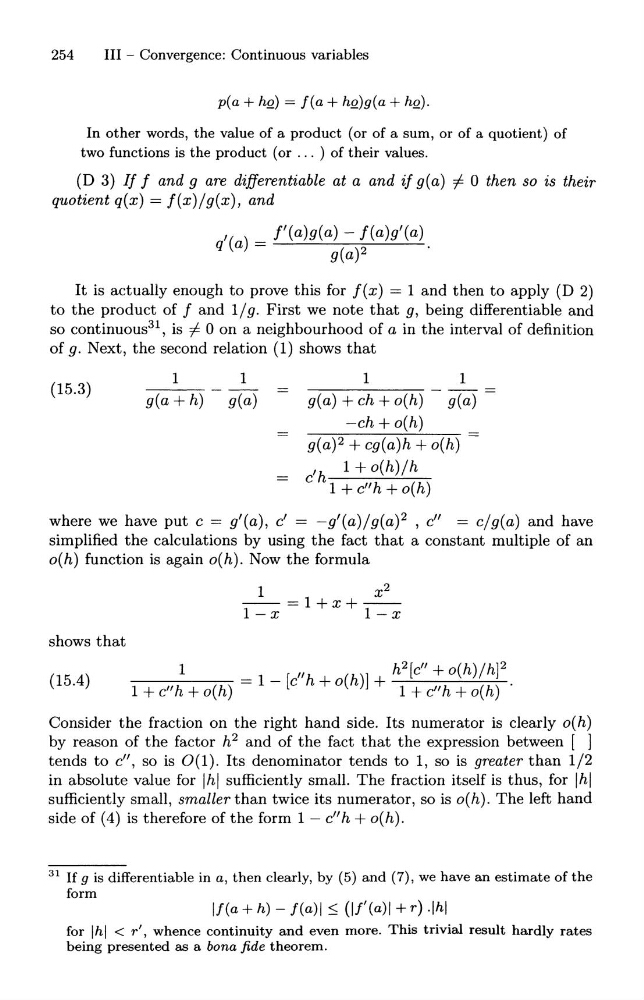
It is actually enough to prove this for f(x) = 1 and then to apply (D 2)
to the product of f and 1/ g. First we note that g, being differentiable and
so continuous 31 , is =1= 0 on a neighbourhood of a in the interval of definition
of g. Next, the second relation (1) shows that
(15.3)
1
g(a + h)
1
g(a)
1
1
g(a) + eh + o(h) g(a)
-eh + o(h)
g(a)2 + eg(a)h + o(h)
e'h 1 + o(h)/h
1 + e"h + o(h)
where we have put e = g'(a), e' = -g'(a)/g(a)2 ,e" = e/g(a) and have
simplified the calculations by using the fact that a constant multiple of an
o(h) function is again o(h). Now the formula
shows that
(15.4)
1
x 2
- - = I + x + - -
I-x
I-x
1
h2[e" + 0(h)/h]2
-------,--,- = 1 - [e" h + o(h)] +
.
1 + c"h + o(h)
1 + e"h + o(h)
Consider the fraction on the right hand side. Its numerator is clearly o(h)
by reason of the factor h 2 and of the fact that the expression between [ ]
tends to e', so is 0(1). Its denominator tends to 1, so is greater than 1/2
in absolute value for Ihl sufficiently small. The fraction itself is thus, for Ihl
sufficiently small, smaller than twice its numerator, so is o(h). The left hand
side of (4) is therefore of the form 1 - e" h + o( h).
31 If 9 is differentiable in a, then clearly, by (5) and (7), we have an estimate of the
form
If(a + h) - f(a)1 :' S: (If' (a)1 + r) ·Ihl
for Ihl < r', whence continuity and even more. This trivial result hardly rates
being presented as a bona fide theorem.
III - Convergence: Continuous variables
p(a + hQ) = f(a + hQ)g(a + hQ).
In other words, the value of a product (or of a sum, or of a quotient) of
two functions is the product (or ... ) of their values.
(D 3) If f and 9 are differentiable at a and if g(a) =1= 0 then so is their
quotient q(x) = f(x)/g(x), and
'( ) _ f'(a)g(a) - f(a)g'(a)
q a -
g(a)2
.
It is actually enough to prove this for f(x) = 1 and then to apply (D 2)
to the product of f and 1/ g. First we note that g, being differentiable and
so continuous 31 , is =1= 0 on a neighbourhood of a in the interval of definition
of g. Next, the second relation (1) shows that
(15.3)
1
g(a + h)
1
g(a)
1
1
g(a) + eh + o(h) g(a)
-eh + o(h)
g(a)2 + eg(a)h + o(h)
e'h 1 + o(h)/h
1 + e"h + o(h)
where we have put e = g'(a), e' = -g'(a)/g(a)2 ,e" = e/g(a) and have
simplified the calculations by using the fact that a constant multiple of an
o(h) function is again o(h). Now the formula
shows that
(15.4)
1
x 2
- - = I + x + - -
I-x
I-x
1
h2[e" + 0(h)/h]2
-------,--,- = 1 - [e" h + o(h)] +
.
1 + c"h + o(h)
1 + e"h + o(h)
Consider the fraction on the right hand side. Its numerator is clearly o(h)
by reason of the factor h 2 and of the fact that the expression between [ ]
tends to e', so is 0(1). Its denominator tends to 1, so is greater than 1/2
in absolute value for Ihl sufficiently small. The fraction itself is thus, for Ihl
sufficiently small, smaller than twice its numerator, so is o(h). The left hand
side of (4) is therefore of the form 1 - e" h + o( h).
31 If 9 is differentiable in a, then clearly, by (5) and (7), we have an estimate of the
form
If(a + h) - f(a)1 :' S: (If' (a)1 + r) ·Ihl
for Ihl < r', whence continuity and even more. This trivial result hardly rates
being presented as a bona fide theorem.