

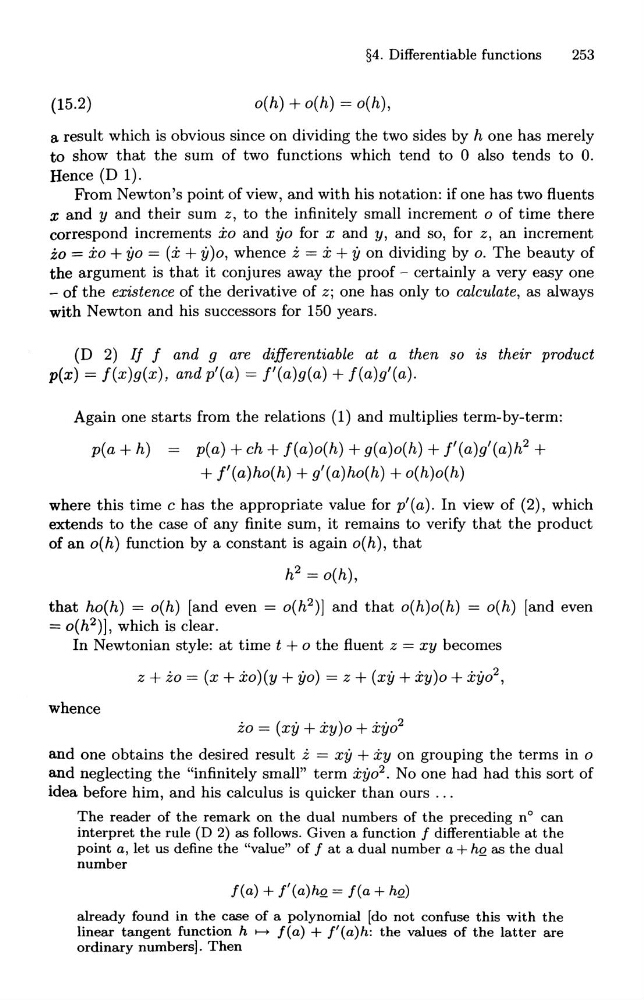
§4. Differentiable functions
253
(15.2)
o{h) + o(h) = o(h),
a result which is obvious since on dividing the two sides by h one has merely
to show that the sum of two functions which tend to 0 also tends to o.
Hence (D 1).
From Newton's point of view, and with his notation: if one has two fluents
x and y and their sum z, to the infinitely small increment 0 of time there
correspond increments :i;o and yo for x and y, and so, for z, an increment
io = :i;o + yo = (:i; + y)o, whence z = :i; + yon dividing byo. The beauty of
the argument is that it conjures away the proof - certainly a very easy one
- of the existence of the derivative of z; one has only to calculate, as always
with Newton and his successors for 150 years.
(D 2) If f and 9 are differentiable at a then so is their product
p{x) = f(x)g(x), and p'(a) = f'(a)g(a) + f(a)g'(a).
Again one starts from the relations (1) and multiplies term-by-term:
p(a+h)
p(a) + ch + f(a)o(h) + g(a)o(h) + J'(a)g'(a)h 2 +
+ f'(a)ho(h) + g'(a)ho(h) + o(h)o(h)
where this time c has the appropriate value for p'(a). In view of (2), which
extends to the case of any finite sum, it remains to verify that the product
of an o(h) function by a constant is again o(h), that
h 2 = o(h),
that ho(h) = o(h) [and even = o(h 2 )] and that o(h)o(h) = o(h) [and even
= o(h 2 )], which is clear.
In Newtonian style: at time t + 0 the fluent z = xy becomes
z + zo = (x + :i;o)(y + yo) = z + (xy + :i;y)o + :i;yo2,
whence
io = (xy + :i;y)o + :i;yo2
and one obtains the desired result i = xy +:i;y on grouping the terms in 0
and neglecting the "infinitely small" term :i;yo2. No one had had this sort of
idea before him, and his calculus is quicker than ours ...
The reader of the remark on the dual numbers of the preceding nO can
interpret the rule (D 2) as follows. Given a function f differentiable at the
point a, let us define the "value" of f at a dual number a + hQ as the dual
number
f(a) + j'(a)hQ = f(a + hQ)
already found in the case of a polynomial [do not confuse this with the
linear tangent function h 1-+ f(a) + f'(a)h: the values of the latter are
ordinary numbers]. Then
253
(15.2)
o{h) + o(h) = o(h),
a result which is obvious since on dividing the two sides by h one has merely
to show that the sum of two functions which tend to 0 also tends to o.
Hence (D 1).
From Newton's point of view, and with his notation: if one has two fluents
x and y and their sum z, to the infinitely small increment 0 of time there
correspond increments :i;o and yo for x and y, and so, for z, an increment
io = :i;o + yo = (:i; + y)o, whence z = :i; + yon dividing byo. The beauty of
the argument is that it conjures away the proof - certainly a very easy one
- of the existence of the derivative of z; one has only to calculate, as always
with Newton and his successors for 150 years.
(D 2) If f and 9 are differentiable at a then so is their product
p{x) = f(x)g(x), and p'(a) = f'(a)g(a) + f(a)g'(a).
Again one starts from the relations (1) and multiplies term-by-term:
p(a+h)
p(a) + ch + f(a)o(h) + g(a)o(h) + J'(a)g'(a)h 2 +
+ f'(a)ho(h) + g'(a)ho(h) + o(h)o(h)
where this time c has the appropriate value for p'(a). In view of (2), which
extends to the case of any finite sum, it remains to verify that the product
of an o(h) function by a constant is again o(h), that
h 2 = o(h),
that ho(h) = o(h) [and even = o(h 2 )] and that o(h)o(h) = o(h) [and even
= o(h 2 )], which is clear.
In Newtonian style: at time t + 0 the fluent z = xy becomes
z + zo = (x + :i;o)(y + yo) = z + (xy + :i;y)o + :i;yo2,
whence
io = (xy + :i;y)o + :i;yo2
and one obtains the desired result i = xy +:i;y on grouping the terms in 0
and neglecting the "infinitely small" term :i;yo2. No one had had this sort of
idea before him, and his calculus is quicker than ours ...
The reader of the remark on the dual numbers of the preceding nO can
interpret the rule (D 2) as follows. Given a function f differentiable at the
point a, let us define the "value" of f at a dual number a + hQ as the dual
number
f(a) + j'(a)hQ = f(a + hQ)
already found in the case of a polynomial [do not confuse this with the
linear tangent function h 1-+ f(a) + f'(a)h: the values of the latter are
ordinary numbers]. Then