

240
III - Convergence: Continuous variables
(i) un(x) tends to a limit Cn when x tends to a,
(ii) un(x) converges uniformly on X to a limit u(x).
Then u(x) tends to a limit C when x E X tends to a, and C = limcn, i.e.
(1) holds.
If a E X, the hypothesis (i) simply means that the Un are continuous at
the point a, the case already examined. Suppose now that a tf. X and consider
the functions Vn on the set X' = X U {a} given by
Vn(x) = un(x) if x E X,
Vn(x) = en if x = a.
Hypothesis (i) means that the Vn are continuous at the point a of X', as
remarked in nO 2. The relation (1) will thus be a consequence of the theorem
on the uniform limits of continuous functions if we can show that the Vn
converge to a limit function uniformly on X', and not only on X.
It is enough to show that it satisfies Cauchy's criterion for uniform convergence. Now hypothesis (ii) shows that for any r > 0 there exists an integer
N such that
p,q > N ==> dX (u 1 "uq) = dx(vp,vq) :::; r.
When x E X tends to a, Iup(x) -uq(x)1 tends, for p and q given, to lep-cql =
Ivp(a) - vq(a)l, which is thus:::; r. So dx'(vp, vq) :::; r, qed.
---- --------------- -.~-o
n
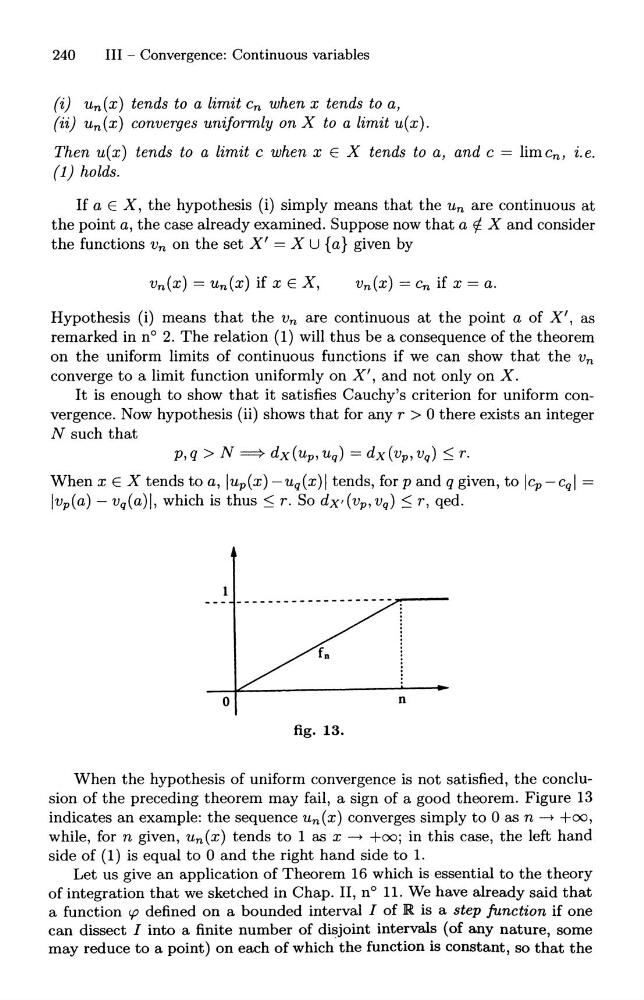
fig. 13.
When the hypothesis of uniform convergence is not satisfied, the conclusion of the preceding theorem may fail, a sign of a good theorem. Figure 13
indicates an example: the sequence un(x) converges simply to 0 as n --t +00,
while, for n given, un(x) tends to 1 as x --t +00; in this case, the left hand
side of (1) is equal to 0 and the right hand side to 1.
Let us give an application of Theorem 16 which is essential to the theory
of integration that we sketched in Chap. II, nO 11. We have already said that
a function cp defined on a bounded interval I of R is a step function if one
can dissect I into a finite number of disjoint intervals (of any nature, some
may reduce to a point) on each of which the function is constant, so that the
III - Convergence: Continuous variables
(i) un(x) tends to a limit Cn when x tends to a,
(ii) un(x) converges uniformly on X to a limit u(x).
Then u(x) tends to a limit C when x E X tends to a, and C = limcn, i.e.
(1) holds.
If a E X, the hypothesis (i) simply means that the Un are continuous at
the point a, the case already examined. Suppose now that a tf. X and consider
the functions Vn on the set X' = X U {a} given by
Vn(x) = un(x) if x E X,
Vn(x) = en if x = a.
Hypothesis (i) means that the Vn are continuous at the point a of X', as
remarked in nO 2. The relation (1) will thus be a consequence of the theorem
on the uniform limits of continuous functions if we can show that the Vn
converge to a limit function uniformly on X', and not only on X.
It is enough to show that it satisfies Cauchy's criterion for uniform convergence. Now hypothesis (ii) shows that for any r > 0 there exists an integer
N such that
p,q > N ==> dX (u 1 "uq) = dx(vp,vq) :::; r.
When x E X tends to a, Iup(x) -uq(x)1 tends, for p and q given, to lep-cql =
Ivp(a) - vq(a)l, which is thus:::; r. So dx'(vp, vq) :::; r, qed.
---- --------------- -.~-o
n
fig. 13.
When the hypothesis of uniform convergence is not satisfied, the conclusion of the preceding theorem may fail, a sign of a good theorem. Figure 13
indicates an example: the sequence un(x) converges simply to 0 as n --t +00,
while, for n given, un(x) tends to 1 as x --t +00; in this case, the left hand
side of (1) is equal to 0 and the right hand side to 1.
Let us give an application of Theorem 16 which is essential to the theory
of integration that we sketched in Chap. II, nO 11. We have already said that
a function cp defined on a bounded interval I of R is a step function if one
can dissect I into a finite number of disjoint intervals (of any nature, some
may reduce to a point) on each of which the function is constant, so that the