

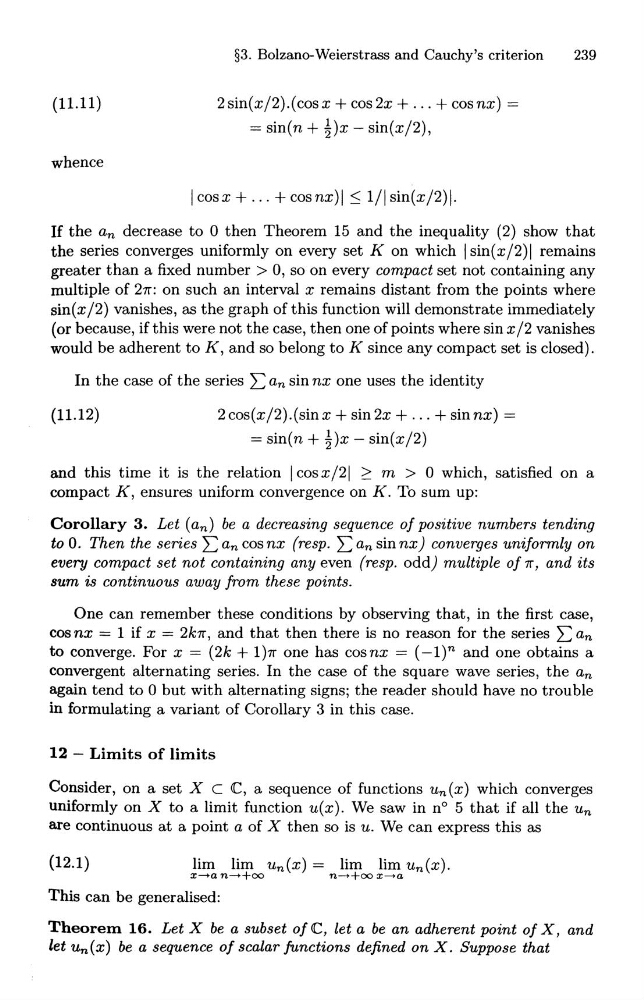
(11.11)
whence
§3. Bolzano-Weierstrass and Cauchy's criterion
239
2 sin(x/2).(cos x + cos2x + ... + cosnx) =
= sin(n + ~)x - sin(x/2)'
I cos x + ... + cosnx)1 :::; 1/1 sin(x/2)1·
If the an decrease to 0 then Theorem 15 and the inequality (2) show that
the series converges uniformly on every set K on which I sin(x/2)1 remains
greater than a fixed number> 0, so on every compact set not containing any
multiple of 2rr: on such an interval x remains distant from the points where
sin(x/2) vanishes, as the graph of this function will demonstrate immediately
(or because, if this were not the case, then one of points where sin x /2 vanishes
would be adherent to K, and so belong to K since any compact set is closed).
In the case of the series L an sin nx one uses the identity
(11.12)
2cos(x/2).(sinx + sin2x + ... + sinnx) =
= sin(n + !)x - sin(x/2)
and this time it is the relation I cosx/21 ~ m > 0 which, satisfied on a
compact K, ensures uniform convergence on K. To sum up:
Corollary 3. Let (an) be a decreasing sequence of positive numbers tending
to o. Then the series L an cos nx (resp. L an sin nx) converges uniformly on
every compact set not containing any even (resp. odd) multiple of rr, and its
sum is continuous away from these points.
One can remember these conditions by observing that, in the first case,
cos nx = 1 if x = 2krr, and that then there is no reason for the series L an
to converge. For x = (2k + l)rr one has cosnx = (_I)n and one obtains a
convergent alternating series. In the case of the square wave series, the an
again tend to 0 but with alternating signs; the reader should have no trouble
in formulating a variant of Corollary 3 in this case.
12 - Limits of limits
Consider, on a set X C C, a sequence of functions un(x) which converges
uniformly on X to a limit function u(x). We saw in nO 5 that if all the Un
are continuous at a point a of X then so is u. We can express this as
(12.1)
lim lim un(x) = lim lim un(x).
x~an~+~
n~+~x~a
This can be generalised:
Theorem 16. Let X be a subset ofC, let a be an adherent point of X, and
let un(x) be a sequence of scalar functions defined on X. Suppose that
whence
§3. Bolzano-Weierstrass and Cauchy's criterion
239
2 sin(x/2).(cos x + cos2x + ... + cosnx) =
= sin(n + ~)x - sin(x/2)'
I cos x + ... + cosnx)1 :::; 1/1 sin(x/2)1·
If the an decrease to 0 then Theorem 15 and the inequality (2) show that
the series converges uniformly on every set K on which I sin(x/2)1 remains
greater than a fixed number> 0, so on every compact set not containing any
multiple of 2rr: on such an interval x remains distant from the points where
sin(x/2) vanishes, as the graph of this function will demonstrate immediately
(or because, if this were not the case, then one of points where sin x /2 vanishes
would be adherent to K, and so belong to K since any compact set is closed).
In the case of the series L an sin nx one uses the identity
(11.12)
2cos(x/2).(sinx + sin2x + ... + sinnx) =
= sin(n + !)x - sin(x/2)
and this time it is the relation I cosx/21 ~ m > 0 which, satisfied on a
compact K, ensures uniform convergence on K. To sum up:
Corollary 3. Let (an) be a decreasing sequence of positive numbers tending
to o. Then the series L an cos nx (resp. L an sin nx) converges uniformly on
every compact set not containing any even (resp. odd) multiple of rr, and its
sum is continuous away from these points.
One can remember these conditions by observing that, in the first case,
cos nx = 1 if x = 2krr, and that then there is no reason for the series L an
to converge. For x = (2k + l)rr one has cosnx = (_I)n and one obtains a
convergent alternating series. In the case of the square wave series, the an
again tend to 0 but with alternating signs; the reader should have no trouble
in formulating a variant of Corollary 3 in this case.
12 - Limits of limits
Consider, on a set X C C, a sequence of functions un(x) which converges
uniformly on X to a limit function u(x). We saw in nO 5 that if all the Un
are continuous at a point a of X then so is u. We can express this as
(12.1)
lim lim un(x) = lim lim un(x).
x~an~+~
n~+~x~a
This can be generalised:
Theorem 16. Let X be a subset ofC, let a be an adherent point of X, and
let un(x) be a sequence of scalar functions defined on X. Suppose that