

180
II - Convergence: Discrete variables
(23.2)
Gk(L) = L l/w k = L 1/ (nlwi + n2w2)k
of 1847, where one sums over all the periods W E L, with 0 obviously excluded.
These vanish for k odd, but they are the series 2:= 1/lwl k which interest us
here.
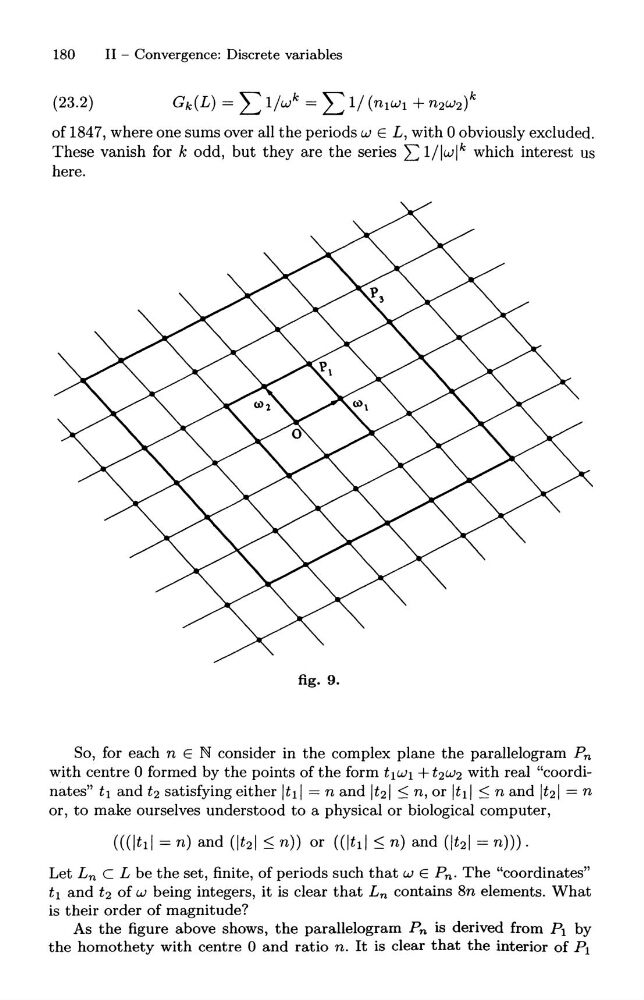
fig. 9.
So, for each n E N consider in the complex plane the parallelogram Pn
with centre 0 formed by the points of the form tlWI + t2w2 with real "coordinates" tl and t2 satisfying either Ih I = nand It21 ::; n, or Itll ::; nand It21 = n
or, to make ourselves understood to a physical or biological computer,
(((It I I = n) and (It21 ::; n)) or ((Ihl ::; n) and (lhl = n))).
Let Ln C L be the set, finite, of periods such that W E Pn. The "coordinates"
tl and t2 of W being integers, it is clear that Ln contains 8n elements. What
is their order of magnitude?
As the figure above shows, the parallelogram Pn is derived from PI by
the homothety with centre 0 and ratio n. It is clear that the interior of PI
II - Convergence: Discrete variables
(23.2)
Gk(L) = L l/w k = L 1/ (nlwi + n2w2)k
of 1847, where one sums over all the periods W E L, with 0 obviously excluded.
These vanish for k odd, but they are the series 2:= 1/lwl k which interest us
here.
fig. 9.
So, for each n E N consider in the complex plane the parallelogram Pn
with centre 0 formed by the points of the form tlWI + t2w2 with real "coordinates" tl and t2 satisfying either Ih I = nand It21 ::; n, or Itll ::; nand It21 = n
or, to make ourselves understood to a physical or biological computer,
(((It I I = n) and (It21 ::; n)) or ((Ihl ::; n) and (lhl = n))).
Let Ln C L be the set, finite, of periods such that W E Pn. The "coordinates"
tl and t2 of W being integers, it is clear that Ln contains 8n elements. What
is their order of magnitude?
As the figure above shows, the parallelogram Pn is derived from PI by
the homothety with centre 0 and ratio n. It is clear that the interior of PI