

§3. First concepts of analytic functions
179
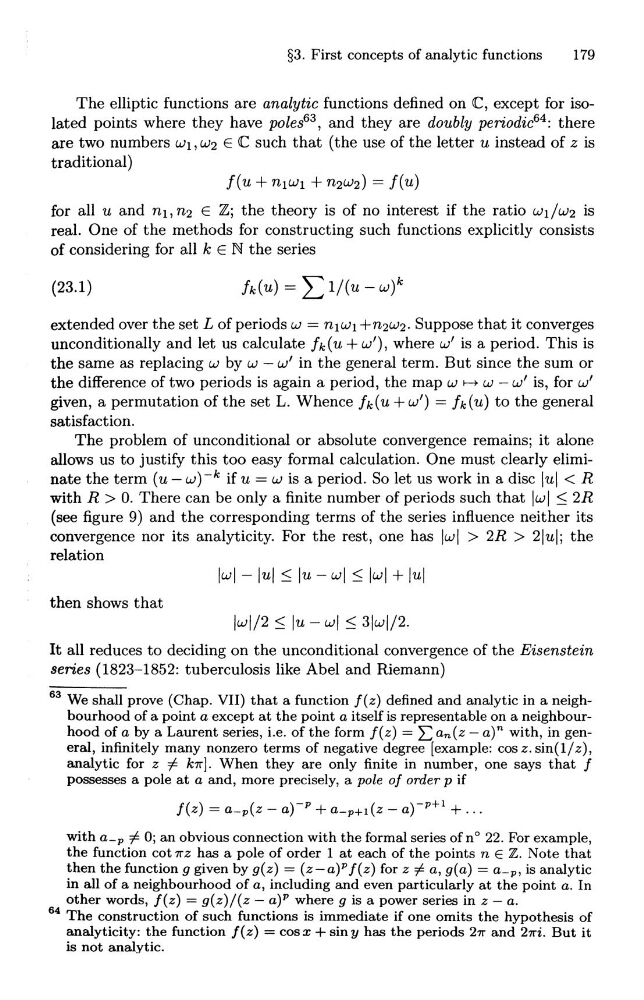
The elliptic functions are analytic functions defined on C, except for isolated points where they have poles 63 , and they are doubly periodic 64 : there
are two numbers WI, W2 E C such that (the use of the letter u instead of z is
traditional)
f(u + nlWl + n2w2) = f(u)
for all u and nl, n2 E Z; the theory is of no interest if the ratio wI/w2 is
real. One of the methods for constructing such functions explicitly consists
of considering for all kEN the series
(23.1)
extended over the set L of periods W = nlWI +n2w2. Suppose that it converges
unconditionally and let us calculate h(u + w'), where w' is a period. This is
the same as replacing w by w - w' in the general term. But since the sum or
the difference of two periods is again a period, the map w ~ w - w' is, for w'
given, a permutation ofthe set L. Whence fd u + w') = fk (u) to the general
satisfaction.
The problem of unconditional or absolute convergence remains; it alone
allows us to justify this too easy formal calculation. One must clearly eliminate the term (u - w) -k if u = w is a period. So let us work in a disc lui < R
with R > O. There can be only a finite number of periods such that Iw I :::; 2R
(see figure 9) and the corresponding terms of the series influence neither its
convergence nor its analyticity. For the rest, one has Iwl > 2R > 21ul; the
relation
Iwl - lui:::; lu - wi :::; Iwl + lui
then shows that
Iwl/2 :::; lu - wi :::; 31w1/2.
It all reduces to deciding on the unconditional convergence of the Eisenstein
series (1823-1852: tuberculosis like Abel and Riemann)
63 We shall prove (Chap. VII) that a function J(z) defined and analytic in a neighbourhood of a point a except at the point a itself is representable on a neighbourhood of a by a Laurent series, i.e. of the form J(z) = L an(z - a)n with, in general, infinitely many nonzero terms of negative degree [example: cosz.sin(l/z),
analytic for z # k7r]. When they are only finite in number, one says that J
possesses a pole at a and, more precisely, a pole oj order p if
J(z) = a_p(z - a)-P + a-pH(z - a)-PH + ...
with a_p # OJ an obvious connection with the formal series of nO 22. For example,
the function cot 7rZ has a pole of order 1 at each of the points n E Z. Note that
then the function g given by g(z) = (z-a)P J(z) for z # a, g(a) = a_ p, is analytic
in all of a neighbourhood of a, including and even particularly at the point a. In
other words, J(z) = g(z)/(z - a)P where g is a power series in z - a.
64 The construction of such functions is immediate if one omits the hypothesis of
analyticity: the function J(z) = cos x + siny has the periods 27r and 27ri. But it
is not analytic.
179
The elliptic functions are analytic functions defined on C, except for isolated points where they have poles 63 , and they are doubly periodic 64 : there
are two numbers WI, W2 E C such that (the use of the letter u instead of z is
traditional)
f(u + nlWl + n2w2) = f(u)
for all u and nl, n2 E Z; the theory is of no interest if the ratio wI/w2 is
real. One of the methods for constructing such functions explicitly consists
of considering for all kEN the series
(23.1)
extended over the set L of periods W = nlWI +n2w2. Suppose that it converges
unconditionally and let us calculate h(u + w'), where w' is a period. This is
the same as replacing w by w - w' in the general term. But since the sum or
the difference of two periods is again a period, the map w ~ w - w' is, for w'
given, a permutation ofthe set L. Whence fd u + w') = fk (u) to the general
satisfaction.
The problem of unconditional or absolute convergence remains; it alone
allows us to justify this too easy formal calculation. One must clearly eliminate the term (u - w) -k if u = w is a period. So let us work in a disc lui < R
with R > O. There can be only a finite number of periods such that Iw I :::; 2R
(see figure 9) and the corresponding terms of the series influence neither its
convergence nor its analyticity. For the rest, one has Iwl > 2R > 21ul; the
relation
Iwl - lui:::; lu - wi :::; Iwl + lui
then shows that
Iwl/2 :::; lu - wi :::; 31w1/2.
It all reduces to deciding on the unconditional convergence of the Eisenstein
series (1823-1852: tuberculosis like Abel and Riemann)
63 We shall prove (Chap. VII) that a function J(z) defined and analytic in a neighbourhood of a point a except at the point a itself is representable on a neighbourhood of a by a Laurent series, i.e. of the form J(z) = L an(z - a)n with, in general, infinitely many nonzero terms of negative degree [example: cosz.sin(l/z),
analytic for z # k7r]. When they are only finite in number, one says that J
possesses a pole at a and, more precisely, a pole oj order p if
J(z) = a_p(z - a)-P + a-pH(z - a)-PH + ...
with a_p # OJ an obvious connection with the formal series of nO 22. For example,
the function cot 7rZ has a pole of order 1 at each of the points n E Z. Note that
then the function g given by g(z) = (z-a)P J(z) for z # a, g(a) = a_ p, is analytic
in all of a neighbourhood of a, including and even particularly at the point a. In
other words, J(z) = g(z)/(z - a)P where g is a power series in z - a.
64 The construction of such functions is immediate if one omits the hypothesis of
analyticity: the function J(z) = cos x + siny has the periods 27r and 27ri. But it
is not analytic.