

172
II - Convergence: Discrete variables
for all n. The terms of the unordered sum (9) are then, in modulus, majorised
by those of the analogous sum obtained by replacing an and bn everywhere
by Mr n - this is the method of majomnts of Weierstrass, applicable in many
other situations - and z by 14 All now reduces to establishing the unconditional convergence of the new sum, which has positive terms. But this is
just
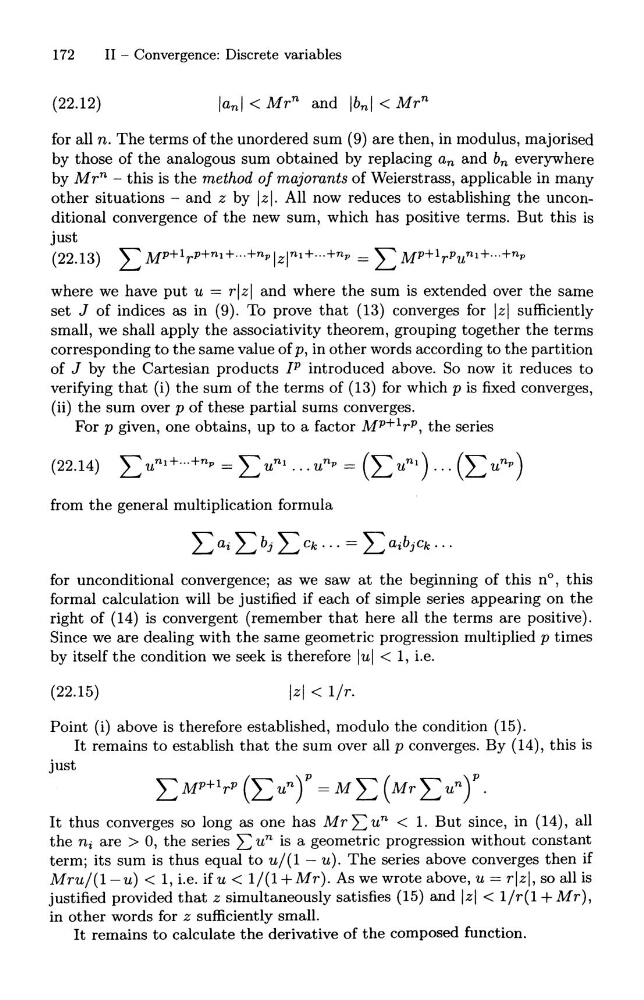
(22.13) L MP+1 r P+n1 + ... +np Izlnl + ... +np = L MP+l r Pu n 1 + ... +np
where we have put u = rlzl and where the sum is extended over the same
set J of indices as in (9). To prove that (13) converges for Izl sufficiently
small, we shall apply the associativity theorem, grouping together the terms
corresponding to the same value of p, in other words according to the partition
of J by the Cartesian products IP introduced above. So now it reduces to
verifying that (i) the sum of the terms of (13) for which p is fixed converges,
(ii) the sum over p of these partial sums converges.
For p given, one obtains, up to a factor MP+1 r P, the series
from the general multiplication formula
for unconditional convergence; as we saw at the beginning of this n°, this
formal calculation will be justified if each of simple series appearing on the
right of (14) is convergent (remember that here all the terms are positive).
Since we are dealing with the same geometric progression multiplied p times
by itself the condition we seek is therefore lui < 1, i.e.
(22.15)
Izl < l/r.
Point (i) above is therefore established, modulo the condition (15).
It remains to establish that the sum over all p converges. By (14), this is
just
It thus converges so long as one has Mr L un < 1. But since, in (14), all
the ni are > 0, the series L un is a geometric progression without constant
term; its sum is thus equal to u/(l - u). The series above converges then if
Mru/(l-u) < 1, i.e. ifu < l/(l+Mr). As we wrote above, u = rlzl. so all is
justified provided that z simultaneously satisfies (15) and Izi < l/r(l + Mr),
in other words for z sufficiently small.
It remains to calculate the derivative of the composed function.
II - Convergence: Discrete variables
for all n. The terms of the unordered sum (9) are then, in modulus, majorised
by those of the analogous sum obtained by replacing an and bn everywhere
by Mr n - this is the method of majomnts of Weierstrass, applicable in many
other situations - and z by 14 All now reduces to establishing the unconditional convergence of the new sum, which has positive terms. But this is
just
(22.13) L MP+1 r P+n1 + ... +np Izlnl + ... +np = L MP+l r Pu n 1 + ... +np
where we have put u = rlzl and where the sum is extended over the same
set J of indices as in (9). To prove that (13) converges for Izl sufficiently
small, we shall apply the associativity theorem, grouping together the terms
corresponding to the same value of p, in other words according to the partition
of J by the Cartesian products IP introduced above. So now it reduces to
verifying that (i) the sum of the terms of (13) for which p is fixed converges,
(ii) the sum over p of these partial sums converges.
For p given, one obtains, up to a factor MP+1 r P, the series
from the general multiplication formula
for unconditional convergence; as we saw at the beginning of this n°, this
formal calculation will be justified if each of simple series appearing on the
right of (14) is convergent (remember that here all the terms are positive).
Since we are dealing with the same geometric progression multiplied p times
by itself the condition we seek is therefore lui < 1, i.e.
(22.15)
Izl < l/r.
Point (i) above is therefore established, modulo the condition (15).
It remains to establish that the sum over all p converges. By (14), this is
just
It thus converges so long as one has Mr L un < 1. But since, in (14), all
the ni are > 0, the series L un is a geometric progression without constant
term; its sum is thus equal to u/(l - u). The series above converges then if
Mru/(l-u) < 1, i.e. ifu < l/(l+Mr). As we wrote above, u = rlzl. so all is
justified provided that z simultaneously satisfies (15) and Izi < l/r(l + Mr),
in other words for z sufficiently small.
It remains to calculate the derivative of the composed function.