

§3. First concepts of analytic functions
171
sum, multiplies them, and adds all the products so obtained; here we have
chosen the term nO ni from the first sum, the term nO n2 from the second,
etc. Writing I for the set of integers n ~ 1, the preceding series, the product
of p absolutely convergent series for Izl sufficiently small - but this is not
very important for the moment -, is thus an unordered sum where the index
varies over the Cartesian product I x ... x I = IP, with p factors.
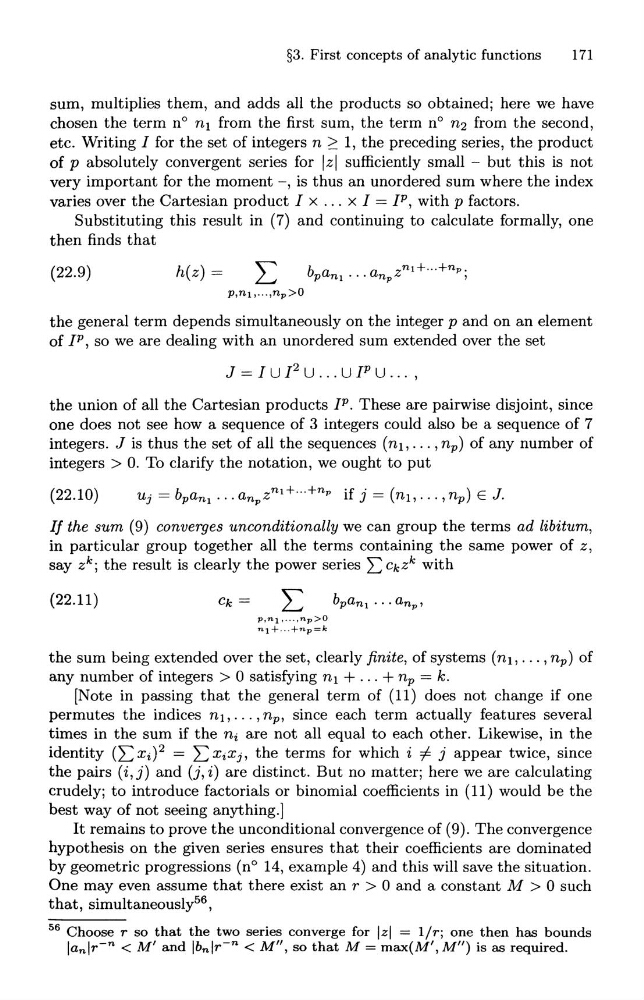
Substituting this result in (7) and continuing to calculate formally, one
then finds that
(22.9)
h(z) =
b a
a Z nl+ ... +n".
P nl .•. np
,
the general term depends simultaneously on the integer p and on an element
of IP, so we are dealing with an unordered sum extended over the set
J=IUI 2 U ... UJPU ... ,
the union of all the Cartesian products IP. These are pairwise disjoint, since
One does not see how a sequence of 3 integers could also be a sequence of 7
integers. J is thus the set of all the sequences (nl, ... ,np) of any number of
integers > o. To clarify the notation, we ought to put
(22.10)
If the sum (9) converges unconditionally we can group the terms ad libitum,
in particular group together all the terms containing the same power of z,
say zk; the result is clearly the power series E Ckzk with
(22.11)
p, 7t l,···,Rp>O
nt+···+np=k
the sum being extended over the set, clearly finite, of systems (nb ... ,np) of
any number of integers> 0 satisfying nl + ... + np = k.
[Note in passing that the general term of (11) does not change if one
permutes the indices nl, ... , np , since each term actually features several
times in the sum if the ni are not all equal to each other. Likewise, in the
identity (E Xi)2 = E XiXj, the terms for which i =I- j appear twice, since
the pairs (i,j) and (j, i) are distinct. But no matter; here we are calculating
crudely; to introduce factorials or binomial coefficients in (11) would be the
best way of not seeing anything.]
It remains to prove the unconditional convergence of (9). The convergence
hypothesis on the given series ensures that their coefficients are dominated
by geometric progressions (nO 14, example 4) and this will save the situation.
One may even assume that there exist an r > 0 and a constant M > 0 such
that, simultaneously56,
56 Choose r so that the two series converge for Izl = liT; one then has bounds
lanlr- n < M' and Ibnlr-n < M", so that M = max(M',M") is as required.
171
sum, multiplies them, and adds all the products so obtained; here we have
chosen the term nO ni from the first sum, the term nO n2 from the second,
etc. Writing I for the set of integers n ~ 1, the preceding series, the product
of p absolutely convergent series for Izl sufficiently small - but this is not
very important for the moment -, is thus an unordered sum where the index
varies over the Cartesian product I x ... x I = IP, with p factors.
Substituting this result in (7) and continuing to calculate formally, one
then finds that
(22.9)
h(z) =
b a
a Z nl+ ... +n".
P nl .•. np
,
the general term depends simultaneously on the integer p and on an element
of IP, so we are dealing with an unordered sum extended over the set
J=IUI 2 U ... UJPU ... ,
the union of all the Cartesian products IP. These are pairwise disjoint, since
One does not see how a sequence of 3 integers could also be a sequence of 7
integers. J is thus the set of all the sequences (nl, ... ,np) of any number of
integers > o. To clarify the notation, we ought to put
(22.10)
If the sum (9) converges unconditionally we can group the terms ad libitum,
in particular group together all the terms containing the same power of z,
say zk; the result is clearly the power series E Ckzk with
(22.11)
p, 7t l,···,Rp>O
nt+···+np=k
the sum being extended over the set, clearly finite, of systems (nb ... ,np) of
any number of integers> 0 satisfying nl + ... + np = k.
[Note in passing that the general term of (11) does not change if one
permutes the indices nl, ... , np , since each term actually features several
times in the sum if the ni are not all equal to each other. Likewise, in the
identity (E Xi)2 = E XiXj, the terms for which i =I- j appear twice, since
the pairs (i,j) and (j, i) are distinct. But no matter; here we are calculating
crudely; to introduce factorials or binomial coefficients in (11) would be the
best way of not seeing anything.]
It remains to prove the unconditional convergence of (9). The convergence
hypothesis on the given series ensures that their coefficients are dominated
by geometric progressions (nO 14, example 4) and this will save the situation.
One may even assume that there exist an r > 0 and a constant M > 0 such
that, simultaneously56,
56 Choose r so that the two series converge for Izl = liT; one then has bounds
lanlr- n < M' and Ibnlr-n < M", so that M = max(M',M") is as required.