

142
II - Convergence: Discrete variables
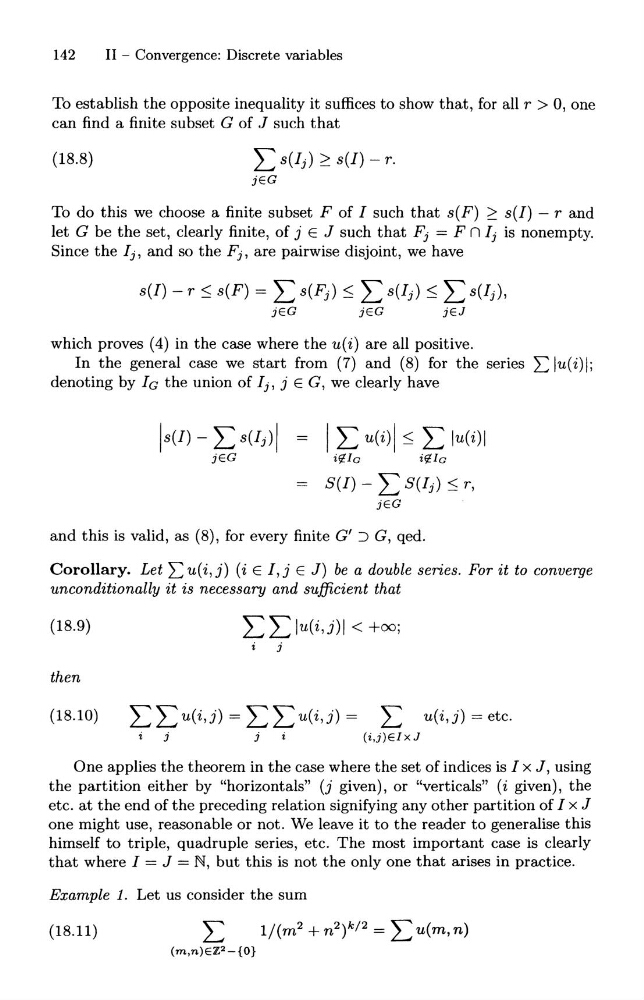
To establish the opposite inequality it suffices to show that, for all r > 0, one
can find a finite subset G of J such that
(18.8)
L s(Ij ) ~ s(I) - r.
jEG
To do this we choose a finite subset F of I such that s(F) ~ s(I) - rand
let G be the set, clearly finite, of j E J such that Fj = F n Ij is nonempty.
Since the Ij , and so the Fj , are pairwise disjoint, we have
s(I) - r :::; s(F) = L s(Fj ) :::; L s(Ij ) :::; L s(Ij),
jEG
jEG
jEJ
which proves (4) in the case where the u(i) are all positive.
In the general case we start from (7) and (8) for the series L lu(i)l;
denoting by IG the union of Ij , j E G, we clearly have
Is(I) - L s(Ij) 1
jEG
1 L u(i)1 :::; L lu(i)1
i~IG
i~IG
S(I) - L S(Ij) :::; r,
jEG
and this is valid, as (8), for every finite G' ::> G, qed.
Corollary. Let L u( i, j) (i E I, j E J) be a double series. For it to converge
unconditionally it is necessary and sufficient that
(18.9)
then
(18.10)
L L lu(i,j)1 < +00;
j
L L u( i, j) = L L u( i, j) = L u( i, j) = etc.
j
j
(i,j)Elx J
One applies the theorem in the case where the set of indices is I x J, using
the partition either by "horizontals" (j given), or "verticals" (i given), the
etc. at the end of the preceding relation signifying any other partition of I x J
one might use, reasonable or not. We leave it to the reader to generalise this
himself to triple, quadruple series, etc. The most important case is clearly
that where I = J = N, but this is not the only one that arises in practice.
Example 1. Let us consider the sum
(18.11)
L Ij(m2 + n 2 )k/2 = L u(m,n)
(m,n)EZ2-{O}
II - Convergence: Discrete variables
To establish the opposite inequality it suffices to show that, for all r > 0, one
can find a finite subset G of J such that
(18.8)
L s(Ij ) ~ s(I) - r.
jEG
To do this we choose a finite subset F of I such that s(F) ~ s(I) - rand
let G be the set, clearly finite, of j E J such that Fj = F n Ij is nonempty.
Since the Ij , and so the Fj , are pairwise disjoint, we have
s(I) - r :::; s(F) = L s(Fj ) :::; L s(Ij ) :::; L s(Ij),
jEG
jEG
jEJ
which proves (4) in the case where the u(i) are all positive.
In the general case we start from (7) and (8) for the series L lu(i)l;
denoting by IG the union of Ij , j E G, we clearly have
Is(I) - L s(Ij) 1
jEG
1 L u(i)1 :::; L lu(i)1
i~IG
i~IG
S(I) - L S(Ij) :::; r,
jEG
and this is valid, as (8), for every finite G' ::> G, qed.
Corollary. Let L u( i, j) (i E I, j E J) be a double series. For it to converge
unconditionally it is necessary and sufficient that
(18.9)
then
(18.10)
L L lu(i,j)1 < +00;
j
L L u( i, j) = L L u( i, j) = L u( i, j) = etc.
j
j
(i,j)Elx J
One applies the theorem in the case where the set of indices is I x J, using
the partition either by "horizontals" (j given), or "verticals" (i given), the
etc. at the end of the preceding relation signifying any other partition of I x J
one might use, reasonable or not. We leave it to the reader to generalise this
himself to triple, quadruple series, etc. The most important case is clearly
that where I = J = N, but this is not the only one that arises in practice.
Example 1. Let us consider the sum
(18.11)
L Ij(m2 + n 2 )k/2 = L u(m,n)
(m,n)EZ2-{O}