

§2. Absolutely convergent series
141
(18.5)
L 8(Fj) = 8(F) :::; 8(1);
JEG
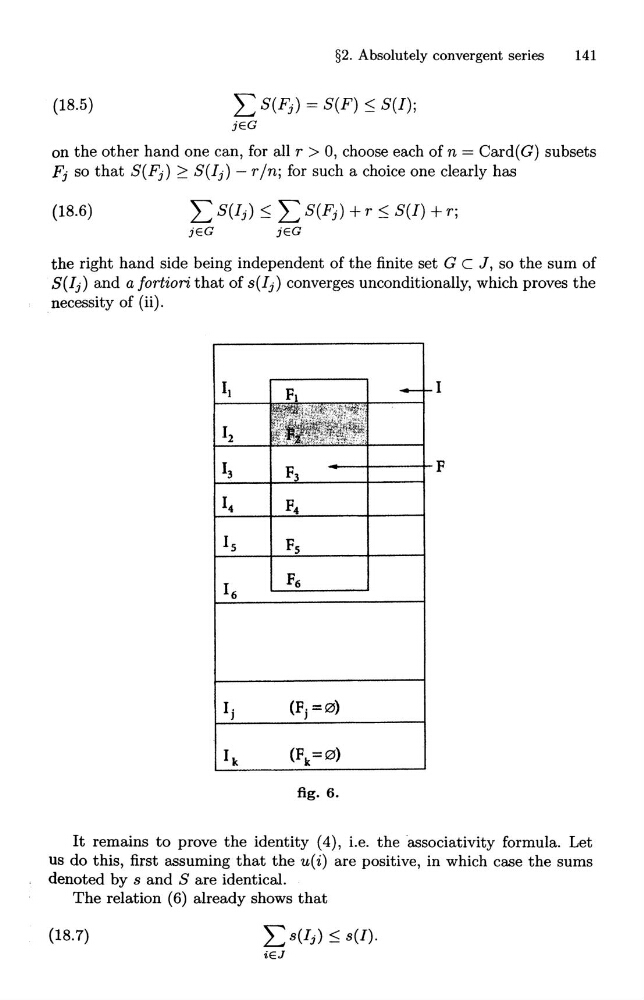
on the other hand one can, for all r > 0, choose each of n = Card( G) subsets
Fj so that 8(Fj ) ~ 8(lj) - rln; for such a choice one clearly has
(18.6)
L 8(lj) :::; L 8(Fj ) + r:::; 8(1) + r;
JEG
JEG
the right hand side being independent of the finite set G c J, so the sum of
8(lj) and a fortiori that of s(Ij) converges unconditionally, which proves the
necessity of (ii).
I
- - - - f - - _ r F
I j
=0)
fig. 6.
It remains to prove the identity (4), i.e. the "associativity formula. Let
us do this, first assuming that the u( i) are positive, in which case the sums
denoted by sand 8 are identical.
The relation (6) already shows that
(18.7)
Ls(Ij)::; sCI).
iEJ
141
(18.5)
L 8(Fj) = 8(F) :::; 8(1);
JEG
on the other hand one can, for all r > 0, choose each of n = Card( G) subsets
Fj so that 8(Fj ) ~ 8(lj) - rln; for such a choice one clearly has
(18.6)
L 8(lj) :::; L 8(Fj ) + r:::; 8(1) + r;
JEG
JEG
the right hand side being independent of the finite set G c J, so the sum of
8(lj) and a fortiori that of s(Ij) converges unconditionally, which proves the
necessity of (ii).
I
- - - - f - - _ r F
I j
=0)
fig. 6.
It remains to prove the identity (4), i.e. the "associativity formula. Let
us do this, first assuming that the u( i) are positive, in which case the sums
denoted by sand 8 are identical.
The relation (6) already shows that
(18.7)
Ls(Ij)::; sCI).
iEJ