

§2. Absolutely convergent series
129
then the sum of w(i), i E G, will be equal to s + t to within 2r, qed 39 .
It follows immediately from this that series with complex terms reduce to
series with real terms as in the classical case. Let us examine these, in order
to show that one can even, in fact, reduce to unordered families or sums with
positive terms.
G
F
fig. 4.
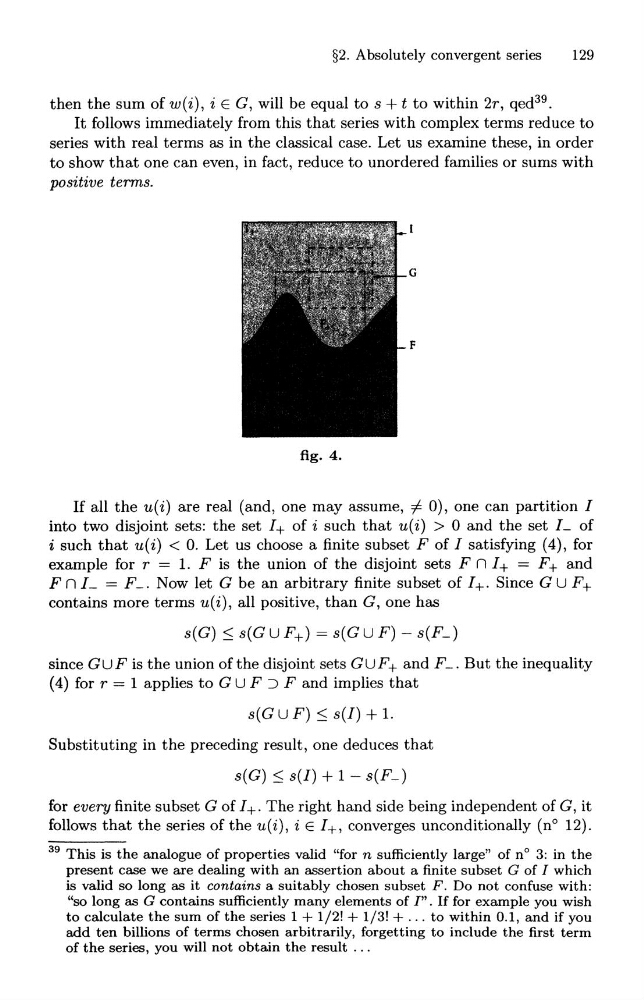
If all the u(i) are real (and, one may assume, =I- 0), one can partition I
into two disjoint sets: the set 1+ of i such that u(i) > 0 and the set L of
i such that u(i) < o. Let us choose a finite subset F of I satisfying (4), for
example for r = 1. F is the union of the disjoint sets F n 1+ = F+ and
F n L = F_. Now let G be an arbitrary finite subset of 1+. Since G U F+
contains more terms u(i), all positive, than G, one has
since GUF is the union of the disjoint sets GUF+ and F_. But the inequality
(4) for r = 1 applies to G U F ::J F and implies that
s( G U F) ~ s(I) + 1.
Substituting in the preceding result, one deduces that
s(G) ~ s(l) + 1 - s(F-)
for every finite subset G of 1+. The right hand side being independent of G, it
follows that the series of the u(i), i E 1+, converges unconditionally (nO 12).
39 This is the analogue of properties valid "for n sufficiently large" of n O 3: in the
present case we are dealing with an assertion about a finite subset G of I which
is valid so long as it contains a suitably chosen subset F. Do not confuse with:
"so long as G contains sufficiently many elements of I" . If for example you wish
to calculate the sum of the series 1 + 1/2! + 1/3! + ... to within 0.1, and if you
add ten billions of terms chosen arbitrarily, forgetting to include the first term
of the series, you will not obtain the result ...
129
then the sum of w(i), i E G, will be equal to s + t to within 2r, qed 39 .
It follows immediately from this that series with complex terms reduce to
series with real terms as in the classical case. Let us examine these, in order
to show that one can even, in fact, reduce to unordered families or sums with
positive terms.
G
F
fig. 4.
If all the u(i) are real (and, one may assume, =I- 0), one can partition I
into two disjoint sets: the set 1+ of i such that u(i) > 0 and the set L of
i such that u(i) < o. Let us choose a finite subset F of I satisfying (4), for
example for r = 1. F is the union of the disjoint sets F n 1+ = F+ and
F n L = F_. Now let G be an arbitrary finite subset of 1+. Since G U F+
contains more terms u(i), all positive, than G, one has
since GUF is the union of the disjoint sets GUF+ and F_. But the inequality
(4) for r = 1 applies to G U F ::J F and implies that
s( G U F) ~ s(I) + 1.
Substituting in the preceding result, one deduces that
s(G) ~ s(l) + 1 - s(F-)
for every finite subset G of 1+. The right hand side being independent of G, it
follows that the series of the u(i), i E 1+, converges unconditionally (nO 12).
39 This is the analogue of properties valid "for n sufficiently large" of n O 3: in the
present case we are dealing with an assertion about a finite subset G of I which
is valid so long as it contains a suitably chosen subset F. Do not confuse with:
"so long as G contains sufficiently many elements of I" . If for example you wish
to calculate the sum of the series 1 + 1/2! + 1/3! + ... to within 0.1, and if you
add ten billions of terms chosen arbitrarily, forgetting to include the first term
of the series, you will not obtain the result ...