

128
II - Convergence: Discrete variables
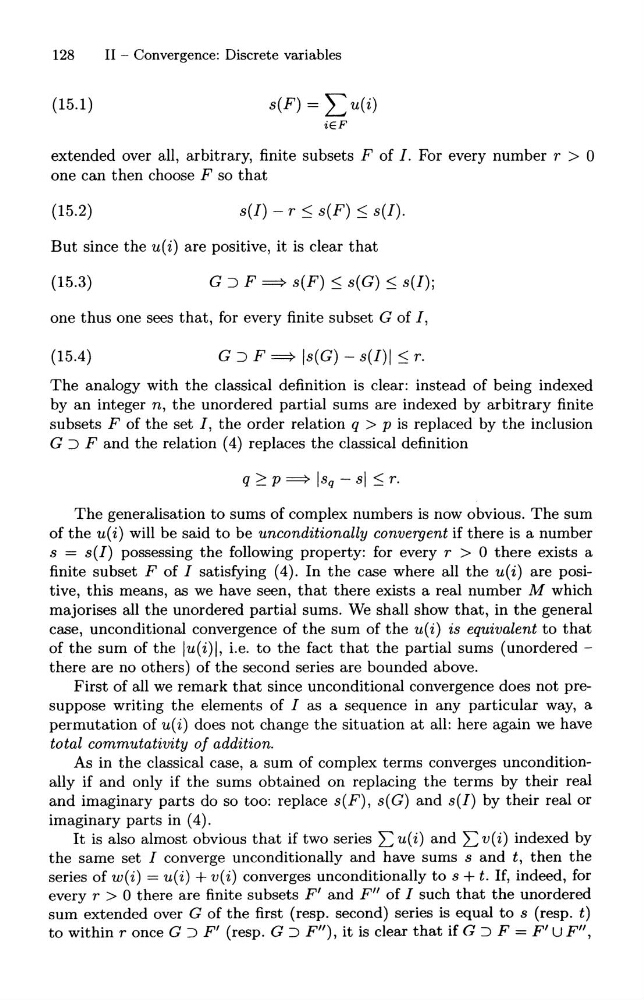
(15.1)
8(F) = L u(i)
iEF
extended over all, arbitrary, finite subsets F of 1. For every number r > 0
one can then choose F so that
(15.2)
8(1) - r :::; 8(F) :::; 8(1).
But since the u( i) are positive, it is clear that
(15.3)
G :::) F ====} 8(F) :::; 8(G) :::; 8(1);
one thus one sees that, for every finite subset G of 1,
(15.4)
The analogy with the classical definition is clear: instead of being indexed
by an integer n, the unordered partial sums are indexed by arbitrary finite
subsets F of the set 1, the order relation q > p is replaced by the inclusion
G:::) F and the relation (4) replaces the classical definition
q ::::: p ====} 18q - 81 :::; r.
The generalisation to sums of complex numbers is now obvious. The sum
of the u( i) will be said to be unconditionally converyent if there is a number
8 = 8(1) possessing the following property: for every r > 0 there exists a
finite subset F of 1 satisfying (4). In the case where all the u(i) are positive, this means, as we have seen, that there exists a real number M which
majorises all the unordered partial sums. We shall show that, in the general
case, unconditional convergence of the sum of the u( i) i8 equivalent to that
of the sum of the lu(i)l, i.e. to the fact that the partial sums (unordered -
there are no others) of the second series are bounded above.
First of all we remark that since unconditional convergence does not presuppose writing the elements of 1 as a sequence in any particular way, a
permutation of u( i) does not change the situation at all: here again we have
total commutativity of addition.
As in the classical case, a sum of complex terms converges unconditionally if and only if the sums obtained on replacing the terms by their real
and imaginary parts do so too: replace 8(F), 8(G) and 8(1) by their real or
imaginary parts in (4).
It is also almost obvious that if two series L u( i) and L v( i) indexed by
the same set 1 converge unconditionally and have sums 8 and t, then the
series of w( i) = u( i) + v( i) converges unconditionally to 8 + t. If, indeed, for
every r > 0 there are finite subsets F' and F" of 1 such that the unordered
sum extended over G of the first (resp. second) series is equal to 8 (resp. t)
to within r once G:::) P' (resp. G:::) P"), it is clear that if G:::) F = F' U F",
II - Convergence: Discrete variables
(15.1)
8(F) = L u(i)
iEF
extended over all, arbitrary, finite subsets F of 1. For every number r > 0
one can then choose F so that
(15.2)
8(1) - r :::; 8(F) :::; 8(1).
But since the u( i) are positive, it is clear that
(15.3)
G :::) F ====} 8(F) :::; 8(G) :::; 8(1);
one thus one sees that, for every finite subset G of 1,
(15.4)
The analogy with the classical definition is clear: instead of being indexed
by an integer n, the unordered partial sums are indexed by arbitrary finite
subsets F of the set 1, the order relation q > p is replaced by the inclusion
G:::) F and the relation (4) replaces the classical definition
q ::::: p ====} 18q - 81 :::; r.
The generalisation to sums of complex numbers is now obvious. The sum
of the u( i) will be said to be unconditionally converyent if there is a number
8 = 8(1) possessing the following property: for every r > 0 there exists a
finite subset F of 1 satisfying (4). In the case where all the u(i) are positive, this means, as we have seen, that there exists a real number M which
majorises all the unordered partial sums. We shall show that, in the general
case, unconditional convergence of the sum of the u( i) i8 equivalent to that
of the sum of the lu(i)l, i.e. to the fact that the partial sums (unordered -
there are no others) of the second series are bounded above.
First of all we remark that since unconditional convergence does not presuppose writing the elements of 1 as a sequence in any particular way, a
permutation of u( i) does not change the situation at all: here again we have
total commutativity of addition.
As in the classical case, a sum of complex terms converges unconditionally if and only if the sums obtained on replacing the terms by their real
and imaginary parts do so too: replace 8(F), 8(G) and 8(1) by their real or
imaginary parts in (4).
It is also almost obvious that if two series L u( i) and L v( i) indexed by
the same set 1 converge unconditionally and have sums 8 and t, then the
series of w( i) = u( i) + v( i) converges unconditionally to 8 + t. If, indeed, for
every r > 0 there are finite subsets F' and F" of 1 such that the unordered
sum extended over G of the first (resp. second) series is equal to 8 (resp. t)
to within r once G:::) P' (resp. G:::) P"), it is clear that if G:::) F = F' U F",