

112
II - Convergence: Discrete variables
::=: ... r::::.-- ____
'"
I{I
I
"
t-== --. . . . . . . . r\
[7 '"
I{I
'"
1/--- ......... .
--I{I
······1\ I , -----..... LJ · · · · ·
a
b
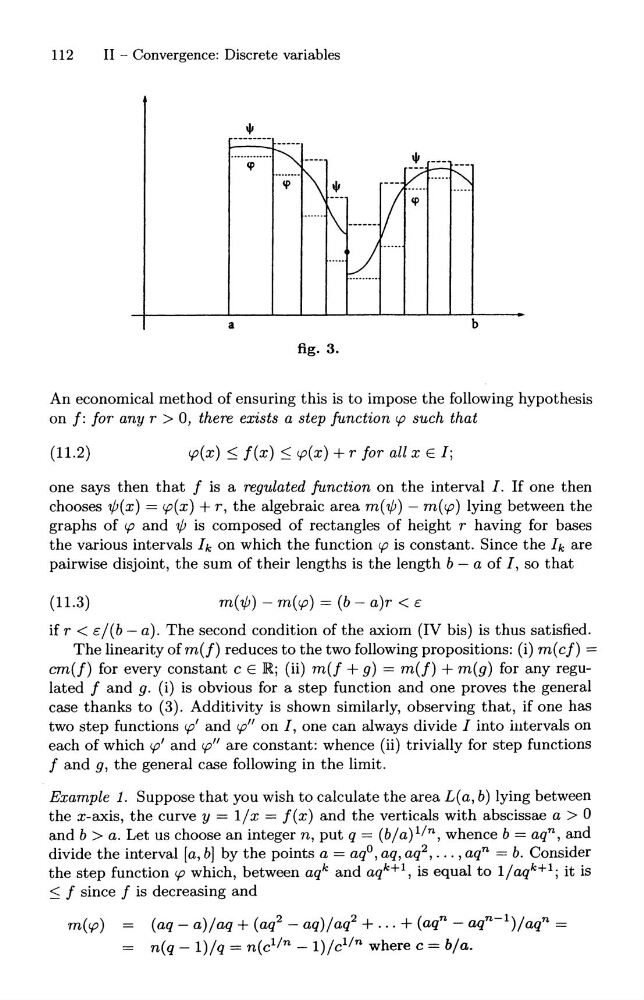
fig. 3.
An economical method of ensuring this is to impose the following hypothesis
on I: lor any r > 0, there exists a step function (11.2)
chooses 1/J(x) =
(11.3)
m(1/J) - m(
The linearity of m(f) reduces to the two following propositions: (i) m(cf) =
em(f) for every constant c E 1R; (ii) m(f + g) = m(f) + m(g) for any regulated I and g. (i) is obvious for a step function and one proves the general
case thanks to (3). Additivity is shown similarly, observing that, if one has
two step functions
Example 1. Suppose that you wish to calculate the area L(a, b) lying between
the x-axis, the curve y = l/x = I(x) and the verticals with abscissae a > 0
and b > a. Let us choose an integer n, put q = (b/a)l/n, whence b = aqn, and
divide the interval [a, b] by the points a = aqo, aq, aq2, ... ,aqn = b. Consider
the step function ::; I since I is decreasing and
m(
=
n(q - l)/q = n(c 1 / n - 1)/c 1 / n where c = b/a.
II - Convergence: Discrete variables
::=: ... r::::.-- ____
'"
I{I
I
"
t-== --. . . . . . . . r\
[7 '"
I{I
'"
1/--- ......... .
--I{I
······1\ I , -----..... LJ · · · · ·
a
b
fig. 3.
An economical method of ensuring this is to impose the following hypothesis
on I: lor any r > 0, there exists a step function (11.2)
chooses 1/J(x) =
(11.3)
m(1/J) - m(
The linearity of m(f) reduces to the two following propositions: (i) m(cf) =
em(f) for every constant c E 1R; (ii) m(f + g) = m(f) + m(g) for any regulated I and g. (i) is obvious for a step function and one proves the general
case thanks to (3). Additivity is shown similarly, observing that, if one has
two step functions
Example 1. Suppose that you wish to calculate the area L(a, b) lying between
the x-axis, the curve y = l/x = I(x) and the verticals with abscissae a > 0
and b > a. Let us choose an integer n, put q = (b/a)l/n, whence b = aqn, and
divide the interval [a, b] by the points a = aqo, aq, aq2, ... ,aqn = b. Consider
the step function ::; I since I is decreasing and
m(
=
n(q - l)/q = n(c 1 / n - 1)/c 1 / n where c = b/a.