

§2. Absolutely convergent series
111
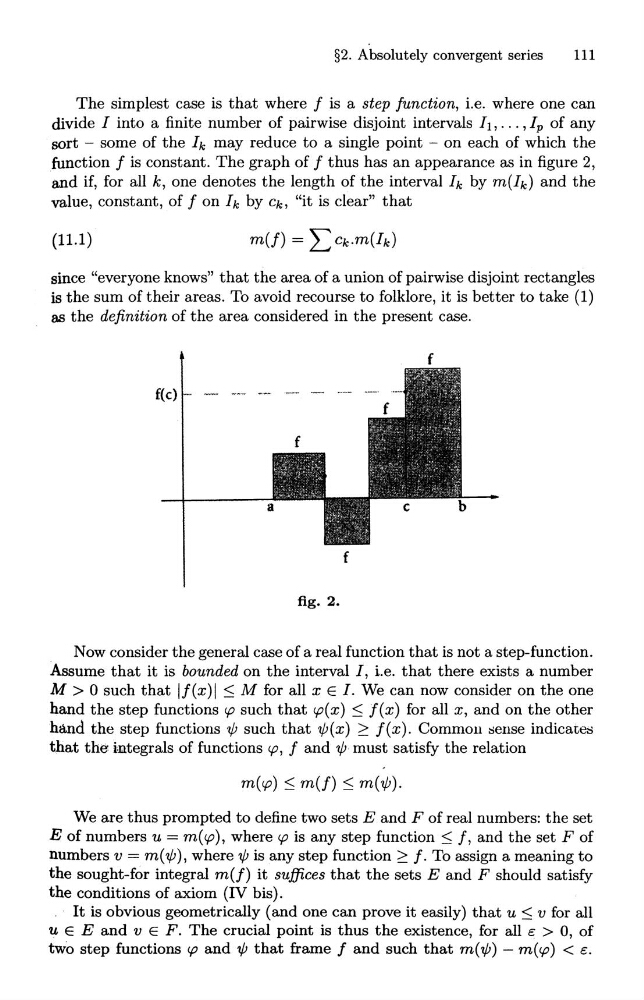
The simplest case is that where I is a step function, i.e. where one can
divide I into a finite number of pairwise disjoint intervals h, . .. ,Ip of any
sort - some of the h may reduce to a single point - on each of which the
function I is constant. The graph of I thus has an appearance as in figure 2,
and if, for all k, one denotes the length of the interval h by m(h) and the
value, constant, of I on Ik by Ck, "it is clear" that
(11.1)
since "everyone knows" that the area of a union of pairwise disjoint rectangles
is the sum of their areas. To avoid recourse to folklore, it is better to take (1)
as the definition of the area considered in the present case.
f
f(c)
f
fig. 2.
Now consider the general case of a real function that is not a step-function.
Assume that it is bounded on the interval I, i.e. that there exists a number
M> 0 such that I/(x)1 ~ M for all x E I. We can now consider on the one
hand the step functions cp such that cp(x) ~ f(x) for all x, and on the other
hand the step functions 'Ij; such that ' Ij; (x) ~ I (x). Common sense indicates
that the integrals of functions cp, I and 'Ij; must satisfy the relation
m(cp) ~ m(f) ~ m('Ij;).
We are thus prompted to define two sets E and F of real numbers: the set
E of numbers u = m(cp), where cp is any step function ~ I, and the set F of
numbers v = m( 'Ij;), where ' Ij; is any step function ~ f. To assign a meaning to
the sought-for integral m(f) it suffices that the sets E and F should satisfy
the conditions of axiom (IV bis).
. It is obvious geometrically (and one can prove it easily) that u ~ v for all
u E E and v E F. The crucial point is thus the existence, for all c > 0, of
tWo step functions cp and 'Ij; that frame f and such that m('Ij;) - m(cp) < c.
111
The simplest case is that where I is a step function, i.e. where one can
divide I into a finite number of pairwise disjoint intervals h, . .. ,Ip of any
sort - some of the h may reduce to a single point - on each of which the
function I is constant. The graph of I thus has an appearance as in figure 2,
and if, for all k, one denotes the length of the interval h by m(h) and the
value, constant, of I on Ik by Ck, "it is clear" that
(11.1)
since "everyone knows" that the area of a union of pairwise disjoint rectangles
is the sum of their areas. To avoid recourse to folklore, it is better to take (1)
as the definition of the area considered in the present case.
f
f(c)
f
fig. 2.
Now consider the general case of a real function that is not a step-function.
Assume that it is bounded on the interval I, i.e. that there exists a number
M> 0 such that I/(x)1 ~ M for all x E I. We can now consider on the one
hand the step functions cp such that cp(x) ~ f(x) for all x, and on the other
hand the step functions 'Ij; such that ' Ij; (x) ~ I (x). Common sense indicates
that the integrals of functions cp, I and 'Ij; must satisfy the relation
m(cp) ~ m(f) ~ m('Ij;).
We are thus prompted to define two sets E and F of real numbers: the set
E of numbers u = m(cp), where cp is any step function ~ I, and the set F of
numbers v = m( 'Ij;), where ' Ij; is any step function ~ f. To assign a meaning to
the sought-for integral m(f) it suffices that the sets E and F should satisfy
the conditions of axiom (IV bis).
. It is obvious geometrically (and one can prove it easily) that u ~ v for all
u E E and v E F. The crucial point is thus the existence, for all c > 0, of
tWo step functions cp and 'Ij; that frame f and such that m('Ij;) - m(cp) < c.