

80
II - Convergence: Discrete variables
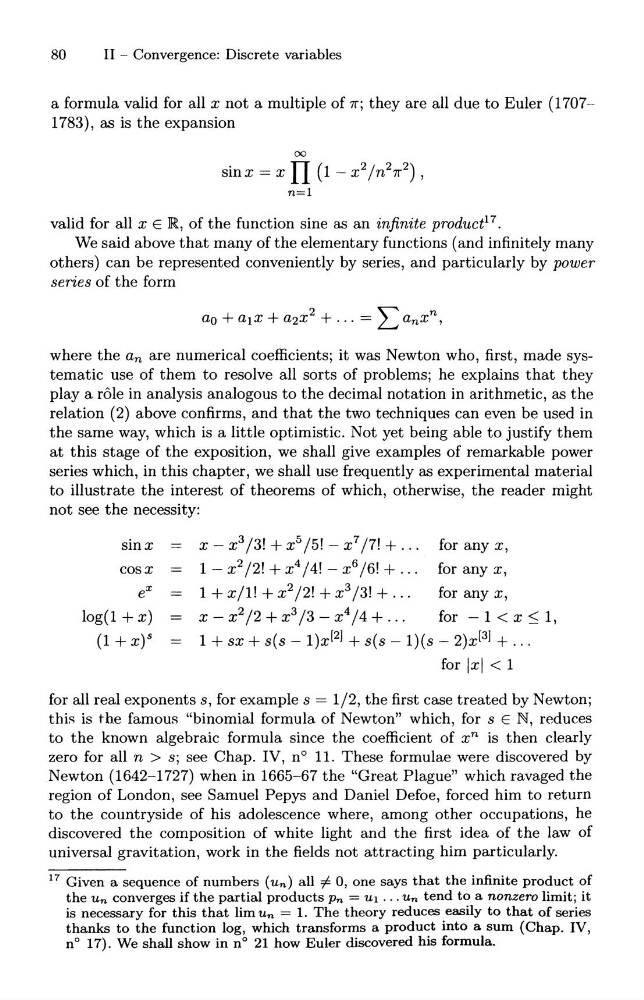
a formula valid for all x not a multiple of rr; they are all due to Euler (17071783), as is the expansion
00
sinx = x II (1 - x 2 /n 2 rr2) ,
n=l
valid for all x E R, of the function sine as an infinite product 17 •
We said above that many of the elementary functions (and infinitely many
others) can be represented conveniently by series, and particularly by power
series of the form
where the an are numerical coefficients; it was Newton who, first, made systematic use of them to resolve all sorts of problems; he explains that they
playa role in analysis analogous to the decimal notation in arithmetic, as the
relation (2) above confirms, and that the two techniques can even be used in
the same way, which is a little optimistic. Not yet being able to justify them
at this stage of the exposition, we shall give examples of remarkable power
series which, in this chapter, we shall use frequently as experimental material
to illustrate the interest of theorems of which, otherwise, the reader might
not see the necessity:
sin x
cos x
log(1 + x)
(1 + x)S
x - x 3 /3! + x 5 /5! - x 7 /7! + . . . for any x,
1 - x 2 /2! + x 4 /4! - x 6 /6! + ... for any x,
1 + x/I! + x 2 /2! + x 3 /3! + . . . for any x,
x - x 2 /2 + x 3 /3 - x4 /4 + . . . for - 1 < x ~ 1,
1 + sx + s(s - l)x[2] + s(s - l)(s - 2)x[3] + ...
for Ixl < 1
for all real exponents s, for example s = 1/2, the first case treated by Newton;
this is the famous "binomial formula of Newton" which, for SEN, reduces
to the known algebraic formula since the coefficient of xn is then clearly
zero for all n > s; see Chap. IV, nO 11. These formulae were discovered by
Newton (1642-1727) when in 1665-67 the "Great Plague" which ravaged the
region of London, see Samuel Pepys and Daniel Defoe, forced him to return
to the countryside of his adolescence where, among other occupations, he
discovered the composition of white light and the first idea of the law of
universal gravitation, work in the fields not attracting him particularly.
17 Given a sequence of numbers (Un) all =1= 0, one says that the infinite product of
the Un converges if the partial products pn = U1 .•. Un tend to a nonzero limit; it
is necessary for this that lim Un = 1. The theory reduces easily to that of series
thanks to the function log, which transforms a product into a sum (Chap. IV,
nO 17). We shall show in nO 21 how Euler discovered his formula.
II - Convergence: Discrete variables
a formula valid for all x not a multiple of rr; they are all due to Euler (17071783), as is the expansion
00
sinx = x II (1 - x 2 /n 2 rr2) ,
n=l
valid for all x E R, of the function sine as an infinite product 17 •
We said above that many of the elementary functions (and infinitely many
others) can be represented conveniently by series, and particularly by power
series of the form
where the an are numerical coefficients; it was Newton who, first, made systematic use of them to resolve all sorts of problems; he explains that they
playa role in analysis analogous to the decimal notation in arithmetic, as the
relation (2) above confirms, and that the two techniques can even be used in
the same way, which is a little optimistic. Not yet being able to justify them
at this stage of the exposition, we shall give examples of remarkable power
series which, in this chapter, we shall use frequently as experimental material
to illustrate the interest of theorems of which, otherwise, the reader might
not see the necessity:
sin x
cos x
log(1 + x)
(1 + x)S
x - x 3 /3! + x 5 /5! - x 7 /7! + . . . for any x,
1 - x 2 /2! + x 4 /4! - x 6 /6! + ... for any x,
1 + x/I! + x 2 /2! + x 3 /3! + . . . for any x,
x - x 2 /2 + x 3 /3 - x4 /4 + . . . for - 1 < x ~ 1,
1 + sx + s(s - l)x[2] + s(s - l)(s - 2)x[3] + ...
for Ixl < 1
for all real exponents s, for example s = 1/2, the first case treated by Newton;
this is the famous "binomial formula of Newton" which, for SEN, reduces
to the known algebraic formula since the coefficient of xn is then clearly
zero for all n > s; see Chap. IV, nO 11. These formulae were discovered by
Newton (1642-1727) when in 1665-67 the "Great Plague" which ravaged the
region of London, see Samuel Pepys and Daniel Defoe, forced him to return
to the countryside of his adolescence where, among other occupations, he
discovered the composition of white light and the first idea of the law of
universal gravitation, work in the fields not attracting him particularly.
17 Given a sequence of numbers (Un) all =1= 0, one says that the infinite product of
the Un converges if the partial products pn = U1 .•. Un tend to a nonzero limit; it
is necessary for this that lim Un = 1. The theory reduces easily to that of series
thanks to the function log, which transforms a product into a sum (Chap. IV,
nO 17). We shall show in nO 21 how Euler discovered his formula.