

§l. Convergent sequences and series
79
already known to Viete, Newton and Mercator, the last two having used it
around 1665 to calculate the area of a segment of a hyperbola. The mathematicians of the xvn th century, Newton in the first place, obtained these
series by a very different procedure, the division of 1 by 1 + q according to the
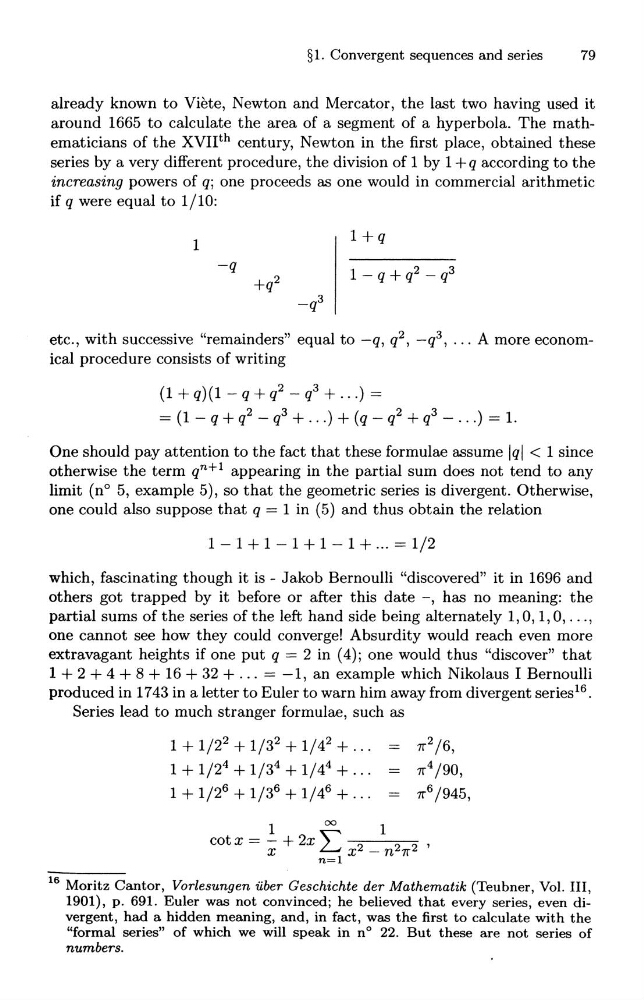
increasing powers of q; one proceeds as one would in commercial arithmetic
if q were equal to 1/10:
1
l+q
-q
etc., with successive "remainders" equal to -q, q2, _q3, ... A more economical procedure consists of writing
(1 + q)(1 _ q + q2 _ q3 + ... ) =
= (1 - q + q2 _ q3 + ... ) + (q _ q2 + q3 _ ... ) = 1.
One should pay attention to the fact that these formulae assume iqi < 1 since
otherwise the term qn+1 appearing in the partial sum does not tend to any
limit (nO 5, example 5), so that the geometric series is divergent. Otherwise,
one could also suppose that q = 1 in (5) and thus obtain the relation
1 - 1 + 1 - 1 + 1 - 1 + ... = 1/2
which, fascinating though it is - Jakob Bernoulli "discovered" it in 1696 and
others got trapped by it before or after this date -, has no meaning: the
partial sums of the series of the left hand side being alternately 1,0,1,0, ... ,
one cannot see how they could converge! Absurdity would reach even more
extravagant heights if one put q = 2 in (4); one would thus "discover" that
1 + 2 + 4 + 8 + 16 + 32 + ... = -1, an example which Nikolaus I Bernoulli
produced in 1743 in a letter to Euler to warn him away from divergent series 16 .
Series lead to much stranger formulae, such as
1 + 1/2 2 + 1/3 2 + 1/4 2 + .. .
1 + 1/2 4 + 1/3 4 + 1/4 4 + .. .
1 + 1/2 6 + 1/3 6 + 1/4 6 + .. .
71"2/6,
71"4/90,
71"6/945,
1
00
1
cot x = - + 2x L 2 2 2 '
X
n=l X - n 71"
16 Moritz Cantor, Vorlesungen tiber Geschichte der Mathematik (Teubner, Vol. III,
1901), p. 691. Euler was not convinced; he believed that every series, even divergent, had a hidden meaning, and, in fact, was the first to calculate with the
"formal series" of which we will speak in nO 22. But these are not series of
numbers.
79
already known to Viete, Newton and Mercator, the last two having used it
around 1665 to calculate the area of a segment of a hyperbola. The mathematicians of the xvn th century, Newton in the first place, obtained these
series by a very different procedure, the division of 1 by 1 + q according to the
increasing powers of q; one proceeds as one would in commercial arithmetic
if q were equal to 1/10:
1
l+q
-q
etc., with successive "remainders" equal to -q, q2, _q3, ... A more economical procedure consists of writing
(1 + q)(1 _ q + q2 _ q3 + ... ) =
= (1 - q + q2 _ q3 + ... ) + (q _ q2 + q3 _ ... ) = 1.
One should pay attention to the fact that these formulae assume iqi < 1 since
otherwise the term qn+1 appearing in the partial sum does not tend to any
limit (nO 5, example 5), so that the geometric series is divergent. Otherwise,
one could also suppose that q = 1 in (5) and thus obtain the relation
1 - 1 + 1 - 1 + 1 - 1 + ... = 1/2
which, fascinating though it is - Jakob Bernoulli "discovered" it in 1696 and
others got trapped by it before or after this date -, has no meaning: the
partial sums of the series of the left hand side being alternately 1,0,1,0, ... ,
one cannot see how they could converge! Absurdity would reach even more
extravagant heights if one put q = 2 in (4); one would thus "discover" that
1 + 2 + 4 + 8 + 16 + 32 + ... = -1, an example which Nikolaus I Bernoulli
produced in 1743 in a letter to Euler to warn him away from divergent series 16 .
Series lead to much stranger formulae, such as
1 + 1/2 2 + 1/3 2 + 1/4 2 + .. .
1 + 1/2 4 + 1/3 4 + 1/4 4 + .. .
1 + 1/2 6 + 1/3 6 + 1/4 6 + .. .
71"2/6,
71"4/90,
71"6/945,
1
00
1
cot x = - + 2x L 2 2 2 '
X
n=l X - n 71"
16 Moritz Cantor, Vorlesungen tiber Geschichte der Mathematik (Teubner, Vol. III,
1901), p. 691. Euler was not convinced; he believed that every series, even divergent, had a hidden meaning, and, in fact, was the first to calculate with the
"formal series" of which we will speak in nO 22. But these are not series of
numbers.