

38
R. Ebinghaus et al.
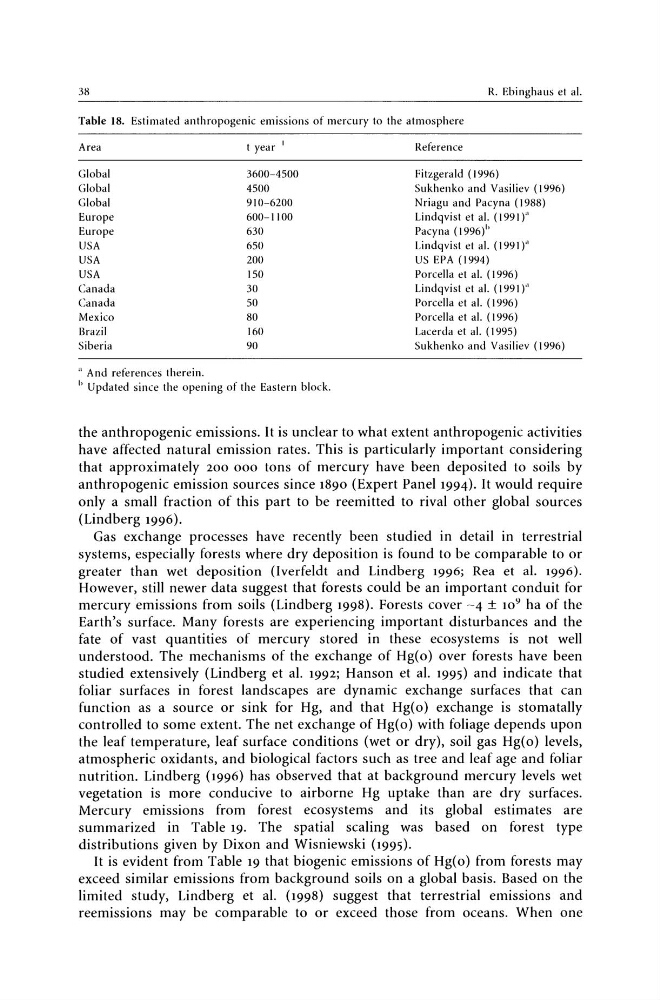
Table 18. Estimated anthropogenic emissions of mercury to the atmosphere
Area
t year I
Reference
Global
3600-4500
Fitzgerald (1996)
Global
4500
Sukhenko and Vasiliev (1996)
Global
9\0-6200
Nriagu and Pacyna (1988)
Europe
600-1100
Lindqvist et al. (1991)"
Europe
630
Pacyna (1996)"
USA
650
Lindqvist et al. (1991)"
USA
200
US EPA (1994)
USA
ISO
Porcella et al. (1996)
Canada
30
Lindqvist et al. (1991)"
Canada
50
Porcella et al. (1996)
Mexico
80
Porcella et al. (1996)
Brazil
160
Lacerda et al. (1995)
Siberia
90
Sukhenko and Vasiliev (1996)
" And references therein.
" Updated since the opening of the Eastern block.
the anthropogenic emissions. It is unclear to what extent anthropogenic activities
have affected natural emission rates. This is particularly important considering
that approximately 200 000 tons of mercury have been deposited to soils by
anthropogenic emission sources since 1890 (Expert Panel 1994). It would require
only a small fraction of this part to be reemitted to rival other global sources
(Lindberg 1996).
Gas exchange processes have recently been studied in detail in terrestrial
systems, especially forests where dry deposition is found to be comparable to or
greater than wet deposition (Iverfeldt and Lindberg 1996; Rea et al. 1996).
However, still newer data suggest that forests could be an important conduit for
mercury emissions from soils (Lindberg 1998). Forests cover -4 ± 10 9 ha of the
Earth's surface. Many forests are experiencing important disturbances and the
fate of vast quantities of mercury stored in these ecosystems is not well
understood. The mechanisms of the exchange of Hg( 0) over forests have been
studied extensively (Lindberg et al. 1992; Hanson et al. 1995) and indicate that
foliar surfaces in forest landscapes are dynamic exchange surfaces that can
function as a source or sink for Hg, and that Hg(o) exchange is stomatally
controlled to some extent. The net exchange of Hg(o) with foliage depends upon
the leaf temperature, leaf surface conditions (wet or dry), soil gas Hg(o) levels,
atmospheric oxidants, and biological factors such as tree and leaf age and foliar
nutrition. Lindberg (1996) has observed that at background mercury levels wet
vegetation is more conducive to airborne Hg uptake than are dry surfaces.
Mercury emissions from forest ecosystems and its global estimates are
summarized in Table 19. The spatial scaling was based on forest type
distributions given by Dixon and Wisniewski (1995).
It is evident from Table 19 that biogenic emissions of Hg(o) from forests may
exceed similar emissions from background soils on a global basis. Based on the
limited study, Lindberg et al. (1998) suggest that terrestrial emissions and
reemissions may be comparable to or exceed those from oceans. When one
R. Ebinghaus et al.
Table 18. Estimated anthropogenic emissions of mercury to the atmosphere
Area
t year I
Reference
Global
3600-4500
Fitzgerald (1996)
Global
4500
Sukhenko and Vasiliev (1996)
Global
9\0-6200
Nriagu and Pacyna (1988)
Europe
600-1100
Lindqvist et al. (1991)"
Europe
630
Pacyna (1996)"
USA
650
Lindqvist et al. (1991)"
USA
200
US EPA (1994)
USA
ISO
Porcella et al. (1996)
Canada
30
Lindqvist et al. (1991)"
Canada
50
Porcella et al. (1996)
Mexico
80
Porcella et al. (1996)
Brazil
160
Lacerda et al. (1995)
Siberia
90
Sukhenko and Vasiliev (1996)
" And references therein.
" Updated since the opening of the Eastern block.
the anthropogenic emissions. It is unclear to what extent anthropogenic activities
have affected natural emission rates. This is particularly important considering
that approximately 200 000 tons of mercury have been deposited to soils by
anthropogenic emission sources since 1890 (Expert Panel 1994). It would require
only a small fraction of this part to be reemitted to rival other global sources
(Lindberg 1996).
Gas exchange processes have recently been studied in detail in terrestrial
systems, especially forests where dry deposition is found to be comparable to or
greater than wet deposition (Iverfeldt and Lindberg 1996; Rea et al. 1996).
However, still newer data suggest that forests could be an important conduit for
mercury emissions from soils (Lindberg 1998). Forests cover -4 ± 10 9 ha of the
Earth's surface. Many forests are experiencing important disturbances and the
fate of vast quantities of mercury stored in these ecosystems is not well
understood. The mechanisms of the exchange of Hg( 0) over forests have been
studied extensively (Lindberg et al. 1992; Hanson et al. 1995) and indicate that
foliar surfaces in forest landscapes are dynamic exchange surfaces that can
function as a source or sink for Hg, and that Hg(o) exchange is stomatally
controlled to some extent. The net exchange of Hg(o) with foliage depends upon
the leaf temperature, leaf surface conditions (wet or dry), soil gas Hg(o) levels,
atmospheric oxidants, and biological factors such as tree and leaf age and foliar
nutrition. Lindberg (1996) has observed that at background mercury levels wet
vegetation is more conducive to airborne Hg uptake than are dry surfaces.
Mercury emissions from forest ecosystems and its global estimates are
summarized in Table 19. The spatial scaling was based on forest type
distributions given by Dixon and Wisniewski (1995).
It is evident from Table 19 that biogenic emissions of Hg(o) from forests may
exceed similar emissions from background soils on a global basis. Based on the
limited study, Lindberg et al. (1998) suggest that terrestrial emissions and
reemissions may be comparable to or exceed those from oceans. When one