

524
G.G. Pandit et aI.
Samples were washed to remove adhering sediment particles, dissected and the
edible portions were separated, homogenized and freeze-dried.
2.3
Determination of Total Mercury
Acidified water samples were evaporated to reduce the volume by five to six times
prior to analysis. A known aliquot is used for the determination of total mercury
by cold vapour atomic absorption spectrometry (CVAAS, model EC,MA-5800 E)
using SnC12 reduction methodology. The loss of mercury during evaporation was
studied using radio tracer 20 3 Hg experiments and found to be < 5%. When the
concentration of mercury in samples was very low, a coprecipitation technique
with copper sulphide followed by chemical separation through ion exchange was
employed for its determination (Doshi' and Joshi 1987). This has facilitated
improving the minimum detection limit by an order of magnitude.
The freeze-dried sediment and biological samples (1 g) were refiuxed with 13
ml digestion mixture ( HN0 3 :H2 S0 4 :HCI0 4 = 10:2:1) in a Soxhlet apparatus for
6 h to extract the total mercury content. The concentrations were determined by
CVAAS technique, as mentioned earlier.
2.4
Determination of Methylmercury
Separate aliquots of freeze-dried sediment and biological samples were homogenized, rinsed with acetone (Hight and Corcoran 1987) and extracted in 6 M HCl
using a mechanical shaker for 12 h. The methylmercury component was extracted
in toluene, followed by backextraction in sodium thiosulphate. Reversed phase
high performance liquid chromatography (HPLC) with ultraviolet detection (UV)
was used for separation and quantification of methylmercury. An ODS column
was used for the separation of methylmercury using methanol-water (1:1)
containing 2-mercaptoethanol buffered to pH 5 as the mobile phase (Pandit et al.
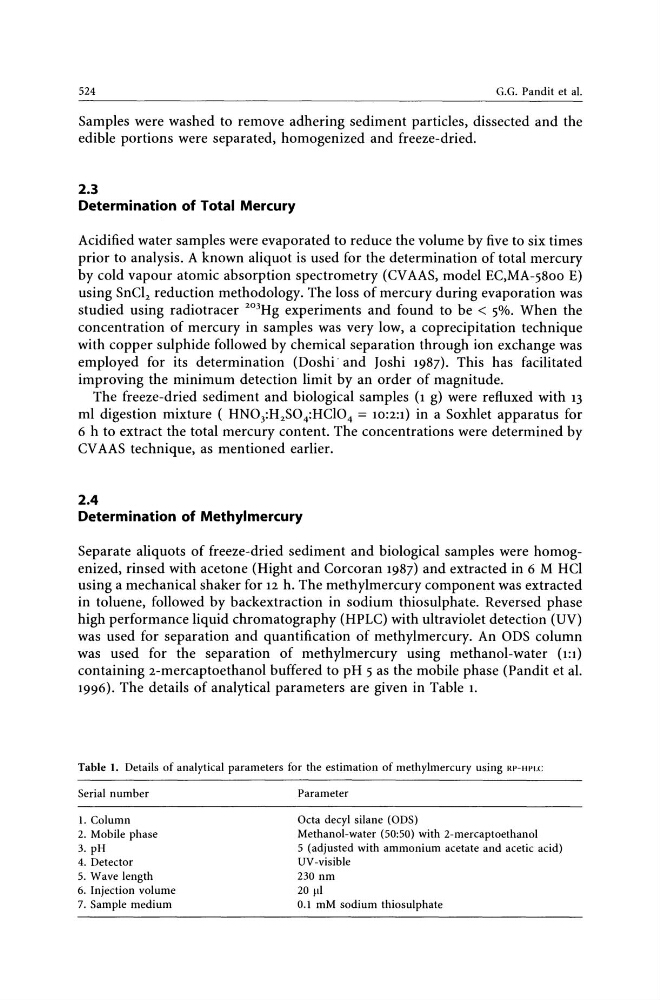
1996). The details of analytical parameters are given in Table 1.
Table 1. Details of analytical parameters for the estimation of methylmercury using RP-HPI.C
Serial number
1. Column
2. Mobile phase
3. pH
4. Detector
5. Wave length
6. Injection volume
7. Sample medium
Parameter
Octa decyl silane (ODS)
Methanol-water (50:50) with 2-mercaptoethanol
5 (adjusted with ammonium acetate and acetic acid)
UV-visible
230 nm
20 III
0.1 mM sodium thiosulphate
G.G. Pandit et aI.
Samples were washed to remove adhering sediment particles, dissected and the
edible portions were separated, homogenized and freeze-dried.
2.3
Determination of Total Mercury
Acidified water samples were evaporated to reduce the volume by five to six times
prior to analysis. A known aliquot is used for the determination of total mercury
by cold vapour atomic absorption spectrometry (CVAAS, model EC,MA-5800 E)
using SnC12 reduction methodology. The loss of mercury during evaporation was
studied using radio tracer 20 3 Hg experiments and found to be < 5%. When the
concentration of mercury in samples was very low, a coprecipitation technique
with copper sulphide followed by chemical separation through ion exchange was
employed for its determination (Doshi' and Joshi 1987). This has facilitated
improving the minimum detection limit by an order of magnitude.
The freeze-dried sediment and biological samples (1 g) were refiuxed with 13
ml digestion mixture ( HN0 3 :H2 S0 4 :HCI0 4 = 10:2:1) in a Soxhlet apparatus for
6 h to extract the total mercury content. The concentrations were determined by
CVAAS technique, as mentioned earlier.
2.4
Determination of Methylmercury
Separate aliquots of freeze-dried sediment and biological samples were homogenized, rinsed with acetone (Hight and Corcoran 1987) and extracted in 6 M HCl
using a mechanical shaker for 12 h. The methylmercury component was extracted
in toluene, followed by backextraction in sodium thiosulphate. Reversed phase
high performance liquid chromatography (HPLC) with ultraviolet detection (UV)
was used for separation and quantification of methylmercury. An ODS column
was used for the separation of methylmercury using methanol-water (1:1)
containing 2-mercaptoethanol buffered to pH 5 as the mobile phase (Pandit et al.
1996). The details of analytical parameters are given in Table 1.
Table 1. Details of analytical parameters for the estimation of methylmercury using RP-HPI.C
Serial number
1. Column
2. Mobile phase
3. pH
4. Detector
5. Wave length
6. Injection volume
7. Sample medium
Parameter
Octa decyl silane (ODS)
Methanol-water (50:50) with 2-mercaptoethanol
5 (adjusted with ammonium acetate and acetic acid)
UV-visible
230 nm
20 III
0.1 mM sodium thiosulphate