

Fluvial Transports of Mercury Pollution in the III River Basin (Northeastern France)
511
30
360
Sampling sites
II
o Thann
• Vieux-Thann 1
e------;.
• Vieux-Thann 2
11 Ensisheim
300
til
~
~
"';"bI) 2
240 .. 1l I
C ~
. .
•
o VieiUe-Thur river (1)
• Industrial waste water
"
180 ~]
- !i
120
]
12
..
0
60
6
~
it
I
.
0
o
< 2~m
[2 - 20~ml
[20-50~1
[50- 200 ~ml
> 200 ~m
Granulometric fractions
a
10
~
Sampling sites
-;' . .
• Reguisheim
o Ohnheim
OIl
8
,:,
.Oberhergheim x III river (2)
~
•
.Ladhof
X Lauch river (3)
6
•
... Illhaeuscm
<> Fecht river (3)
b. Huttenheim
+ Gissen river (3)
: I I :
u
~
+
6
15
8
0 I
Y
<211m
[2-20~ml
(20-50~1
[50 - 200 ~mJ
> 200~m
Granulometric fractions
b
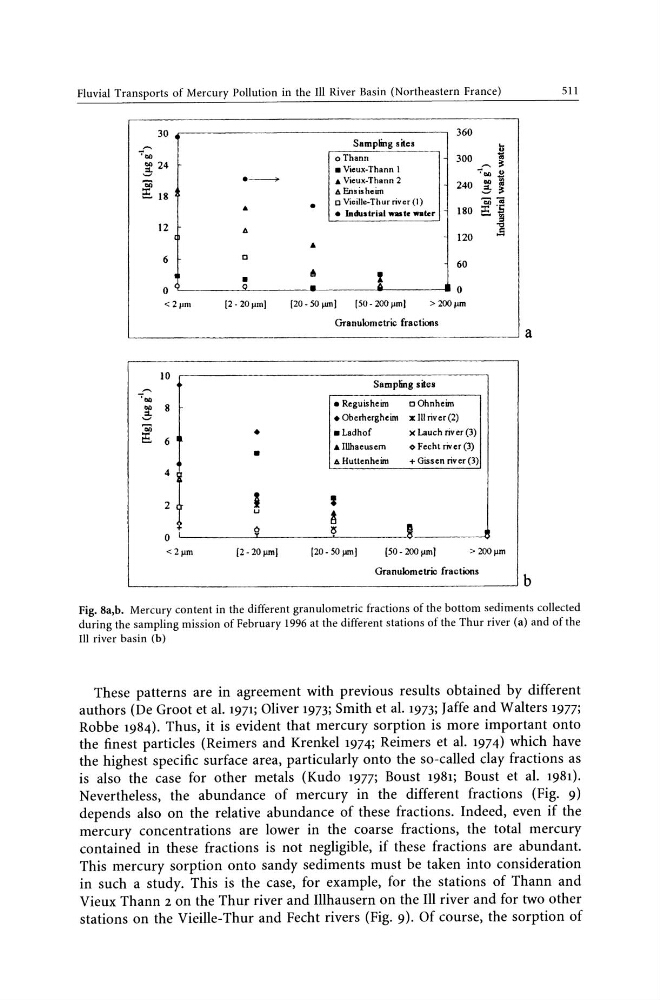
Fig. 8a,b. Mercury content in the different granulometric fractions of the bottom sediments collected
during the sampling mission of February 1996 at the different stations of the Thur river (a) and of the
111 river basin (b)
These patterns are in agreement with previous results obtained by different
authors (De Groot et al. 1971; Oliver 1973; Smith et al. 1973; Jaffe and Walters 1977;
Robbe 1984). Thus, it is evident that mercury sorption is more important onto
the finest particles (Reimers and Krenkel 1974; Reimers et al. 1974) which have
the highest specific surface area, particularly onto the so-called clay fractions as
is also the case for other metals (Kudo 1977; Boust 1981; Boust et al. 1981).
Nevertheless, the abundance of mercury in the different fractions (Fig. 9)
depends also on the relative abundance of these fractions. Indeed, even if the
mercury concentrations are lower in the coarse fractions, the total mercury
contained in these fractions is not negligible, if these fractions are abundant.
This mercury sorption onto sandy sediments must be taken into consideration
in such a study. This is the case, for example, for the stations of Thann and
Vieux Thann 2 on the Thur river and Illhausern on the III river and for two other
stations on the Vieille-Thur and Fecht rivers (Fig. 9). Of course, the sorption of
511
30
360
Sampling sites
II
o Thann
• Vieux-Thann 1
e------;.
• Vieux-Thann 2
11 Ensisheim
300
til
~
~
"';"bI) 2
240 .. 1l I
C ~
. .
•
o VieiUe-Thur river (1)
• Industrial waste water
"
180 ~]
- !i
120
]
12
..
0
60
6
~
it
I
.
0
o
< 2~m
[2 - 20~ml
[20-50~1
[50- 200 ~ml
> 200 ~m
Granulometric fractions
a
10
~
Sampling sites
-;' . .
• Reguisheim
o Ohnheim
OIl
8
,:,
.Oberhergheim x III river (2)
~
•
.Ladhof
X Lauch river (3)
6
•
... Illhaeuscm
<> Fecht river (3)
b. Huttenheim
+ Gissen river (3)
: I I :
u
~
+
6
15
8
0 I
Y
<211m
[2-20~ml
(20-50~1
[50 - 200 ~mJ
> 200~m
Granulometric fractions
b
Fig. 8a,b. Mercury content in the different granulometric fractions of the bottom sediments collected
during the sampling mission of February 1996 at the different stations of the Thur river (a) and of the
111 river basin (b)
These patterns are in agreement with previous results obtained by different
authors (De Groot et al. 1971; Oliver 1973; Smith et al. 1973; Jaffe and Walters 1977;
Robbe 1984). Thus, it is evident that mercury sorption is more important onto
the finest particles (Reimers and Krenkel 1974; Reimers et al. 1974) which have
the highest specific surface area, particularly onto the so-called clay fractions as
is also the case for other metals (Kudo 1977; Boust 1981; Boust et al. 1981).
Nevertheless, the abundance of mercury in the different fractions (Fig. 9)
depends also on the relative abundance of these fractions. Indeed, even if the
mercury concentrations are lower in the coarse fractions, the total mercury
contained in these fractions is not negligible, if these fractions are abundant.
This mercury sorption onto sandy sediments must be taken into consideration
in such a study. This is the case, for example, for the stations of Thann and
Vieux Thann 2 on the Thur river and Illhausern on the III river and for two other
stations on the Vieille-Thur and Fecht rivers (Fig. 9). Of course, the sorption of