

510
J.L. Probst et al.
mainly because of methylation processes and biological autochthonous production, which increase the total suspended matter concentrations and the mercury
content in suspended matter.
As one can see in Fig. 6a, b, it was possible, using input-output budgets
between two sampling stations, to calculate the flux of particulate mercury which
was lost by sedimentation processes or supplied by remobilization of bottom
sediments. These mercury losses or gains during the river-suspended sediment
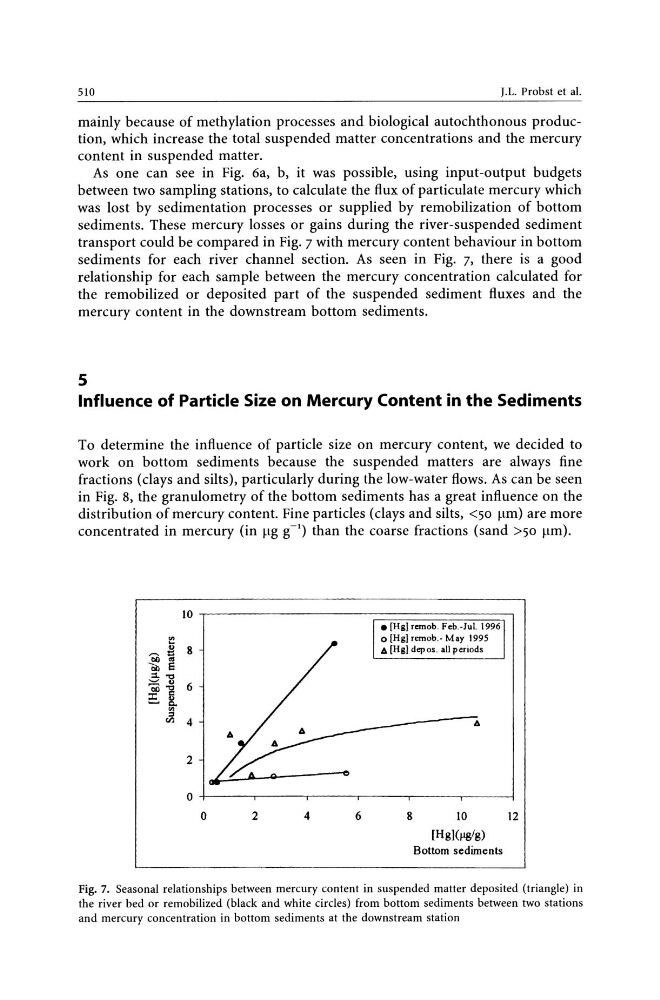
transport could be compared in Fig. 7 with mercury content behaviour in bottom
sediments for each river channel section. As seen in Fig. 7, there is a good
relationship for each sample between the mercury concentration calculated for
the remobilized or deposited part of the suspended sediment fluxes and the
mercury content in the downstream bottom sediments.
5
Influence of Particle Size on Mercury Content in the Sediments
To determine the influence of particle size on mercury content, we decided to
work on bottom sediments because the suspended matters are always fine
fractions (clays and silts), particularly during the low-water flows. As can be seen
in Fig. 8, the granulometry of the bottom sediments has a great influence on the
distribution of mercury content. Fine particles (clays and silts, <50 ~lm) are more
concentrated in mercury (in ~lg g~l) than the coarse fractions (sand >50 ~lm).
10
~
...
--.t:l
~ ~
8
::1.."
~ " 6
~1
CoIl
4
2
0
0
2
4
6
• [HgJ remob. Feb.-Jul. 1996
o [HgJ remob.· May 1995
A [HgJ depos. all periods
A
8
10
[HgJ(flSIg)
Bottom sediments
12
Fig. 7. Seasonal relationships between mercury content in suspended matter deposited (triangle) in
the river bed or remobilized (black and white circles) from bottom sediments between two stations
and mercury concentration in bottom sediments at the downstream station
J.L. Probst et al.
mainly because of methylation processes and biological autochthonous production, which increase the total suspended matter concentrations and the mercury
content in suspended matter.
As one can see in Fig. 6a, b, it was possible, using input-output budgets
between two sampling stations, to calculate the flux of particulate mercury which
was lost by sedimentation processes or supplied by remobilization of bottom
sediments. These mercury losses or gains during the river-suspended sediment
transport could be compared in Fig. 7 with mercury content behaviour in bottom
sediments for each river channel section. As seen in Fig. 7, there is a good
relationship for each sample between the mercury concentration calculated for
the remobilized or deposited part of the suspended sediment fluxes and the
mercury content in the downstream bottom sediments.
5
Influence of Particle Size on Mercury Content in the Sediments
To determine the influence of particle size on mercury content, we decided to
work on bottom sediments because the suspended matters are always fine
fractions (clays and silts), particularly during the low-water flows. As can be seen
in Fig. 8, the granulometry of the bottom sediments has a great influence on the
distribution of mercury content. Fine particles (clays and silts, <50 ~lm) are more
concentrated in mercury (in ~lg g~l) than the coarse fractions (sand >50 ~lm).
10
~
...
--.t:l
~ ~
8
::1.."
~ " 6
~1
CoIl
4
2
0
0
2
4
6
• [HgJ remob. Feb.-Jul. 1996
o [HgJ remob.· May 1995
A [HgJ depos. all periods
A
8
10
[HgJ(flSIg)
Bottom sediments
12
Fig. 7. Seasonal relationships between mercury content in suspended matter deposited (triangle) in
the river bed or remobilized (black and white circles) from bottom sediments between two stations
and mercury concentration in bottom sediments at the downstream station