

Mercury Subsurface Maxima in Sediments
16U
eo 140
Oil
c
_ 120
c
"
~ 100
..
.,
~
110
c
"
u 60
/I
rf ~
' - ' - - ' - r '-E
'"
os
..
~
' "'
.:::
CL
;;)
' =
;.:
t
.c
' "
:§
:;
c..
477
t
rtc
c
...
=
"
"
.. ... "
'2
e
J:>
. . .....
os
"
"
c...l
"
' "'
"
'"
.c
' "'
...
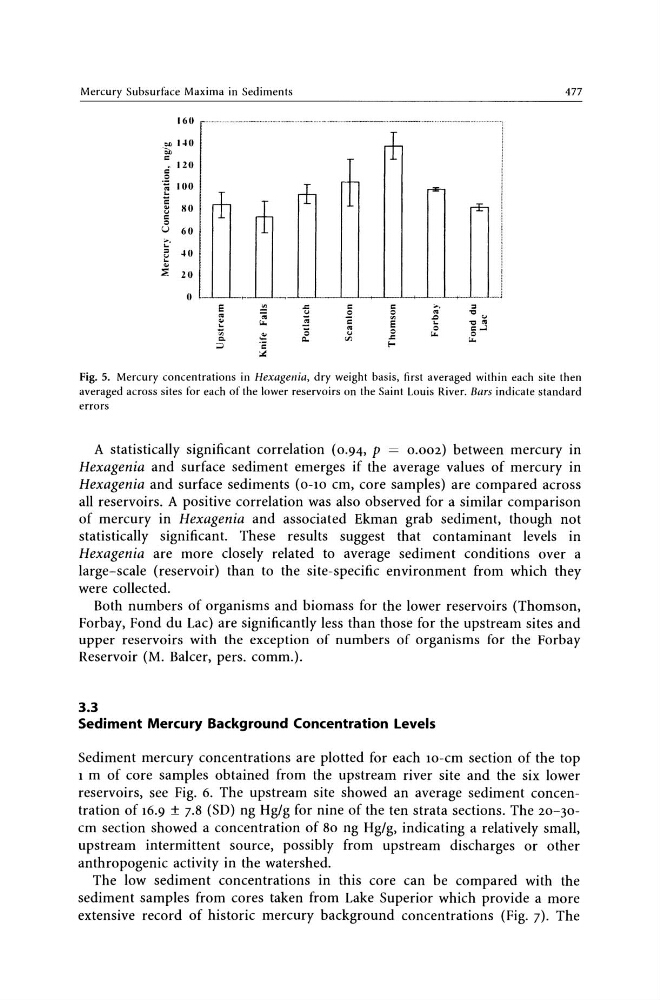
Fig. 5. Mercury concentrations in Hexagenia, dry weight basis, first averaged within each site then
averaged across sites for each of the lower reservoirs on the Saint Louis River. Bars indicate standard
errors
A statistically significant correlation (0.94, p = 0.002) between mercury in
Hexagenia and surface sediment emerges if the average values of mercury in
Hexagenia and surface sediments (0-10 cm, core samples) are compared across
all reservoirs. A positive correlation was also observed for a similar comparison
of mercury in Hexagenia and associated Ekman grab sediment, though not
statistically significant. These results suggest that contaminant levels in
Hexagenia are more closely related to average sediment conditions over a
large-scale (reservoir) than to the site-specific environment from which they
were collected.
Both numbers of organisms and biomass for the lower reservoirs (Thomson,
Forbay, Fond du Lac) are significantly less than those for the upstream sites and
upper reservoirs with the exception of numbers of organisms for the Forbay
Reservoir (M. Balcer, pers. comm.).
3.3
Sediment Mercury Background Concentration Levels
Sediment mercury concentrations are plotted for each lO-cm section of the top
1 m of core samples obtained from the upstream river site and the six lower
reservoirs, see Fig. 6. The upstream site showed an average sediment concentration of 16.9 ± 7.8 (SD) ng Hg/g for nine of the ten strata sections. The 20-30cm section showed a concentration of 80 ng Hg/g, indicating a relatively small,
upstream intermittent source, possibly from upstream discharges or other
anthropogenic activity in the watershed.
The low sediment concentrations in this core can be compared with the
sediment samples from cores taken from Lake Superior which provide a more
extensive record of historic mercury background concentrations (Fig. 7). The
16U
eo 140
Oil
c
_ 120
c
"
~ 100
..
.,
~
110
c
"
u 60
/I
rf ~
' - ' - - ' - r '-E
'"
os
..
~
' "'
.:::
CL
;;)
' =
;.:
t
.c
' "
:§
:;
c..
477
t
rtc
c
...
=
"
"
.. ... "
'2
e
J:>
. . .....
os
"
"
c...l
"
' "'
"
'"
.c
' "'
...
Fig. 5. Mercury concentrations in Hexagenia, dry weight basis, first averaged within each site then
averaged across sites for each of the lower reservoirs on the Saint Louis River. Bars indicate standard
errors
A statistically significant correlation (0.94, p = 0.002) between mercury in
Hexagenia and surface sediment emerges if the average values of mercury in
Hexagenia and surface sediments (0-10 cm, core samples) are compared across
all reservoirs. A positive correlation was also observed for a similar comparison
of mercury in Hexagenia and associated Ekman grab sediment, though not
statistically significant. These results suggest that contaminant levels in
Hexagenia are more closely related to average sediment conditions over a
large-scale (reservoir) than to the site-specific environment from which they
were collected.
Both numbers of organisms and biomass for the lower reservoirs (Thomson,
Forbay, Fond du Lac) are significantly less than those for the upstream sites and
upper reservoirs with the exception of numbers of organisms for the Forbay
Reservoir (M. Balcer, pers. comm.).
3.3
Sediment Mercury Background Concentration Levels
Sediment mercury concentrations are plotted for each lO-cm section of the top
1 m of core samples obtained from the upstream river site and the six lower
reservoirs, see Fig. 6. The upstream site showed an average sediment concentration of 16.9 ± 7.8 (SD) ng Hg/g for nine of the ten strata sections. The 20-30cm section showed a concentration of 80 ng Hg/g, indicating a relatively small,
upstream intermittent source, possibly from upstream discharges or other
anthropogenic activity in the watershed.
The low sediment concentrations in this core can be compared with the
sediment samples from cores taken from Lake Superior which provide a more
extensive record of historic mercury background concentrations (Fig. 7). The