

Mercury Decontamination of a Chloralkali Plant in Alexandria, Egypt
461
However, the best safety of workers was provided by the extensive use of
demolition machines instead of manual work.
The main features of the health and safety plan had been developed based on
the worldwide remediation experience of Dames & Moore and relevant European
and US regulations and technical standards, including German regulations
(Gefahrstoffverordnung; guidelines of the Employment Accident Insurance Fund
of the Industry) and us Occupational Safety and Health Administration
standards (29 Code of Federal Regulations 1910 and 1926).
While focusing on mercury hazards, the health and safety plan also addressed
hazards due to general activities at demolition and construction sites (electric
shock, burns, falls, motor vehicle accidents, asbestos fibers, entry into confined
spaces, etc.) and specific hazards related to past and ongoing chemical
production at the MCI site, such as inhalation of chlorine gas and physical
contact with strong acids and caustics.
6
Description of Landfill
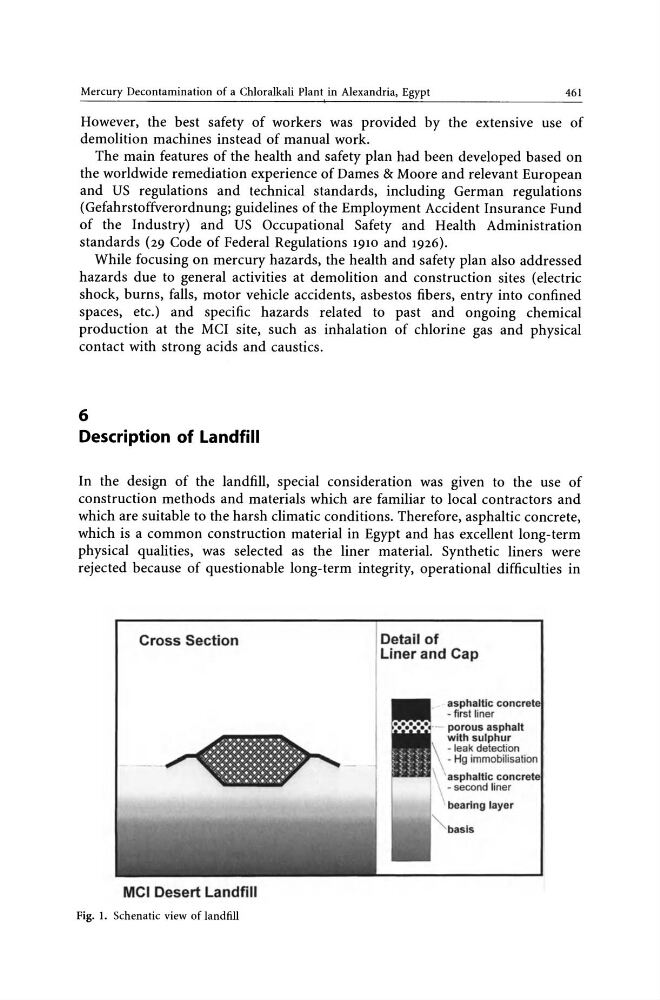
In the design of the landfill, special consideration was given to the use of
construction methods and materials which are familiar to local contractors and
which are suitable to the harsh climatic conditions. Therefore, asphaltic concrete,
which is a common construction material in Egypt and has excellent long-term
physical qualities, was selected as the liner material. Synthetic liners were
rejected because of questionable long-term integrity, operational difficulties in
Cross Section
• ,
.... - t
• • '
" .
-,
•
ii,
MCI Desert Landfill
Fig. 1. Schena tic view of landfill
Detail of
Liner and Cap
asphaltic concrete
- first liner
porous asphalt
with sulphur
- leak detection
- Hg i
mmobilisation
asphaltic concrete
- second liner
sis
461
However, the best safety of workers was provided by the extensive use of
demolition machines instead of manual work.
The main features of the health and safety plan had been developed based on
the worldwide remediation experience of Dames & Moore and relevant European
and US regulations and technical standards, including German regulations
(Gefahrstoffverordnung; guidelines of the Employment Accident Insurance Fund
of the Industry) and us Occupational Safety and Health Administration
standards (29 Code of Federal Regulations 1910 and 1926).
While focusing on mercury hazards, the health and safety plan also addressed
hazards due to general activities at demolition and construction sites (electric
shock, burns, falls, motor vehicle accidents, asbestos fibers, entry into confined
spaces, etc.) and specific hazards related to past and ongoing chemical
production at the MCI site, such as inhalation of chlorine gas and physical
contact with strong acids and caustics.
6
Description of Landfill
In the design of the landfill, special consideration was given to the use of
construction methods and materials which are familiar to local contractors and
which are suitable to the harsh climatic conditions. Therefore, asphaltic concrete,
which is a common construction material in Egypt and has excellent long-term
physical qualities, was selected as the liner material. Synthetic liners were
rejected because of questionable long-term integrity, operational difficulties in
Cross Section
• ,
.... - t
• • '
" .
-,
•
ii,
MCI Desert Landfill
Fig. 1. Schena tic view of landfill
Detail of
Liner and Cap
asphaltic concrete
- first liner
porous asphalt
with sulphur
- leak detection
- Hg i
mmobilisation
asphaltic concrete
- second liner
sis