

Basic Study on the Remediation Technology
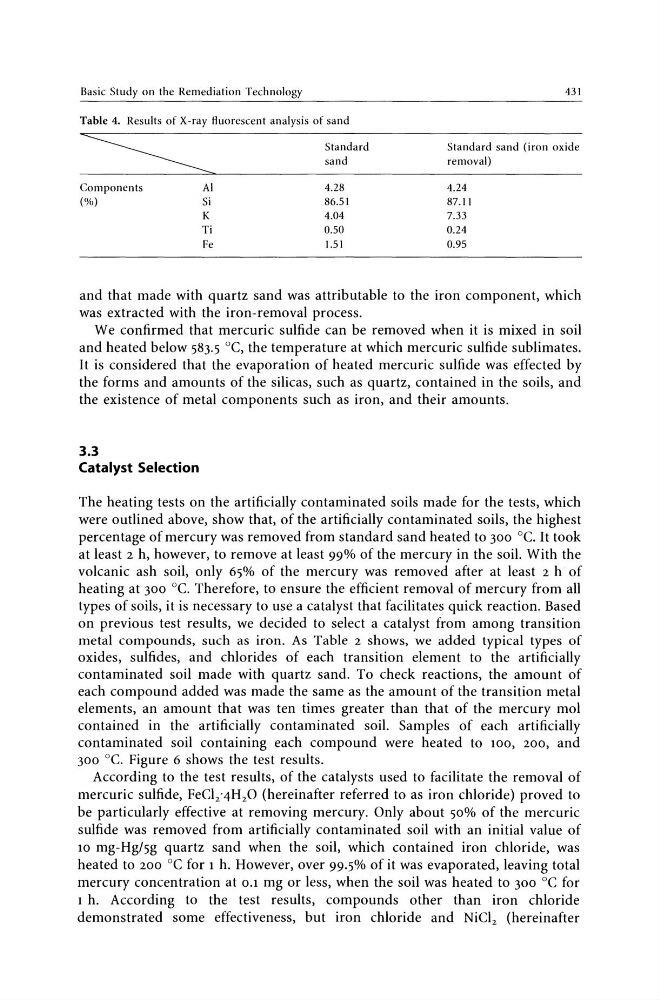
Table 4. Results of X-ray fluorescent analysis of sand
Components
AI
(%)
Si
K
Ti
Fe
Standard
sand
4.28
86.51
4.04
0.50
1.51
431
Standard sand (iron oxide
removal)
4.24
87.11
7.33
0.24
0.95
and that made with quartz sand was attributable to the iron component, which
was extracted with the iron-removal process.
We confirmed that mercuric sulfide can be removed when it is mixed in soil
and heated below 583.5 DC, the temperature at which mercuric sulfide sublimates.
It is considered that the evaporation of heated mercuric sulfide was effected by
the forms and amounts of the silicas, such as quartz, contained in the soils, and
the existence of metal components such as iron, and their amounts.
3.3
Catalyst Selection
The heating tests on the artificially contaminated soils made for the tests, which
were outlined above, show that, of the artificially contaminated soils, the highest
percentage of mercury was removed from standard sand heated to 300 DC. It took
at least 2 h, however, to remove at least 99% of the mercury in the soil. With the
volcanic ash soil, only 65% of the mercury was removed after at least 2 h' of
heating at 300 DC. Therefore, to ensure the efficient removal of mercury from all
types of soils, it is necessary to use a catalyst that facilitates quick reaction. Based
on previous test results, we decided to select a catalyst from among transition
metal compounds, such as iron. As Table 2 shows, we added typical types of
oxides, sulfides, and chlorides of each transition element to the artificially
contaminated soil made with quartz sand. To check reactions, the amount of
each compound added was made the same as the amount of the transition metal
elements, an amount that was ten times greater than that of the mercury mol
contained in the artificially contaminated soil. Samples of each artificially
contaminated soil containing each compound were heated to 100, 200, and
300 DC. Figure 6 shows the test results.
According to the test results, of the catalysts used to facilitate the removal of
mercuric sulfide, FeCI2 "4H2 0 (hereinafter referred to as iron chloride) proved to
be particularly effective at removing mercury. Only about 50% of the mercuric
sulfide was removed from artificially contaminated soil with an initial value of
10 mg-Hg/5g quartz sand when the soil, which contained iron chloride, was
heated to 200 DC for 1 h. However, over 99.5% of it was evaporated, leaving total
mercury concentration at 0.1 mg or less, when the soil was heated to 300 DC for
1 h. According to the test results, compounds other than iron chloride
demonstrated some effectiveness, but iron chloride and NiCl2 (hereinafter
Table 4. Results of X-ray fluorescent analysis of sand
Components
AI
(%)
Si
K
Ti
Fe
Standard
sand
4.28
86.51
4.04
0.50
1.51
431
Standard sand (iron oxide
removal)
4.24
87.11
7.33
0.24
0.95
and that made with quartz sand was attributable to the iron component, which
was extracted with the iron-removal process.
We confirmed that mercuric sulfide can be removed when it is mixed in soil
and heated below 583.5 DC, the temperature at which mercuric sulfide sublimates.
It is considered that the evaporation of heated mercuric sulfide was effected by
the forms and amounts of the silicas, such as quartz, contained in the soils, and
the existence of metal components such as iron, and their amounts.
3.3
Catalyst Selection
The heating tests on the artificially contaminated soils made for the tests, which
were outlined above, show that, of the artificially contaminated soils, the highest
percentage of mercury was removed from standard sand heated to 300 DC. It took
at least 2 h, however, to remove at least 99% of the mercury in the soil. With the
volcanic ash soil, only 65% of the mercury was removed after at least 2 h' of
heating at 300 DC. Therefore, to ensure the efficient removal of mercury from all
types of soils, it is necessary to use a catalyst that facilitates quick reaction. Based
on previous test results, we decided to select a catalyst from among transition
metal compounds, such as iron. As Table 2 shows, we added typical types of
oxides, sulfides, and chlorides of each transition element to the artificially
contaminated soil made with quartz sand. To check reactions, the amount of
each compound added was made the same as the amount of the transition metal
elements, an amount that was ten times greater than that of the mercury mol
contained in the artificially contaminated soil. Samples of each artificially
contaminated soil containing each compound were heated to 100, 200, and
300 DC. Figure 6 shows the test results.
According to the test results, of the catalysts used to facilitate the removal of
mercuric sulfide, FeCI2 "4H2 0 (hereinafter referred to as iron chloride) proved to
be particularly effective at removing mercury. Only about 50% of the mercuric
sulfide was removed from artificially contaminated soil with an initial value of
10 mg-Hg/5g quartz sand when the soil, which contained iron chloride, was
heated to 200 DC for 1 h. However, over 99.5% of it was evaporated, leaving total
mercury concentration at 0.1 mg or less, when the soil was heated to 300 DC for
1 h. According to the test results, compounds other than iron chloride
demonstrated some effectiveness, but iron chloride and NiCl2 (hereinafter