

430
A. Matsuyama et al.
iron oxide). Iron oxide was not generated in the artificially contaminated soil
made with standard sand, which was not heated. It is known that iron, which is a
weathering product of granite, adheres to the surface of standard sand and exists
in the form of amorphous iron hydroxide and oxidized iron hydroxide (FeOOH).
These iron components change to iron oxide after heating, although the
temperatures that effects this change differ according to form (Nakajima 1994).
Based on the test results and existing reports, the differences in mercuric sulfide
removal percentage between the heated artificially contaminated soil made with
quartz sand and artificially contaminated soil made with standard sand were
thought to be a function of chemical changes in the iron component and so on of
the standard sand and soils. Therefore, if the iron component and so on of the
standard sand were removed, the removal percentage of mercuric sulfide when
the soil is heated should drop. Therefore, we removed iron from the standard
sand with the method described above, and the sand from which the iron was
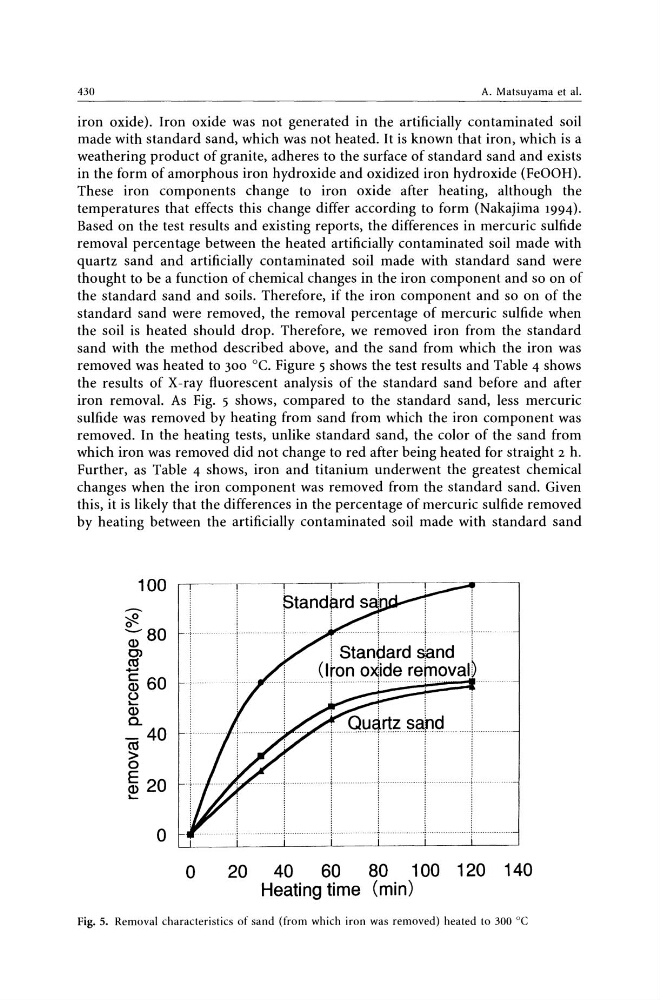
removed was heated to 300°C. Figure 5 shows the test results and Table 4 shows
the results of X-ray fluorescent analysis of the standard sand before and after
iron removal. As Fig. 5 shows, compared to the standard sand, less mercuric
sulfide was removed by heating from sand from which the iron component was
removed. In the heating tests, unlike standard sand, the color of the sand from
which iron was removed did not change to red after being heated for straight 2 h.
Further, as Table 4 shows, iron and titanium underwent the greatest chemical
changes when the iron component was removed from the standard sand. Given
this, it is likely that the differences in the percentage of mercuric sulfide removed
by heating between the artificially contaminated soil made with standard sand
100
~ o
-80 Q)
~
- 55 60
~
Q)
a.
«S
>
o
40
~ 20
....
o
~tand~rd s
j
:
··t ............. -.+_.
.\
Q~irg~;ID(j
1]:···············[' ·
.. -:-.......
. ... -: ... __ ........ __ ..•....
o 20 40 60 80 100 120 140
Heating time (min)
Fig. 5. Removal characteristics of sand (from which iron was removed) heated to 300°C
A. Matsuyama et al.
iron oxide). Iron oxide was not generated in the artificially contaminated soil
made with standard sand, which was not heated. It is known that iron, which is a
weathering product of granite, adheres to the surface of standard sand and exists
in the form of amorphous iron hydroxide and oxidized iron hydroxide (FeOOH).
These iron components change to iron oxide after heating, although the
temperatures that effects this change differ according to form (Nakajima 1994).
Based on the test results and existing reports, the differences in mercuric sulfide
removal percentage between the heated artificially contaminated soil made with
quartz sand and artificially contaminated soil made with standard sand were
thought to be a function of chemical changes in the iron component and so on of
the standard sand and soils. Therefore, if the iron component and so on of the
standard sand were removed, the removal percentage of mercuric sulfide when
the soil is heated should drop. Therefore, we removed iron from the standard
sand with the method described above, and the sand from which the iron was
removed was heated to 300°C. Figure 5 shows the test results and Table 4 shows
the results of X-ray fluorescent analysis of the standard sand before and after
iron removal. As Fig. 5 shows, compared to the standard sand, less mercuric
sulfide was removed by heating from sand from which the iron component was
removed. In the heating tests, unlike standard sand, the color of the sand from
which iron was removed did not change to red after being heated for straight 2 h.
Further, as Table 4 shows, iron and titanium underwent the greatest chemical
changes when the iron component was removed from the standard sand. Given
this, it is likely that the differences in the percentage of mercuric sulfide removed
by heating between the artificially contaminated soil made with standard sand
100
~ o
-80 Q)
~
- 55 60
~
Q)
a.
«S
>
o
40
~ 20
....
o
~tand~rd s
j
:
··t ............. -.+_.
.\
Q~irg~;ID(j
1]:···············[' ·
.. -:-.......
. ... -: ... __ ........ __ ..•....
o 20 40 60 80 100 120 140
Heating time (min)
Fig. 5. Removal characteristics of sand (from which iron was removed) heated to 300°C