

422
A. Matsuyama et al.
As a result of our studies, we confirmed that, even when mercury in the soil is
in the form of mercuric sulfide, this starts to evaporate when the soil is heated at
the relatively low temperatures of 200-3 00 dc.
Further, when the soil is heated with a catalyst, a sufficient amount of mercury
is removed quickly. This chapter discusses the results of our basic laboratory
study.
2
Materials and Methods
2.1
Equipment and Apparatus
Based on existing study reports (Ono et al. 1993), we established a system for
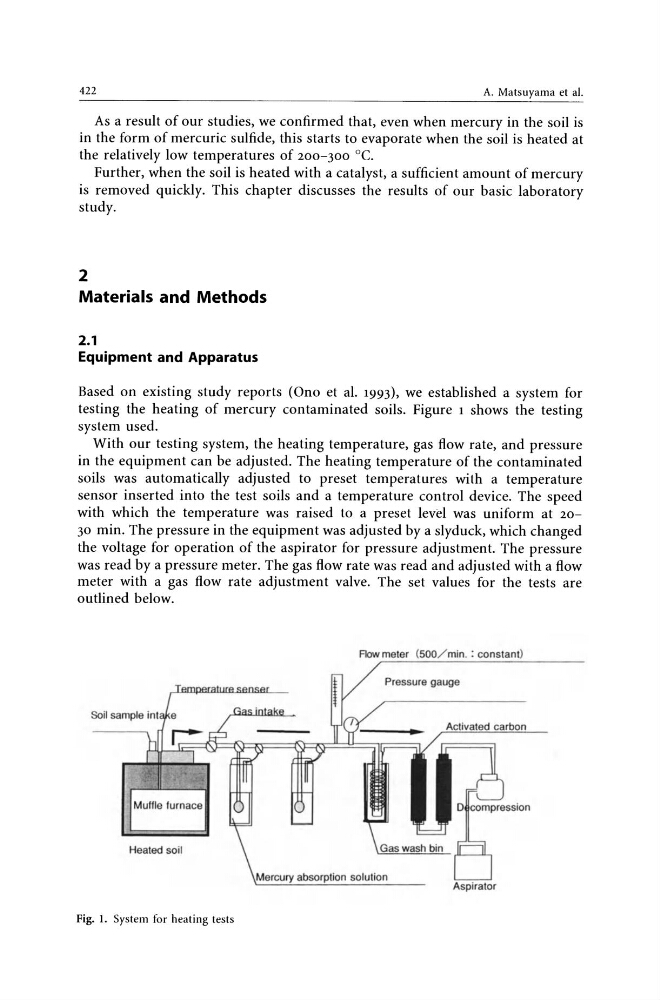
testing the heating of mercury contaminated soils. Figure 1 shows the testing
system used.
With our testing system, the heating temperature, gas flow rate, and pressure
in the equipment can be adjusted. The heating temperature of the contaminated
soils was automatically adjusted to preset temperatures with a temperature
sensor inserted into the test soils and a temperature control device. The speed
with which the temperature was raised to a preset level was uniform at 2030 min. The pressure in the equipment was adjusted by a slyduck, which changed
the voltage for operation of the aspirator for pressure adjustment. The pressure
was read by a pressure meter. The gas flow rate was read and adjusted with a flow
meter with a gas flow rate adjustment valve. The set values for the tests are
outlined below.
Flowmeler (SOO/ min.: conslan1)
Pressure gauge
Fig. 1. System for heating tests
A. Matsuyama et al.
As a result of our studies, we confirmed that, even when mercury in the soil is
in the form of mercuric sulfide, this starts to evaporate when the soil is heated at
the relatively low temperatures of 200-3 00 dc.
Further, when the soil is heated with a catalyst, a sufficient amount of mercury
is removed quickly. This chapter discusses the results of our basic laboratory
study.
2
Materials and Methods
2.1
Equipment and Apparatus
Based on existing study reports (Ono et al. 1993), we established a system for
testing the heating of mercury contaminated soils. Figure 1 shows the testing
system used.
With our testing system, the heating temperature, gas flow rate, and pressure
in the equipment can be adjusted. The heating temperature of the contaminated
soils was automatically adjusted to preset temperatures with a temperature
sensor inserted into the test soils and a temperature control device. The speed
with which the temperature was raised to a preset level was uniform at 2030 min. The pressure in the equipment was adjusted by a slyduck, which changed
the voltage for operation of the aspirator for pressure adjustment. The pressure
was read by a pressure meter. The gas flow rate was read and adjusted with a flow
meter with a gas flow rate adjustment valve. The set values for the tests are
outlined below.
Flowmeler (SOO/ min.: conslan1)
Pressure gauge
Fig. 1. System for heating tests