

Mercury Saturation Profile Across the Sulphur-Impregnated Activated Carbon Bed
413
11,c. lu(:r~ury co ntan,jnatcd
n:ilur:ll gas inlet
•
11.(: mcrclIIY free
na tural "as < mtJd
4/1411.993.
111(: MRU :5hlrt · UI'
b
216 /1994.
('ontrol mea u!"elUent
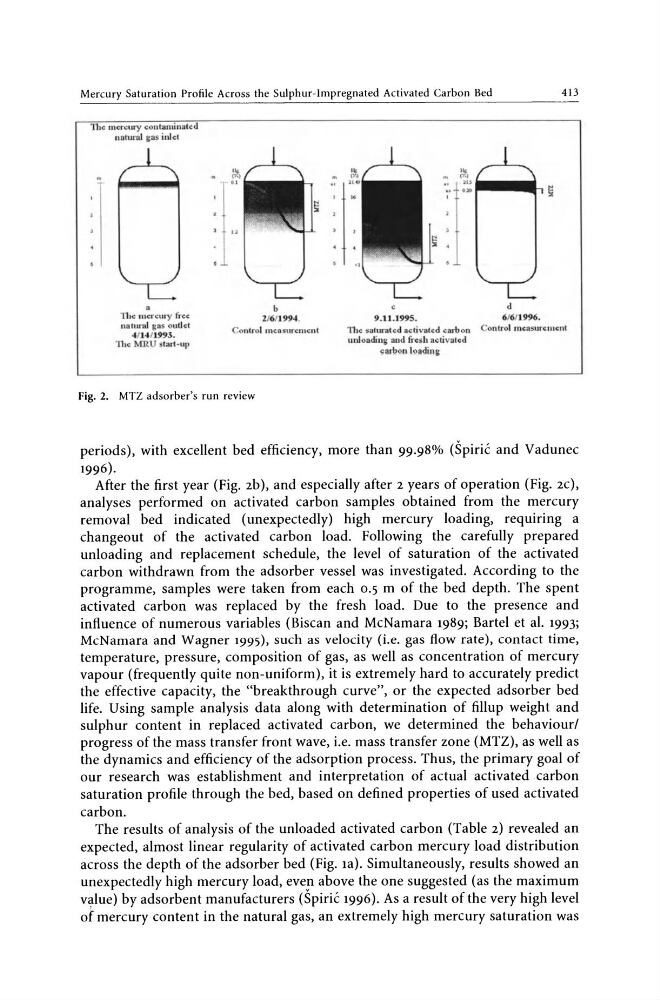
Fig. 2. MTZ ad sorber's run review
d
9.11.1995.
6/6/1996.
l1u: : $allU" at c d adl',I. ... cd c~ub Qn
ol'l.irol mcaSl,lrclllcnl
unloadinB .md fres h acti v 3tcd
carbon loadin g.
periods), with excellent bed efficiency, more than 99.98% (Spiric and Vadunec
1996).
After the first year (Fig. 2b), and especially after 2 years of operation (Fig. 2C),
analyses performed on activated carbon samples obtained from the mercury
removal bed indicated (unexpectedly) high mercury loading, requiring a
changeout of the activated carbon load. Following the carefully prepared
unloading and replacement schedule, the level of saturation of the activated
carbon withdrawn from the adsorber vessel was investigated. According to the
programme, samples were taken from each 0.5 m of the bed depth. The spent
activated carbon was replaced by the fresh load. Due to the presence and
influence of numerous variables (Biscan and McNamara 1989; Bartel et al. 1993;
McNamara and Wagner 1995), such as velocity (Le. gas flow rate), contact time,
temperature, pressure, composition of gas, as well as concentration of mercury
vapour (frequently quite non-uniform), it is extremely hard to accurately predict
the effective capacity, the "breakthrough curve", or the expected adsorber bed
life. Using sample analysis data along with determination of fillup weight and
sulphur content in replaced activated carbon, we determined the behaviour/
progress of the mass transfer front wave, i.e. mass transfer zone (MTZ), as well as
the dynamics and efficiency of the adsorption process. Thus, the primary goal of
our research was establishment and interpretation of actual activated carbon
saturation profile through the bed, based on defined properties of used activated
carbon.
The results of analysis of the unloaded activated carbon (Table 2) revealed an
expected, almost linear regularity of activated carbon mercury load distribution
across the depth of the adsorber bed (Fig. 1a). Simultaneously, results showed an
unexpectedly high mercury load, even above the one suggested (as the maximum
value) by adsorbent manufacturers (Spiric 1996). As a result of the very high level
of mercury content in the natural gas, an extremely high mercury saturation was
413
11,c. lu(:r~ury co ntan,jnatcd
n:ilur:ll gas inlet
•
11.(: mcrclIIY free
na tural "as < mtJd
4/1411.993.
111(: MRU :5hlrt · UI'
b
216 /1994.
('ontrol mea u!"elUent
Fig. 2. MTZ ad sorber's run review
d
9.11.1995.
6/6/1996.
l1u: : $allU" at c d adl',I. ... cd c~ub Qn
ol'l.irol mcaSl,lrclllcnl
unloadinB .md fres h acti v 3tcd
carbon loadin g.
periods), with excellent bed efficiency, more than 99.98% (Spiric and Vadunec
1996).
After the first year (Fig. 2b), and especially after 2 years of operation (Fig. 2C),
analyses performed on activated carbon samples obtained from the mercury
removal bed indicated (unexpectedly) high mercury loading, requiring a
changeout of the activated carbon load. Following the carefully prepared
unloading and replacement schedule, the level of saturation of the activated
carbon withdrawn from the adsorber vessel was investigated. According to the
programme, samples were taken from each 0.5 m of the bed depth. The spent
activated carbon was replaced by the fresh load. Due to the presence and
influence of numerous variables (Biscan and McNamara 1989; Bartel et al. 1993;
McNamara and Wagner 1995), such as velocity (Le. gas flow rate), contact time,
temperature, pressure, composition of gas, as well as concentration of mercury
vapour (frequently quite non-uniform), it is extremely hard to accurately predict
the effective capacity, the "breakthrough curve", or the expected adsorber bed
life. Using sample analysis data along with determination of fillup weight and
sulphur content in replaced activated carbon, we determined the behaviour/
progress of the mass transfer front wave, i.e. mass transfer zone (MTZ), as well as
the dynamics and efficiency of the adsorption process. Thus, the primary goal of
our research was establishment and interpretation of actual activated carbon
saturation profile through the bed, based on defined properties of used activated
carbon.
The results of analysis of the unloaded activated carbon (Table 2) revealed an
expected, almost linear regularity of activated carbon mercury load distribution
across the depth of the adsorber bed (Fig. 1a). Simultaneously, results showed an
unexpectedly high mercury load, even above the one suggested (as the maximum
value) by adsorbent manufacturers (Spiric 1996). As a result of the very high level
of mercury content in the natural gas, an extremely high mercury saturation was