

406
J. Wang et al.
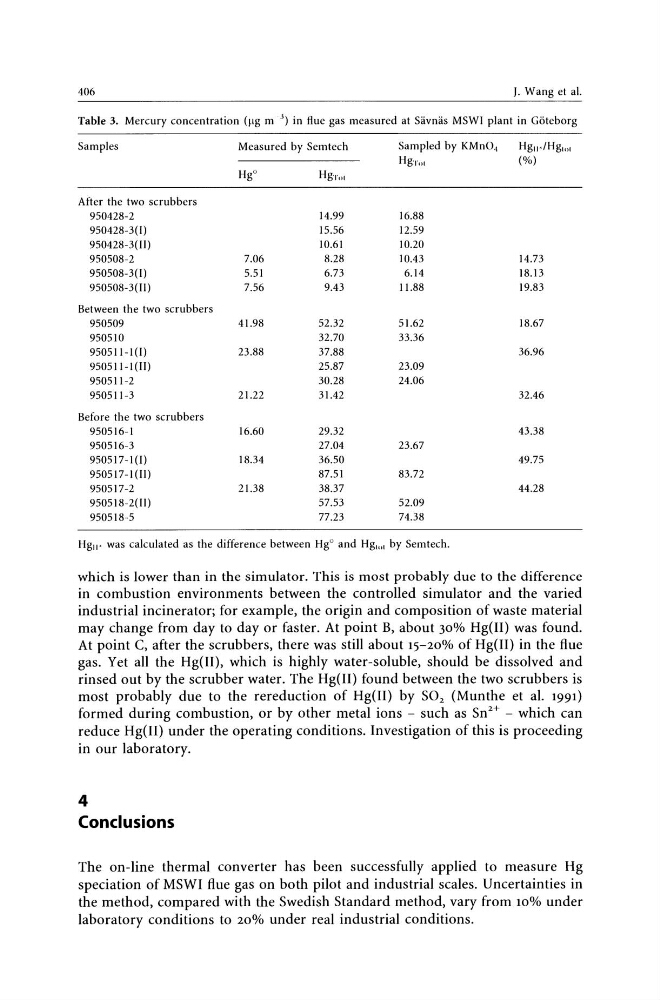
Table 3. Mercury concentration (~lg m J) in flue gas measured at Savnas MSWI plant in Goteborg
Samples
Measured by Semtech
Sampled by KMn04
HglI,/Hg""
HgTo•
(%)
Hgo
HgTo•
After the two scrubbers
950428-2
14.99
16.88
950428-3(1)
15.56
12.59
950428-3(11)
10.61
10.20
950508-2
7.06
8.28
1Q.43
14.73
950508-3(1)
5.51
6.73
6.14
18.13
950508-3(11)
7.56
9.43
11.88
19.83
Between the two scrubbers
950509
41.98
52.32
51.62
18.67
950510
32.70
33.36
950511-1 (I)
23.88
37.88
36.96
950511-1 (II)
25.87
23.09
950511-2
30.28
24.06
950511-3
21.22
31.42
32.46
Before the two scrubbers
950516-1
16.60
29.32
43.38
950516-3
27.04
23.67
950517-1(1)
18.34
36.50
49.75
950517 -1 (II)
87.51
83.72
950517-2
21.38
38.37
44.28
950518-2(11)
57.53
52.09
950518-5
77.23
74.38
Hgll' was calculated as the difference between Hgo and Hg.o• by Semtech.
which is lower than in the simulator. This is most probably due to the difference
in combustion environments between the controlled simulator and the varied
industrial incinerator; for example, the origin and composition of waste material
may change from day to day or faster. At point B, about 30% Hg(II) was found.
At point C, after the scrubbers, there was still about 15-20% of Hg(II) in the flue
gas. Yet all the Hg(II), which is highly water-soluble, should be dissolved and
rinsed out by the scrubber water. The Hg(II) found between the two scrubbers is
most probably due to the rereduction of Hg(II) by S02 (Munthe et al. 1991)
formed during combustion, or by other metal ions - such as Sn H - which can
reduce Hg(II) under the operating conditions. Investigation of this is proceeding
in our laboratory.
4
Conclusions
The on-line thermal converter has been successfully applied to measure Hg
speciation of MSWI flue gas on both pilot and industrial scales. Uncertainties in
the method, compared with the Swedish Standard method, vary from 10% under
laboratory conditions to 20% under real industrial conditions.
J. Wang et al.
Table 3. Mercury concentration (~lg m J) in flue gas measured at Savnas MSWI plant in Goteborg
Samples
Measured by Semtech
Sampled by KMn04
HglI,/Hg""
HgTo•
(%)
Hgo
HgTo•
After the two scrubbers
950428-2
14.99
16.88
950428-3(1)
15.56
12.59
950428-3(11)
10.61
10.20
950508-2
7.06
8.28
1Q.43
14.73
950508-3(1)
5.51
6.73
6.14
18.13
950508-3(11)
7.56
9.43
11.88
19.83
Between the two scrubbers
950509
41.98
52.32
51.62
18.67
950510
32.70
33.36
950511-1 (I)
23.88
37.88
36.96
950511-1 (II)
25.87
23.09
950511-2
30.28
24.06
950511-3
21.22
31.42
32.46
Before the two scrubbers
950516-1
16.60
29.32
43.38
950516-3
27.04
23.67
950517-1(1)
18.34
36.50
49.75
950517 -1 (II)
87.51
83.72
950517-2
21.38
38.37
44.28
950518-2(11)
57.53
52.09
950518-5
77.23
74.38
Hgll' was calculated as the difference between Hgo and Hg.o• by Semtech.
which is lower than in the simulator. This is most probably due to the difference
in combustion environments between the controlled simulator and the varied
industrial incinerator; for example, the origin and composition of waste material
may change from day to day or faster. At point B, about 30% Hg(II) was found.
At point C, after the scrubbers, there was still about 15-20% of Hg(II) in the flue
gas. Yet all the Hg(II), which is highly water-soluble, should be dissolved and
rinsed out by the scrubber water. The Hg(II) found between the two scrubbers is
most probably due to the rereduction of Hg(II) by S02 (Munthe et al. 1991)
formed during combustion, or by other metal ions - such as Sn H - which can
reduce Hg(II) under the operating conditions. Investigation of this is proceeding
in our laboratory.
4
Conclusions
The on-line thermal converter has been successfully applied to measure Hg
speciation of MSWI flue gas on both pilot and industrial scales. Uncertainties in
the method, compared with the Swedish Standard method, vary from 10% under
laboratory conditions to 20% under real industrial conditions.